
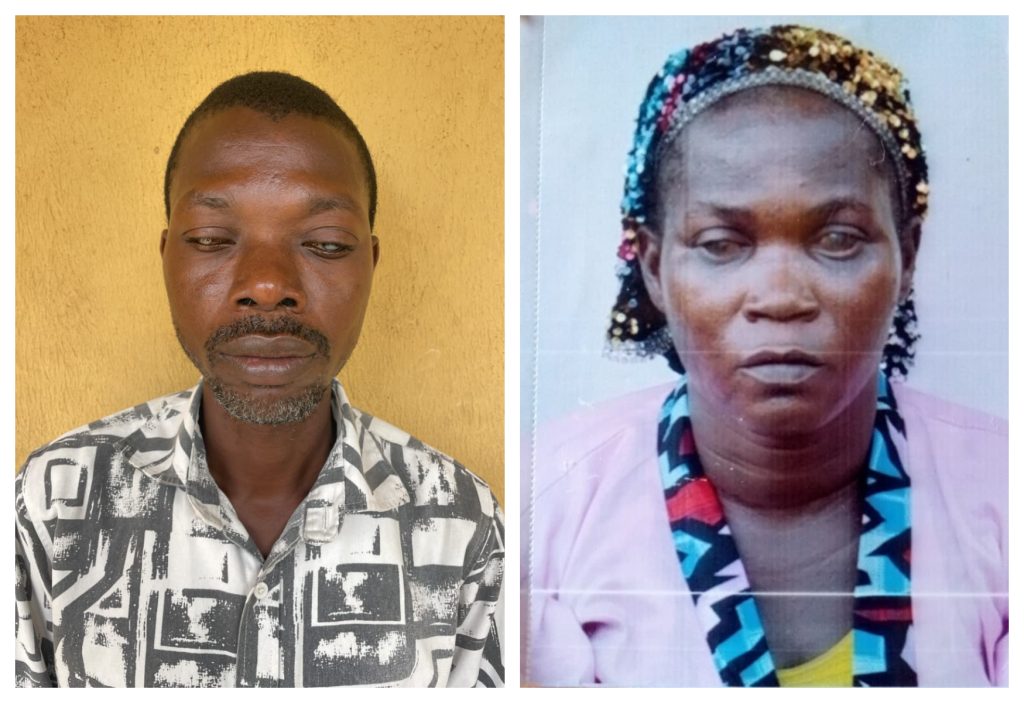
We don’t need pity, we need jobs — Blind couple
By Juliet Umeh
Michael and Akintomide cannot see, but together they cook, clean, raise their children and battle unemployment as they wait for the teaching jobs they believe could transform their family.
For Michael Ogunkanmi, darkness has been part of life for almost as long as he can remember. His wife, Akintomide, also lives without sight. Yet, inside their modest home, the couple are raising three children who can see.
Their lives are built around memory, touch, teamwork and an understanding developed over years together.
If an item is kept somewhere in the house, everyone knows where it belongs. If either Michael or his wife changes its position, the other must be told. “We do things together,” Michael said.
“Even though we cannot see, we do things together. If she is doing something and I don’t know how to do it, she will teach me. That is how we help each other at home.”
Now their children are old enough to lend their eyes occasionally.
“Sometimes, when there are things we cannot identify, we call the children and ask, ‘What is this?’ and they will tell us,” he said.
But long before the children became old enough to help, Michael and Akintomide managed by themselves. “Nobody was helping us,” he recalled.
“If I put something in a particular place, I know there is something there. If anybody wants to change it, we will inform each other.”
Love found in school
Michael, 39, and Akintomide, 34, met in school. Their shared disability became only one part of a relationship that eventually produced three children – two girls and a boy.
Their eldest daughter is eight, their son is five, while their youngest daughter is three.
The children are sighted, although Michael said the eldest has difficulty seeing objects at a distance.
At eight, she is already becoming useful around the house.
“She can wash plates and sweep,” Michael said proudly. “Sometimes she can cook rice or beans. Just little things like that.”
The children also have dreams far bigger than the circumstances surrounding them.
“My first daughter says she wants to become a doctor. The second one, the boy, says he wants to become a lecturer,” he said.
Those dreams are precisely what keep their father awake.
Not because he doubts his children, but because he worries about whether he will have the resources to give them the education they need.
When children return to an empty pot
Michael is a trained teacher, musician and special educator, but he has no regular job.
For now, he survives mainly by playing drums in a church.
Even that income is uncertain.
“They used to pay me N20,000, but the payment is not regular,” he said.
Sometimes, church members give him N1,000, N2,000 or N3,000 after he plays.
“That is what I use to manage,” he said.
Managing, however, becomes particularly difficult when three children must eat, go to school and have their everyday needs met.
There have been days when the children returned from school and there was simply no food waiting for them.
“Sometimes, if they come back from school and there is no food, I will go outside and buy something on credit,” Michael said.
“I can buy biscuits for them just to take first. Sometimes one of our neighbours sells raw food, so I go there to buy on credit and later we pay.”
The needs never stop
“The school is about to resume. They need textbooks, sandals, and another school uniform. All those things, there is no money to get them for now,” he said.
Two trained teachers waiting for opportunity
What makes the family’s situation particularly painful is that both parents are educated and believe they are capable of working.
Michael has a Nigeria Certificate in Education, NCE, having studied Music and Special Education.
Akintomide also has an NCE in Social Studies and Special Education.
They say they applied for teaching jobs through the Lagos State Universal Basic Education Board, SUBEB, in July last year.
According to Michael, they were told they would be contacted.
When nothing happened, they returned to make inquiries and were again told to wait for a call.
Michael said he was later advised to obtain a recommendation letter, which he did and submitted.
“The acknowledgement letter is still with us,” he said.
“They said they would call us. They have been calling some people, but up till now, since last year, they haven’t called us.
We are still expecting that they will call us.”
For Michael, employment is not merely about receiving a salary. It represents security for three children whose futures depend largely on him and his wife.
“What gives me concern is this job because I know that if I have a job, things will be easier for me. I can take care of them and cater for them.”
He is not asking to abandon his music if he gets employed.
Even with a teaching job, Michael says he intends to continue drumming and pursuing other legitimate means of supporting his family.
“Even if I have the work, I must still have another work. My handwork and this drumming will support the job. But only the handwork and drumming cannot be enough. That is why I am looking for a job.”
Sight lost to measles
Michael was not born blind.
According to what his parents told him before their deaths, he could see as a baby.
His sight was lost following measles when he was about two years old while living with his parents in Badagry. “The problem started when I was two years old. It was caused by measles. My parents told me that I was seeing before,” he recalled.
Akintomide’s experience was different.
She had sight for several years and was already in primary school when she lost it.
“My wife’s sight problem started when she was in Primary Four or Five,” Michael explained. “Her own was caused by measles too.”
Their loss of sight did not end their education. It did not stop them from falling in love. And it has not stopped them from raising children.
‘The love is still there’
Poverty and unemployment have tested the marriage, but Michael insists that the affection that broght them together remains.
“I still love her. If I didn’t love her, and if she didn’t love me, she couldn’t have stayed with me till now,” he said.
Asked what he loves most about his wife, his answer was simple.
“I love her because she is very enduring.”
Akintomide’s answer about her husband was equally simple: “I like him because he does things for God. He loves me.”
Michael has received vocational training in the past, including training in soap-making. Akintomide has also learnt perfume production through an association, but the family says the little start-up materials provided could not sustain a viable business.
For now, therefore, their biggest hope remains employment.
Asked whether regaining his sight would be the first thing he would change about his life if given the opportunity, Michael paused over the question.
“If God can make me see, I will be very happy,” he said.
But sight, he added, is not the only path to a meaningful life.
“If I can’t see and I am okay, God will provide for me. I know people who cannot see and they are doing well. “Even though I can’t see again, if God blesses me, I can even help the person who can see.”
That statement perhaps captures the Ogunkanmis’ story better than anything else.Their greatest demand is not pity. It is an opportunity.
Michael and Akintomide want jobs that allow them to use the education they struggled to acquire, provide food without borrowing from neighbours and buy their children’s textbooks without wondering where the next N1,000 will come from.
They want their daughter to have a fair chance of becoming the doctor she dreams of becoming, and their son a chance to become a lecturer.
Above all, Michael dreams of reaching a point where his family will no longer be the one waiting for help. “God should give us rest of mind and make us better people in life. And when God makes us better people, we too can help others.” he said.
For Akintomide, the future is held together by the same faith that has carried the family through difficult days. “We are only depending on God,” she said quietly. We believe that God will help us.”
Vanguard News
The post We don’t need pity, we need jobs — Blind couple appeared first on Vanguard News.