

THE LEGEND OF ODI: How a Buffalo’s fall gave birth to festival of freedom
By Samuel Oyadongha
ODI — For years, a story has been passed down through generations in Odi, a riverside settlement. It is a tale of terror and triumph, of a community held hostage by a supernatural beast, and of the gunshot that finally set them free.
The year was 1953. The people of Odi community in Kolokuma-Opokuma Local Government Area went about their daily lives, fishing in the creeks, farming the fertile land, raising their families and then came the buffalo (Ogori).
Not an ordinary buffalo. The elders speak of Ogori as something more than flesh and blood, a creature of supernatural origins that seemed to mock every attempt to bring it down. For four long years, it terrorized the community with impunity. Local and foreign hunters tried but they all failed. The beast evaded every trap, every bullet, every strategy devised by man.
Farmlands lay fallow. Fishing nets gathered dust. Fear gripped the hearts of Odi people as the buffalo claimed life after life, its reign of terror paralysing the very soul of the community.
“The buffalo held the community captive,” said Pa Ebi, an elder, his weathered face reflecting decades of memory. “We could not go to our farms. We could not fish in our waters. We were prisoners in our own land,” he recalled.
Then came July 27, 1957, a day that would forever be etched in the annals of the Od community.
The gunshot that changed everything
It was near a church that the beast was finally cornered, NDV learned, as it grazed, unaware that its reign was about to end. A hunter named Akara Edike took aim. His gunshot rang out across the community, and when the smoke cleared, the Ogori lay dead.
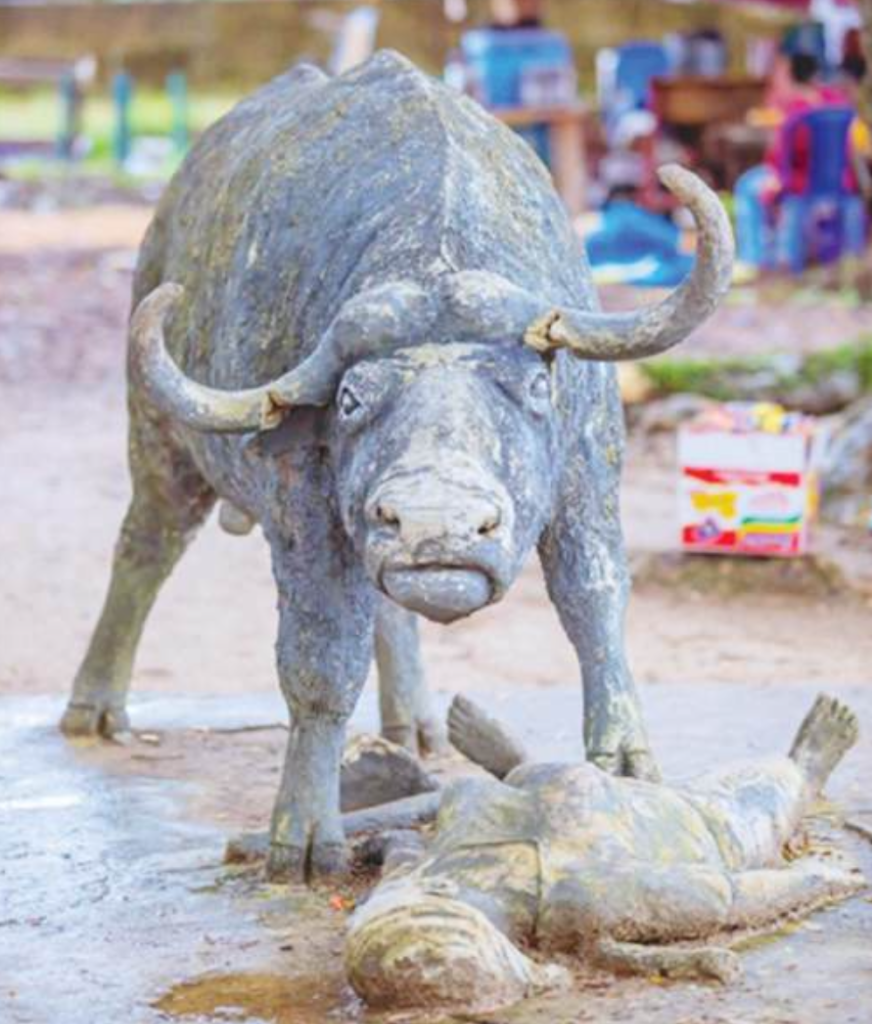
The silence that followed was broken by a single cry of joy, then another, until the entire community erupted in celebration. Songs filled the air. Drums beat with feverish intensity. Dancing feet stomped the marshy land as the people celebrated their liberation.
The name given to the celebration, Odi Ogori Ba Uge, tells the story itself. In the Izon language, it translates directly to “the celebration of Odi killing the buffalo.”
What began as spontaneous joy has, over 69 years, evolved into something far greater, a festival that draws thousands from across Nigeria and beyond, a symbol of resilience that has become one of Niger-Delta’s premier cultural events.
From despair to glory
For those who know the full history of Odi, the festival carries even deeper significance, that is the resilience of a people. Recall that in November 1999, the community suffered a devastating military invasion following the killing of Police officers by armed youths. Dozens of residents lost their lives while homes and public buildings were reduced to rubble, leaving one of the darkest chapters in the history of the Niger-Delta. The community is also facing severe coastal erosion with buildings lost to the river. But like the buffalo of old, the people of Odi refused to be defeated.
“The festival is a living testimony of how the Izon people overcame severe hardship,” said Prof. Ebikisei Udisi, chairman of the 2026 Odi Ogori Ba Uge International Festival Planning Committee adding: “It reminds us of where we came from and inspires courage and unity across generations.”
Prof. Udisi emphasised that the celebration transcends mere entertainment, declaring: “This is not just another festival, it is a celebration of the survival of a people, the power of unity and the ability to transform painful historical experience into a source of identity, pride, culture and hope.”
He called on the people to remember their ancestors, King Akabagu Ofurugbo, under whose reign the Ogori terror occurred, and especially Akara Edike, whose gunshot changed the community’s destiny.
“The story of Odi teaches us that adversity can be transformed into strength,” Prof. Udisi said. “History must not merely be remembered. It must be preserved and passed on to future generations. The Odi Ogori Ba Uge festival is therefore a bridge between the past and the future.”
A festival transformed
Today, the Odi Ogori Ba Uge Festival has become a powerhouse of cultural tourism and economic activity. The week-long celebration, which is held annually starting from July 27 when the rainy season gathers momentum, transforms the community into a bustling hub of commerce and culture.
Traditional boat regattas paint the River Nun with vibrant colours. Wrestlers test their strength in time-honoured competitions. Masquerades dance with otherworldly grace. Native music fills the air, and storytellers captivate audiences with tales passed down through generations.
The festival climaxes with the “love boat cruise” on the River Nun, where thousands of fun seekers gather as music blasts from boats sailing on the majestic waterway and a beach party.
For local artisans, transporters, hoteliers, and food vendors, the festival represents a vital economic lifeline. What began as a community celebration has become a major driver of local commerce in the region.
A call for corporate support
Bayelsa State Governor Douye Diri, who graced this year’s festival, called on corporate organisations to embrace their role in preserving the state’s cultural heritage.
“I am happy with what you are doing, but it is not yet enough. I want to see the private sector as part of the sponsorship of festivals like this in our state. I want to see banks in Bayelsa sponsoring activities like this,” Diri said, addressing the community.
He noted that in many parts of the world, major cultural celebrations depend on private sector sponsorship rather than government funding. “Celebrations like this across the world do not depend on the government as they are mostly private sector-sponsored. But in our situation, organisers often depend on the government,” he said.
The governor also urged participants to understand the deeper meaning behind the celebration, noting: “It is not enough to come here just to celebrate. We should also try to know why we are celebrating. I say so because most of us do not know the history of the celebration.”The governor, who described the festival as representing “unity, resilience, and how the people regained their freedom,” commended the community for immortalising such an important aspect of their history.
His words, “This celebration actually means freedom for the people who were imprisoned by a buffalo. In unity they fought back. It was because the people of this community wanted freedom that they came together.”
A Legacy For Generations
As the 69th edition of the Odi Ogori Ba Uge Festival draws to a close, its organisers are already looking ahead. The festival has been rebranded as an international event, with ambitions to capture global attention and boost the Niger Delta’s economy.
For the people of Odi, however, the celebration remains deeply personal. It is a reminder that no matter how formidable the challenge, whether supernatural beast, mother nature or military might, a united community can overcome.
“The festival is more than an annual celebration,” Prof. Udisi said. “It is a living history that reminds us of who we are.” In a world where cultural identities are increasingly diluted, the Odi Ogori Ba Uge Festival stands as a powerful marker of Ijaw pride and resilience, a celebration born from tragedy, sustained through hardship, and now reaching toward a future of prosperity and global recognition.
The event attracted thousands of visitors from across Nigeria and beyond, reaffirming its enduring legacy as one of Bayelsa State’s most celebrated cultural events.
The post THE LEGEND OF ODI: How a Buffalo’s fall gave birth to festival of freedom appeared first on Vanguard News.