
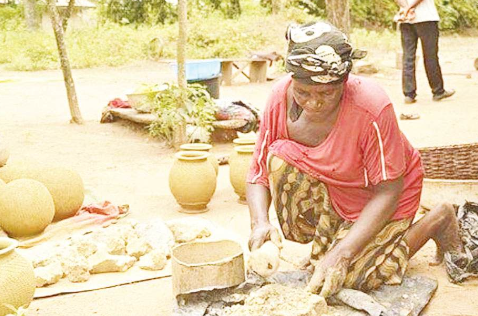
Otor-Edo: Delta’s forgotten clay goldmine
•Residents lament absence of road clinic
By Egufe Yafugborhi
Today (Tuesday), with banners rising and PowerPoints flashing on Day 2, the Delta State Economic and Investment Summit peaked in Asaba as host Governor Sheriff Oborevwori, other state actors, and CEOs negotiated Unlocking potentials and a Made in Delta agenda for a global audience.
And some 160 kilometres away, about a two-hour drive, in Ughelli South Local Government Area, lies a remote community that holds the state’s finest clay deposits.
Otor-Edo clay could feed an industry, but no one at the Asaba summit is speaking about harnessing it. And that silence, residents say, is costing lives, livelihoods, millions in investment, and compromising the future of its children.
A community built on clay, broken by neglect
“By man’s making, Otor-Edo is not like any other community in Ughelli South,” said Kennedy Oghenerukevwe Egone, President-General (PG).
“Since time immemorial, our people have never known what it means to enjoy basic human dignity or the dividends of democracy,” Egone told NDV, close to tears.
Here, pottery is not a hobby; it is heritage. For generations, Otor-Edo women have moulded earthenware from the “highbreed” clay beneath their feet.
“Every native pot you see in markets across Delta was made in Otor-Edo,” Egone said, pride in his voice stifled by pain. Years ago, according to him, a ceramics company came with big promises, surveyed the clay deposits, but left in disappointment. They never returned.
“That happened over 10 years ago. When we call them, the response we get is, ‘Have they done your roads?’” he recalled.
“We appealed to them to come during the dry season and help construct the road for us. They declined, saying they can’t dip into their investment capital to construct a road the government should provide.”
A timeline of abandonment
Otor-Edo is linked by two land routes, Ughevwugho and Effurun-Otor and by water through Edjophe, Okpare, and Oguname Olomu.
With peasant farmers, fishers, and artisans who have worked clay for generations, it has a resource to grow an industry. What it doesn’t have, Egone said, is a government to connect the dots.
That road, Effurun-Otor to Otor-Edo is where hope has gone to die, again and again.
Community accounts and past appeals show the road was first awarded between 2003 and 2007 under the Chief James Ibori administration. Residents trooped out to clear the bush in anticipation but were left disappointed. No asphalt was laid; the contract was abandoned.
It resurfaced between 2015 and 2023 under Senator Ifeanyi Okowa and was re-awarded. Over five years, there was no sign the road would be executed. Nothing changed.
The road remains unmotorable. For over a decade, no truck has entered Otor-Edo during the rainy season. The only way in and out for more than a year, residents said, has been a canoe provided by Ughelli South LG Chairman, Hon. Lucky Avweromre.
“To go to my community, I will drive to Oguname, park there, and board the community canoe to get home,” Egone said quietly.
Painful reality
But the road is only the first door that is locked. Behind it are other failures that tell the story of a community left behind.
A health centre sits at 75 per cent completion, built with communal funds and labour. The government was notified to provide water, electricity, equipment, and personnel. Nothing has come. Pregnant women and the sick travel long distances on foot and by canoe and some do not make it back from such medical emergencies.
The only primary school was started three decades ago as a mud house, later upgraded by the community when Shell carried out a needs assessment in the area. Today, that block stands roofless, dilapidated, and unsafe.
“Our children sit under open skies to receive lessons. With the rains approaching, there may soon be no place for them to learn at all,” Egone said.
He said Delta SUBEB sent engineers for scoping last year and that, in January, he was told “the job has been awarded.” A year later, no contractor has shown up.
There is no pipe-borne water. People still depend on wells and streams that dry up in the dry season. No electricity. No functional market where women can sell pottery or farm produce to feed their families.
The Paradox
This, residents argue, is the cruel irony Delta is selling in Asaba: come invest, while communities sitting on raw materials rot.
Otor-Edo thus defines the paradox of a Delta that talks up its investment potential in rhetoric while strangulating naturally endowed communities with deprivations that deter the very investors it burns huge resources to woo across continents.
“Which serious ceramics investor would commit with no access road to Otor-Edo? No light, no hospital, collapsed schools. Otor-Edo is a forgotten community,” the PG laments.
What could be
The vision, according to community leaders, is simple. Not luxury. Not politics. “The road is number one. Once that is done, a small ceramics hub with kilns, training for artisans, and public-private partnerships becomes possible. Native pots today, tiles and sanitary ware tomorrow. Brand it “Otor-Edo Clay” and plug it into the “Made in Delta” export drive.
Finish the health centre. Fix the school. Provide water and light.”
Egone pleads: “Include Otor-Edo in the development plan of Delta State. We’re not requesting political favours. We are demanding what is just, equitable, and befitting for citizens of Delta State: roads, water, health, and education.
“Beloved leaders, we beg: See the children learning in roofless classrooms. Your mothers trekking distances for water and our sick dying because there is no clinic nearby.
“Otor-Edo Community should not be made to wait for another generation to enjoy what other communities take for granted. All we seek is to be seen, be heard, and to be remembered.”
As the summit closes in Asaba with handshakes and MoUs, the clay in Otor-Edo will still be waiting. So will the people.
The post Otor-Edo: Delta’s forgotten clay goldmine appeared first on Vanguard News.