
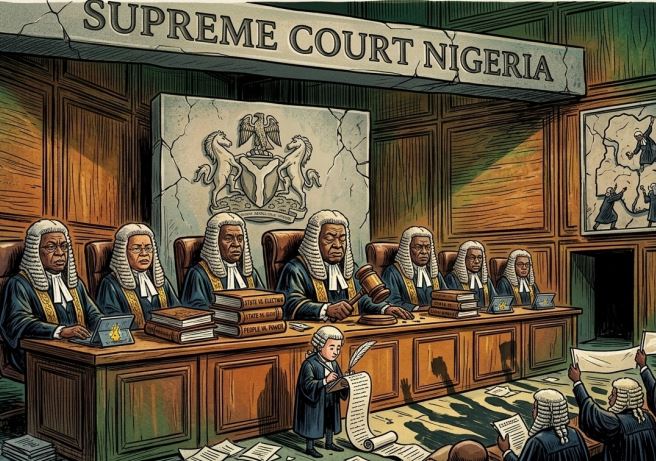
NIGERIA @ 66: Judiciary – Last or lost hope of common man?
•Judges under fresh scrutiny over questionable judgments
•Go to court’ culture, contradictory rulings raise concerns over electoral justice
By Clifford Ndujihe, Politics Editor
The judiciary is often regarded as the last hope of the common man. But to some politicians in Nigeria, the judiciary is becoming the lost hope of the common man especially on election matters, while to a select few, the judiciary is the battle field where everything and anything goes – and things have been going their way, one way or the other.
Sixty-six years after independence, Nigeria’s temple of justice is coming under fresh scrutiny over its handling of disputes especially election cases, with critics alleging that conflicting judgments and technicalities are eroding confidence in the electoral process.
The controversy has also fuelled the now-popular political expression, “go to court”, with critics alleging that politicians, who manipulate elections, sometimes, dare their opponents to seek judicial redress, confident that the outcome would be difficult to reverse.
Those holding this view argue that contradictory decisions in election cases have made it increasingly difficult to overturn disputed polls and could undermine public confidence in Nigeria’s democracy, which is enjoying its longest spell since independence.
However, those on the other side contend that the judiciary should not be blamed for the shortcomings of politicians, who manipulate elections and subsequently seek to use the courts to settle political disputes.
The concerns have become more pronounced as the number of election petitions has risen sharply since the beginning of the Fourth Republic in 1999.
In 1999, only two election petitions were recorded. The figure rose to 560 in 2003, 1,290 in 2007, 732 in 2011, 560 in 2015, 1,697 in 2019 and 1,996 in 2023, a cumulative 6,840 petitions.
When courts changed election outcomes
In the earlier election cycles, courts overturned the victories of several governors, making judicial intervention a significant feature of Nigeria’s electoral history.
The first governor to benefit from a court judgment was former Anambra State governor, Peter Obi, whose case lasted from 2003 to 2006 before the Supreme Court annulled Chris Ngige’s election and declared Obi the winner on the platform of the All Progressives Grand Alliance, APGA.
Other governors who subsequently assumed office following judicial intervention included Rotimi Amaechi of Rivers State, Adams Oshiomhole of Edo, Rauf Aregbesola of Osun, Kayode Fayemi of Ekiti, Rotimi Akeredolu of Ondo, Douye Diri of Bayelsa, Hope Uzodimma of Imo – who came fourth in the election but won at the Supreme Court – and Bello Matawalle of Zamfara.
The history of election litigation has also contributed to the emergence of off-cycle governorship elections in several states.
Kogi, Anambra, Ondo, Ekiti, Osun, Edo, Imo and Bayelsa have had off-cycle governorship elections following judicial nullification of disputed polls. The last governorship election annulled was that of Emeka Ihedioha of Imo State in January 2020.
Since then, no governorship election has been annulled, despite controversies surrounding some elections.
No presidential election has also been annulled in the Fourth Republic. The closest was the 2007 presidential election, when four of the seven Supreme Court justices affirmed the election of the late President Umaru Musa Yar’Adua, while three favoured General Muhammadu Buhari.
Onaiyekan warns against ‘courtroom democracy’
Last Thursday at the 22nd All Nigeria Editors Conference, ANEC, in Enugu, Catholic Archbishop Emeritus of Abuja, John Cardinal Onaiyekan, decried the role the Judiciary is now playing in determining outcome of elections, which he said must change for the good of Nigeria’s democracy.
While reviewing how Nigeria has fared in her democratic journey so far, and how to deepen it, Onaiyekan said: “Finally, there is the judiciary, which is supposed to be the last stage in the electoral process. It should be stressed that the judiciary is not to determine elections about who wins, but rather to adjudicate disputes when they arise. If elections were well conducted, there ought not to be any need for judicial cases. The tribunals were supposed to be there just in case.
“But our experience in the recent past has almost become that we have been witnessing a situation where our elections are being determined not at the polls, but in the courts by the tribunals. And this gives a field day for high-class lawyers with high-level fees, doing their best to manipulate issues on technicalities. There are allegations that are difficult to deny of unjust judgments by some judges in election tribunals. The performance of the judiciary in recent elections has seriously dented the image of this hallowed institution. I do hope that efforts are being made to regain the trust of the people in the courts in these matters.
“On the whole, therefore, we need an improved legal framework for our elections. There have been frequent demands for improvements in this regard. Our National Assembly, which ought to make sure that this is done, so far has shown scarce interest for serious change in this matter. There are allegations that the present members of the National Assembly prefer to retain the porous system that we now have so that they can take advantage of it for their own selfish reasons.
“It seems that politicians have studied all the loopholes in our system and have perfected the art of taking advantage of those loopholes to win elections by hook or by crook, by whatever means. If that is the case, it would not be in their interest to plug those loopholes. But it is certainly in our own interest so to do.”
‘Go to court’ killing democracy – Obasanjo
Former President Olusegun Obasanjo, recently, raised concerns over the state of electoral justice.
In a keynote address titled “Leadership Failure and State Capture in Nigeria,” delivered at the Chinua Achebe Leadership Forum at Yale University, Connecticut, United States, Obasanjo criticised the handling of election disputes and described the 2023 elections as “a travesty” by all national measures.
He alleged that politicians could manipulate elections and then ask those who lost to go to court, arguing that “where justice cannot be assured is the easiest and best way to kill electoral democracy, the judiciary in Nigeria is a very pale version of its once internationally esteemed self.”
He further alleged that some politicians, after manipulating elections, openly ask their opponents to “go to court” because they believe the judicial system has been compromised. He also alleged that some judges had become susceptible to wealthy interests, saying judgments should be based on the law and not financial or political influence.
ActionAid raises concern about contradictory judgment
ActionAid, in its 2023 report on Post-Election Judicial Accountability and Reforms in Nigeria, also raised concerns over contradictory judgments in election-related cases.
The organisation asked: “If we cannot get it right at the polls, if we cannot trust INEC, should we still be apprehensive of the judiciary? What is the hope for Nigerians?”
It cited cases arising from Plateau State elections, the Supreme Court judgment involving former Senate President Ahmed Lawan, the controversy over Vice President Kashim Shettima’s nomination and the presidential election petitions arising from the 2023 election.
On the Plateau cases, ActionAid said different judicial panels reached conflicting conclusions over whether issues relating to political party primaries could be raised at election petition tribunals.
It noted that the Court of Appeal subsequently affirmed decisions nullifying the return of several PDP candidates, including a decision affecting Governor Caleb Mutfwang. The governor appealed to the Supreme Court, which restored his mandate – but on the strength of the same arguments, PDP legislators lost their seats.
Lawan-Machina controversy
ActionAid also examined the legal battle involving Bashir Sheriff Machina and Ahmed Lawan over the Yobe North senatorial ticket.
According to the organisation, Machina won at both the Federal High Court and Court of Appeal after arguing that Lawan did not participate in the senatorial primary.
The Supreme Court subsequently ruled against Machina on the procedure adopted in commencing the case. ActionAid criticised the decision, arguing that the court had relied on technicalities rather than the substance of the case.
The organisation said: “The decision of the court sounds strange as the court abandoned the substance of the case despite the ample evidence that Lawan never contested the primaries for Yobe North.” The Lawan/Machina case is a pure, but shameful reflection of where Nigeria’s judiciary has now landed.
2023 presidential election litigation
ActionAid also examined the Supreme Court’s handling of the 2023 presidential election petitions filed by Atiku Abubakar and Peter Obi against the APC and President Bola Tinubu.
It said the judgment raised “several issues which left citizens more confused than convinced that the tribunal was unbiased in its decision.”
The organisation also discussed the arguments surrounding Shettima’s alleged double nomination and the interpretation of relevant provisions of the Electoral Act.
On the issue, ActionAid said the court focused, among other things, on who had the legal standing to raise the matter. The report also referenced the controversy surrounding the United States forfeiture case involving Tinubu, contrasting arguments made by citizens with earlier Nigerian Supreme Court jurisprudence on forfeiture.
Restoring confidence
The controversy over election judgments comes against the backdrop of growing concern about the relationship between elections, political parties, electoral bodies and the judiciary.
At the heart of the debate is whether elections should be conclusively determined by voters at polling units or whether courts should continue to play a decisive role in determining who eventually occupies elective offices.
Supporters of judicial intervention argue that courts remain essential where electoral laws are breached and voters’ mandates are disputed.
Critics, however, contend that prolonged litigation, conflicting judgments and reliance on technicalities can weaken citizens’ confidence in the ballot and encourage politicians to pursue electoral victories through means other than winning the confidence of voters.
The challenge, therefore, is not simply to reduce the number of election petitions but to strengthen the electoral process sufficiently to ensure that fewer disputes reach the courts in the first place.
As Nigeria prepares for another election cycle, the debate over electoral integrity, the independence of institutions and public confidence in judicial decisions remains central to the country’s democratic development.
Vanguard News
The post NIGERIA @ 66: Judiciary – Last or lost hope of common man? appeared first on Vanguard News.