
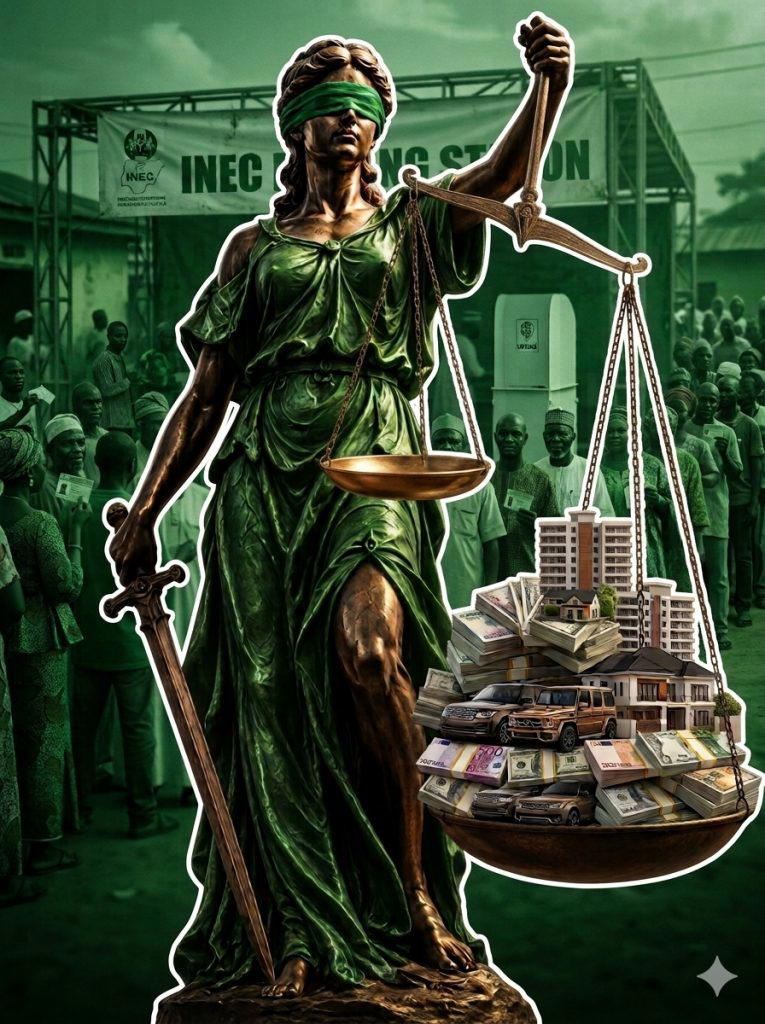
NIGERIA @ 66: Focus on judiciary – When justice loses its way
By Jide Ajani
A republic can survive a bad government. It can even survive a bad legislature. What it cannot easily survive is a public belief that the law no longer means what it says. The judiciary is supposed to be the place where power stops, where the weak can confront the strong, and where political quarrels are translated into rules rather than settled by force. In Nigeria, that promise is under strain – very severe strain.
Sixty-six years after independence, the question is no longer simply whether Nigerians can obtain justice. It is whether they can understand it when it arrives.
The Nigerian Constitution gives the courts formidable responsibilities. Yet an increasingly familiar spectacle is of litigants confronted by judgments whose reasoning appears remote from ordinary logic, conflicting orders issued by courts of coordinate jurisdiction, cases that consume years, and legal technicalities that seem to matter more than the injury that brought a citizen to court. In 2024, the National Judicial Council itself summoned the Chief Judges of the Federal High Court and Kano State High Court over conflicting orders. The Council has also disciplined judges over matters including abuse of discretionary powers and failure to deliver judgments within prescribed periods.
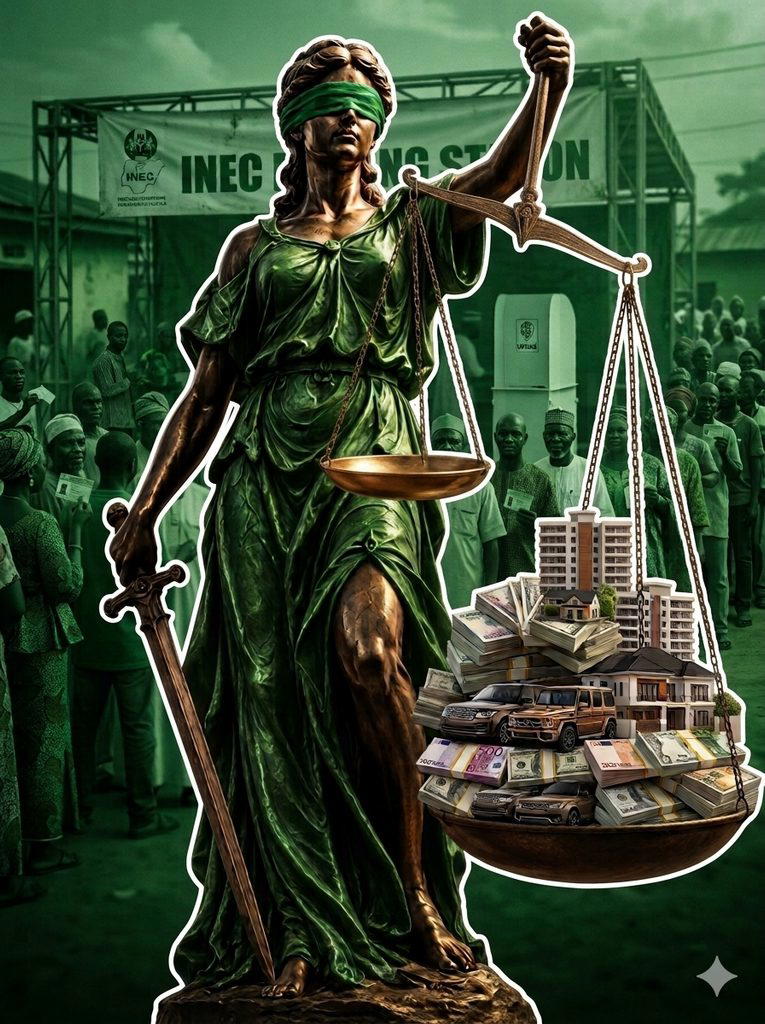
This is not merely a problem of judicial language. Judgments are supposed to explain why the law produces a particular result. When the explanation becomes opaque, strained or internally difficult to reconcile with earlier decisions, confidence suffers. And when two courts appear capable of producing contradictory answers to the same political question, the law begins to resemble a lottery whose prize goes to the litigant who finds the right courtroom first. It is happening in Nigeria.
That is why the appointment of judges matters. It is also why the National Judicial Council matters. So do the Nigerian Bar Association, the quality of advocacy, judicial discipline, court administration and the independence of the bench. The nine questions in this investigation—appointments, delay, contradictory decisions, the NJC, military and civilian rule, the history of Chief Justices, judicial scandals, the responsibility of lawyers and the NBA, and the place of Sharia within the constitutional order—are really one question: what happens when an institution entrusted with restraining power loses the confidence of the people it is meant to protect? Professor Auwalu Yadudu, of Bayero University, Kano, agrees that the judiciary suffers a perception discount.
History offers uncomfortable answers
In 1857, America’s Supreme Court delivered Dred Scott v. Sandford, ruling that enslaved people were not citizens and that Congress could not prohibit slavery in federal territories. The decision did not settle America’s great moral and constitutional dispute. It intensified it. The National Archives records that the judgment moved the country closer to the Civil War; it was eventually undone by the Thirteenth and Fourteenth Amendments.
During the Second World War, America’s Supreme Court likewise upheld the government’s exclusion of Japanese Americans in Korematsu v. United States. Nearly 70,000 of those incarcerated were American citizens. The episode became a lasting warning about what happens when courts give excessive deference to executive power in moments of national anxiety. Decades later, Korematsu’s conviction was vacated after suppressed government evidence came to light; the wider injustice eventually prompted an official apology and reparations under the Civil Liberties Act of 1988.
Germany offers the darker example. Under the Nazis, the judiciary did not merely fail to resist dictatorship; much of it helped translate dictatorship into legal form. Courts increasingly interpreted law according to Nazi ideology, while special courts were created for political cases. After the war, Nazi jurists themselves were prosecuted for what the Nuremberg proceedings described as judicial murder and other atrocities committed in the name of law.
The lesson is not that judges are uniquely wicked. It is that courts are institutions, and institutions are only as strong as the principles and incentives governing the people inside them, just as the society incubates the personnel.
Nigeria has its own cautionary episodes
Consider the 2023 presidential election litigation. The Supreme Court ultimately dismissed the appeals of Atiku Abubakar and Peter Obi and affirmed Bola Tinubu’s election. The court also acknowledged that the failure of INEC’s IReV results-viewing system could reduce public confidence in the electoral process, while holding that it did not constitute sufficient legal grounds to annul the election.
Whatever one’s political allegiance, the institutional consequence was larger than the fortunes of the candidates. For millions of voters, the litigation became a test of whether electoral law could provide a convincing account of what had happened at the ballot box. A judgment can be legally final without being socially persuasive.
When the distinction matters
The Kano governorship case offered another illustration of the judiciary’s capacity to produce radically different stages of litigation. The election tribunal and Court of Appeal removed Governor Abba Yusuf; in January 2024, the Supreme Court reversed those decisions and affirmed his election. The reversal was legally possible because appellate courts exist precisely to correct error. But repeated reversals in politically consequential cases inevitably raise a broader question: how predictable is the law before a litigant reaches the final court?
Then came Rivers State. In February 2025, the Supreme Court invalidated the October 2024 local-government elections, holding that the process had violated relevant electoral requirements. The case became another demonstration of how judicial decisions can have immediate consequences for the control of public resources and political authority. In Rivers, as elsewhere, courts became arenas in which political combat was fought by legal means.
There is nothing inherently wrong with politicians going to court. Indeed, that is preferable to settling disputes by violence. The danger begins when politics becomes so dependent upon litigation that courts themselves become the battlefield.
Nor is Sharia the constitutional anomaly it is sometimes portrayed as being. The 1999 Constitution expressly provides for State Sharia Courts of Appeal and defines their jurisdiction, principally in matters of Islamic personal law. Sections 275–277 establish their constitutional place and jurisdiction. The difficult questions concern boundaries: how religious jurisdiction interacts with constitutional rights, the jurisdiction of other courts, personal liberty and the supremacy of the Constitution.
When the questions deserve law, not alarm
The judiciary’s problem, therefore, is not that it occasionally gets a case wrong. Courts everywhere do. Its deeper problem is credibility: whether citizens believe that appointments are based on merit; that cases will be heard within a reasonable time; that judges are sufficiently insulated from political pressure; that lawyers will not shop between courts for convenient orders; that misconduct will be punished; and that judgments will be comprehensible enough for the public to see the chain of reasoning between law, evidence and conclusion.
The NJC has shown that it can investigate and discipline judicial officers. In 2024 and 2025 it announced investigations, warnings, suspensions and recommendations concerning judges, while also introducing greater public participation in the appointment process. But an overseer must itself inspire confidence. Oversight that is opaque cannot easily cure opacity elsewhere.
Lawyers should not escape scrutiny
A court cannot be cleaner than the legal culture surrounding it. Lawyers who pursue contradictory orders in different courts, litigants who treat injunctions as political weapons, and professional bodies that speak loudly only after institutional damage has been done all contribute to the problem. The NBA’s defence of judicial integrity is therefore not a favour to judges. It is a defence of the legal profession’s own credibility. In 2024, the NBA publicly urged judges to uphold the rule of law amid concerns over conflicting orders in Kano and Rivers.
Nigeria does not need a judiciary that never errs. It needs one whose errors can be corrected, whose reasoning can be understood, whose members can be held accountable, and whose independence is strong enough to withstand the government of the day. Unfortunately, for now, fears persist.
The hope of the common man was never that every judgment would favour him. It was that, when he entered the courtroom, the law would not know whether he was rich or poor, governor or voter, minister or market trader.
At 66, that is the standard by which Nigeria’s judiciary should be judged — not by the grandeur of its courthouses or the length of its judgments, but by the confidence of the citizen who walks through their doors.
For without that confidence, justice may remain available in theory while becoming, in practice, another privilege of power.
Vanguard News
The post NIGERIA @ 66: Focus on judiciary – When justice loses its way appeared first on Vanguard News.