
Iniside Nigeria’s correction centres: Feeding crisis rocks prisons
***Inmates face hunger, starvation
***Prison authorities deny claims, defend feeding system
By Henry Ojelu
For three years inside the Kirikiri Correctional Centre in Lagos, survival for Mike Okoroafor came down to a daily calculation: find alternative food or go hungry. Convicted for fraud and later discharged by the Court of Appeal, Okoroafor said that while his legal ordeal eventually ended, the struggle to stay nourished in custody remains the most haunting part of his experience.
He recalled: “The first week I relied on prison food, my body began to weaken. By the second week, I made up my mind never to depend on it again. That was when I realised that if you don’t find alternatives, you can’t survive.”
Okoroafor’s account is not isolated. Interviews with former and current inmates, as well as independent findings by Vanguard, point to a deeply strained feeding system across Nigeria’s correctional centres – one undermined by chronic overcrowding, inadequate funding, weak oversight, and allegations of diversion of food supplies.
A system stretched beyond limits
Nigeria’s correctional facilities are currently operating far beyond their designed capacity. According to data from the Nigerian Bureau of Statistics, NBS, the inmate population has climbed above 80,000, with about 65 per cent classified as awaiting trial.
This imbalance has invariably placed enormous pressure on basic services, particularly feeding. Facilities originally built to house far fewer inmates now struggle to cater to swelling populations. Kitchens designed for hundreds must now feed thousands, often with limited infrastructure and outdated equipment.
The result, according to multiple accounts, is a system where both the quality and quantity of meals are compromised.
What inmates are fed
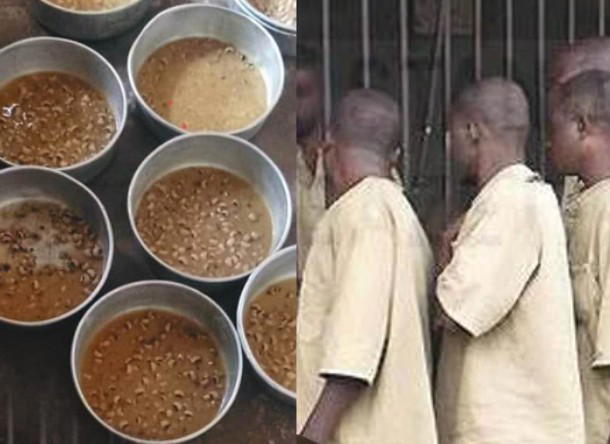
Across custodial centres, feeding follows a predictable pattern. Breakfast typically consists of pap, beans, or tea and bread. Lunch may include rice and stew, or yam or eba served with soup. Dinner is often a repetition or variation of what was served earlier in the day.
Food items are supplied by government contractors and prepared within the prisons, largely by selected inmates using large pots and gas cookers.
On paper, the arrangement appears functional. In reality, inmates describe a vastly different picture.
“The food is just routine, not nutrition. It is cooked to fill space, not to sustain health,” said Tunde Oyedele, a former inmate of Kirikiri Correctional Centre.
His most vivid recollection is the condition of the food itself.
“Eating beans there is like chewing stones. They don’t sort it properly. Sometimes the stones are almost half of what you’re given. You spend more time removing stones than eating,” he said.
He added that rice served within the facility is often poorly processed and inadequately cooked.
“The rice can be worse. Some inmates take their portion, wash it again, and recook it. That is if they can afford to buy pepper or oil. That’s how people manage,” he noted.
Another ex-inmate, Adam Aboh, who was released a few months ago, corroborated this but pointed more directly to preparation methods.
He said: “The problem is not just quantity, it’s how the food is made. Beans are cooked overnight, and by morning they just add small oil, pepper and seasoning. Then they keep adding water depending on how many people want to eat. It becomes watery and tasteless.”
He described meals that, in his words, “even a hungry man would struggle to swallow.”
Health consequences
For many inmates, the effects of poor feeding go beyond discomfort, they translate into real health challenges.
Joyce Edeh, who was held at the Kirikiri Female Correctional Centre, said her time in custody was marked by recurring illness linked to food quality.
She said: “I was constantly going to the clinic for stomach pain, weakness and sometimes diarrhoea. The food was not balanced, and sometimes it was outright bad.”
She added that cases of malnutrition were not uncommon, particularly among inmates who lacked external support from family or friends.
“When you don’t have anyone bringing you food or money, you are forced to depend on what is available. And what is available is not enough to keep you healthy,” she said.
Government intervention
In response to mounting criticism over prison conditions, the Federal Government, about two years ago, increased the daily feeding allowance per inmate from less than N700 to N1,500.
The move was widely seen as a necessary adjustment in light of rising food prices.
However, some inmates told Vanguard that the increment has not translated into meaningful improvement.
“The amount may have increased on paper, but in reality, it doesn’t go far,” an inmate who did not want his name mentioned said.
Beyond quality concerns, the inmate insisted that the quantity of food provided is equally problematic.
He also alleged that less than half a bag of beans is sometimes used to prepare breakfast for over 2,000 inmates.
“You can imagine the result. Everybody just gets a small portion that cannot satisfy hunger,” he said.
Another inmate who simply identified himself as Adegbite disclosed that while quantity is an issue, many inmates deliberately avoid official meals due to their poor state.
“Not many people rely on prison food. Those who do are mostly people who have no other option. You can’t eat that kind of food and survive,” he said.
Allegations of diversion
A recurring theme in inmate testimonies is the alleged diversion of food supplies.
One inmate told Vanguard that the volume of food delivered to prisons often does not match what is eventually cooked.
“When supplies come in, they are usually much. But when it’s time to cook, only small portions are released. The rest is taken away and sometimes sold,” she said.
She alleged that diverted food items are occasionally resold within the prison system, forcing inmates to buy what should have been freely provided.
“Sometimes when we give prison officials money to help us buy food items and within a few minutes they are back, we know that they didn’t actually buy the food items from the market. They most probably took it from the store and sold it to us. It’s a common practice and they can’t deny it,” she narrated.
Survival strategies
Faced with these challenges, inmates have developed informal systems to cope.
Vanguard findings indicate three broad categories of inmates when it comes to feeding: Those who depend entirely on prison meals and occasional donations from NGOs; those who buy and cook their own food; and a privileged minority who can afford better options through canteens or external vendors.
For many, survival depends on the second category.
Despite official restrictions, makeshift cooking arrangements are widespread. Small stoves, pots, and utensils are often found within cell corridors, allowing inmates to prepare their own meals when they can access raw ingredients.
“I cook whenever I have money. That is the only way to eat something decent,” said one awaiting-trial inmate.
He added that prison authorities are aware of these practices and, in some cases, tacitly tolerate them.
“If they stop us from cooking, there will be serious problems. People cannot survive on official food alone,” he said.
NGOs, family support
For inmates without the means to cook, support from outside becomes critical.
Non-governmental organisations occasionally visit correctional centres, distributing food packs and relief materials. Families and friends also provide assistance through food deliveries or financial support.
However, such interventions are irregular and insufficient to meet the needs of the entire inmate population.
Inequality behind bars
Vanguard findings also revealed that feeding conditions have also exposed a clear divide within the prison system.
So-called “VIP inmates”, typically those with financial resources or influence, are able to access better food through the staff canteen or external suppliers.
“There is a staff canteen inside. But only a few inmates can afford to buy from there. For the majority, particularly those in overcrowded cells, such options are out of reach,” said one awaiting-trial inmate.
Staged inspections
Concerns about prison feeding are further complicated by allegations that official inspections do not reflect everyday realities.
A female inmate told Vanguard that whenever high-ranking officials are scheduled to visit, the quality of food improves noticeably.
She said: “They cook special meals when they know visitors are coming. The food looks good, the environment is clean, everything is arranged.”
According to her, such preparations create a misleading impression.
“What they see during inspections is not what we eat everyday. If they come unannounced, they will see the truth,” she added.
It’s a systemic failure – Human rights groups
Reacting to the feeding conditions in the correctional centres, human rights groups called for urgent reforms to the prison feeding system, warning that the situation reflects deep structural and accountability failures.
Executive Director of the Rule of Law and Accountability Advocacy Centre (RULAAC), Okechukwu Nwaguma, said the Federal Government must introduce strict, real-time monitoring of feeding processes within the Nigerian Correctional Service.
According to him, oversight should be driven directly by the Federal Ministry of Interior and include independent verification of both the quality and quantity of meals served to inmates.
The post Iniside Nigeria’s correction centres: Feeding crisis rocks prisons appeared first on Vanguard News.