
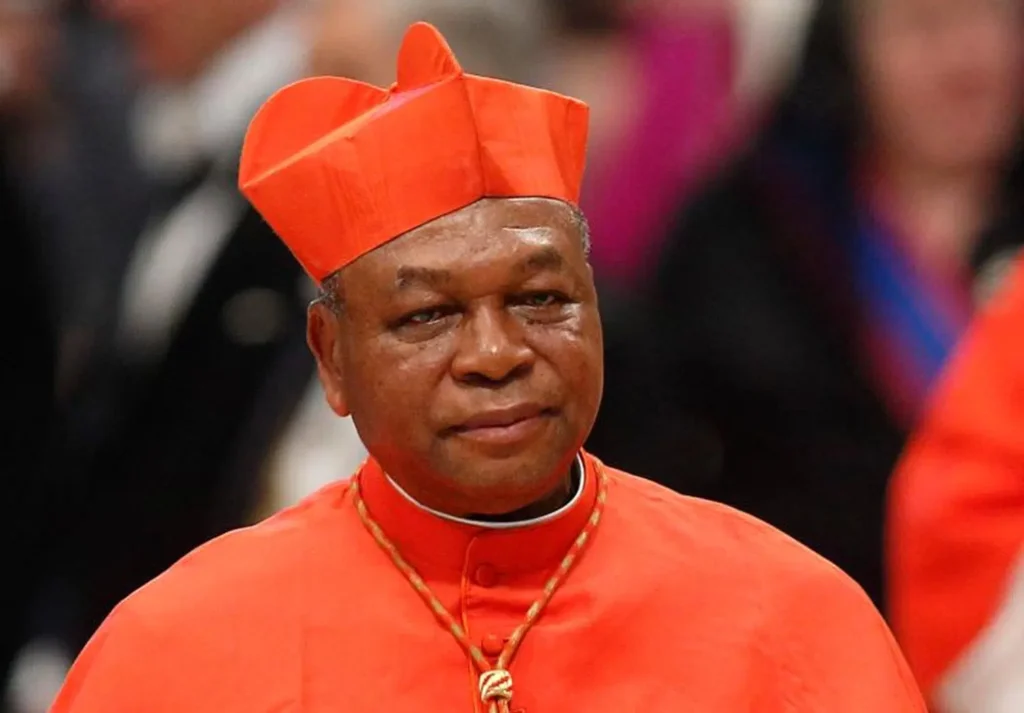
EXCLUSIVE: Fact-Checking Cardinal Onaiyekan: The Data and Law Behind Tinubu’s Presidency
As an investigative journalist committed to separating emotional rhetoric from verifiable facts, I have meticulously analyzed Cardinal John Onaiyekan’s repeated public critiques of President Bola Ahmed Tinubu. While the Cardinal’s voice carries significant moral weight, a rigorous examination of Nigeria’s constitutional framework, electoral data, and macroeconomic realities reveals a vastly different narrative.
Here are the verified, fact-based counter-arguments to his most prominent claims.
1. The 2022 Muslim-Muslim Ticket: Political Mathematics, Not Religious Imposition
The Cardinal’s Claim: The APC’s decision to field a Muslim-Muslim ticket was a deliberate affront that warranted a personal electoral boycott on religious grounds.
The Fact-Based Counter: Elections in Nigeria are dictated by complex geopolitical and demographic realities, not theological preferences. The APC’s ticket was a calculated electoral strategy designed to secure the critical Northern voting bloc.
The Demographic Reality: To win a Nigerian presidential election, a candidate must secure 25% of the votes in two-thirds of the 36 states and the FCT. Tinubu (from the South-West) needed a Northern running mate with immense grassroots influence to counterbalance the strong Northern candidacies of Atiku Abubakar (PDP) and Rabiu Kwankwaso (NNPP).
Cross-Religious Appeal: Despite the narrative of religious exclusion, Tinubu won substantial votes in heavily Christian and mixed demographic regions. He secured majorities or the required 25% spread in diverse states like Rivers, Benue, and across the South-West, proving the ticket succeeded on political viability and regional alliances, rather than religious subjugation.
2. The 2023 “Questionable Legitimacy” and Inauguration Dispute
The Cardinal’s Claim: Tinubu should not have been inaugurated while court petitions were pending, and he labored under a “questionable legitimacy” until the courts finished.
The Fact-Based Counter: This argument fundamentally contradicts the Nigerian Constitution and the established rule of law.
Constitutional Mandate: Section 135 of the 1999 Constitution (as amended) dictates a strict four-year tenure for the President. Swearing in a declared winner on May 29 is a non-negotiable constitutional requirement designed to prevent a dangerous power vacuum and a constitutional crisis.
Judicial Precedent: The Electoral Act 2022 does not pause governance for judicial reviews. Furthermore, in October 2023, the Supreme Court of Nigeria completely dismissed the appeals filed by Atiku Abubakar and Peter Obi. The highest court in the land validated the Independent National Electoral Commission’s (INEC) declaration, permanently neutralizing any claims of “questionable legitimacy.”
3. The “Minority President” and the “Bleeding” Economy (2024-2026)
The Cardinal’s Claim: Tinubu is a “minority president” because more people voted against him, and his economic policies have left the nation “bleeding” with rising poverty.
The Fact-Based Counter: While the economic transition has been undeniably harsh for everyday Nigerians, the Cardinal’s framing lacks necessary macroeconomic and electoral context.
The Electoral System: The “minority” label ignores the reality of Nigeria’s multi-party system. The 2023 election featured four dominant forces (APC, PDP, LP, NNPP), inherently fracturing the popular vote. Tinubu met the strict constitutional benchmark by securing the highest total votes (over 8.7 million) and the geographic spread requirement, preventing any single region from dictating the presidency.
Macroeconomic Realities: The immediate removal of the petrol subsidy and the unification of the forex windows triggered significant inflation and temporary hardship. However, these were not malicious choices; international financial institutions, including the World Bank, have consistently verified that these aggressive macro-fiscal reforms were the only way to pull Nigeria back from the brink of total fiscal collapse. Recent data shows these reforms are beginning to create the fiscal space necessary to fund infrastructure and vital social protection programs.
4. The 2027 Election and the “Civilian Dictatorship” Warning
The Cardinal’s Claim: The Tinubu administration is “bent on winning by all means” in 2027, risking a slide into a one-party dominant state where votes will not count.
The Fact-Based Counter: This is a speculative projection rather than a verified political reality.
Democratic Checks and Balances: The Nigerian political landscape remains highly competitive. Opposition parties currently control key strategic states (such as Kano, Oyo, and Enugu) and hold significant influence in the National Assembly.
Institutional Independence: The judiciary and electoral frameworks continue to function independently. Accusing the administration of rigging an election that has not yet occurred disregards the ongoing civic and institutional efforts aimed at strengthening the electoral process ahead of 2027.