
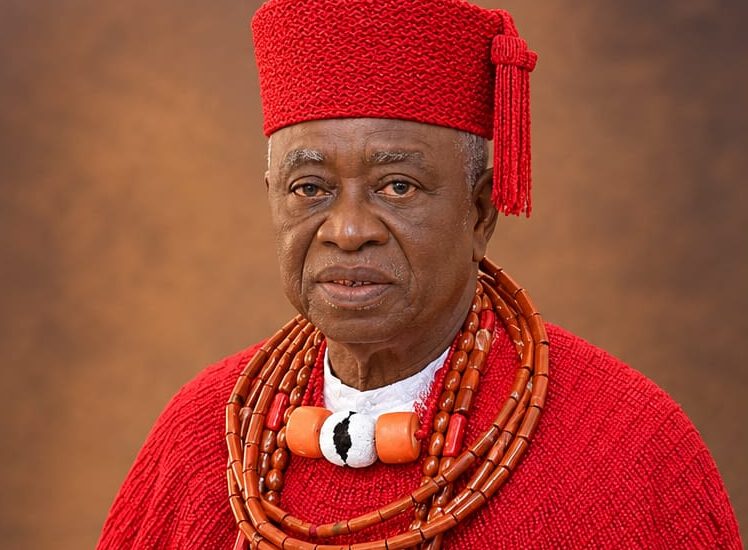
What has changed for Asaba since Azinge became Asagba?
By Egufe Yafugborhi
When HRM Prof. Epiphany Chigbogu Azinge, SAN, ascended the throne of the Asagba of Asaba two years ago, he inherited an institution steeped in history, tradition and expectations.
Today, the palace is becoming something more.
A smart school has been built by the community and handed to the Delta State Government. Ambulances respond to emergencies. A drug rehabilitation centre has emerged.
Security intelligence flows into the palace within minutes. Public spaces are being upgraded, a 1000-capacity Event Centre hosted guests to Nna Agu’s second coronation anniversary.
Women are gaining a stronger voice in traditional affairs. Even long-standing practices such as community burials are being reviewed.
For Azinge, the change is deliberate.
He declared, “I’ve long migrated from being a traditional ruler, and now into traditional governance. I’m not only trying to think about the customs and traditions of our people.
“I’m also thinking about the welfare, healthcare, education, among so many other things, to make sure my people, Asaba people, collectively, are very happy going forward.”
It is a philosophy beginning to redefine what many residents expect from their traditional institution, the people building for themselves
Perhaps nowhere is the new relationship between palace and people more visible than at the Asaba Community Smart Nursery And Primary School recently commissioned and donated by Asaba to the Delta State Government.
Asagba Azinge sees it more than a building. “Today, Asaba is breaking new grounds. We try to shatter ceilings, if and when the opportunity presents itself.
“I believe in the history of Delta state, and I dare say of Nigeria, this is the first time a community will come together, not just to build a smart school, but also have it donated to government”
The project, he said, demonstrates that the traditional institution can mobilise the community while government provides the broader public-service framework.
“It underscores our willingness, readiness at all times to partner our state government, complement their efforts, and support them in the growth and development of our state and our community in particular.”
But the partnership comes with expectations. Standing at the school, Azinge turned to the government with a simple request:
“If Asaba can donate a school to you, please donate a road to us so we can achieve this. Donate a road so people can access this place easily and then be able to school here.”
For Delta State Commissioner for Primary Education, Chief Mrs Rose Ezewu, the message was equally clear.
“This occasion is significant not merely because we are unveiling a new school facility, but because we are witnessing the power of community vision, responsible leadership and purposeful partnership in advancing the cause of education.
“Sustainable progress requires collaboration with communities, traditional institutions, parents and other stakeholders.”
A Palace That Listens
If the school represents physical development, security represents less visible change.
When officers of the Defence Intelligence College, Abuja, visited Asaba, Azinge described an intelligence network that puts the palace at the centre of community security.
“Nothing happens in this kingdom I don’t get to hear within five minutes. Good or bad, it filters into the palace, so I get to know.
“It is my duty and responsibility, as the ruler of Asaba, to determine where to divert such information, depending on severity and the agency best suited to handle the issue at hand.”
The system, he said, depends on trust, “We have cultivated confidence from those who provide such intelligence. We preserve their confidentiality and privacy, and they believe their identity will never be disclosed in a way that will jeopardize their lives.”
A vigilante outfit works with the Police, DSS and other agencies, while security is reviewed every Tuesday.
“We identify potential flashpoints, brainstorm and come up with ideas to mitigate threats before they escalate,” he said.
It is traditional authority operating in a distinctly modern way: gathering information, coordinating institutions and attempting to prevent crises before they happen.
From Ceremonies To Welfare
At the second anniversary thanksgiving Mass at St. Patrick’s Catholic Church, Asaba, Rev. Fr. Peter Muobogwu offered another perspective.
“We are thankful to God for the celebration of today because God has visited us and blessed us with a visionary Asagba.
“It is not a fairy tale or folklore that among the humanitarian services of the Asagba of Asaba, there are functional ambulances.
“Within this period, those who are in emergency health situations can put a call across and can be taken to the hospital.”
A drug rehabilitation centre has also been established, expanding the palace’s intervention into an area traditionally left almost entirely to government and specialised institutions.
With the people watching, the strongest measure of the new model may ultimately be how they perceive it.
Chairman of the anniversary committee, Chief Amb. Charles Onianwa, said, “The people of Asaba felt it wise to honour the Asagba whose achievements over the past two years have been unmatched. “He has taken bold steps for the good of Asaba and its people. We are holding this celebration to express our gratitude and say, ‘Thank you, Nna Agu, for all you have done.’”
Chief Victor Nwosa, Awulika Asaba, was more direct: “He has done so much for Asaba within this short period. So we are encouraging him to do more.”
The list also includes the beautification of Ogbeke Square and upgrading of the Kainebisi Roundabout with Providus Bank’s support
Ogbueshi Dr Jude Mgbeze, Asagba’s Private Secretary, underscored the new place for women within the traditional structure.
He noted, “He has raised status of women in Asaba. First, he has made them proper chiefs on their own. Whether your husband is a chief or not, if you are good enough, he makes you a chief”
REVIEWS
Azinge’s approach has not meant abandoning tradition. Rather, he has shown willingness to bend convention when he considers it necessary.
He had announced he would not confer chieftaincy titles until 2027. He made an exception for renowned environmentalist and businessman, Chief Newton Jibunoh, whom he decorated as ‘Odenigwe Ahaba’.
“I ascended the throne 5 October 2024. And I made it very clear I would not confer any chieftaincy until 2027.
But nothing is cast in stone. When it became absolutely necessary for me to shift ground, I had to because of Chief Newton Jibunoh.”
Significantly, Jibunoh is not an Asaba indigene.
“We don’t often confer titles on non-indigenes,” Azinge said, explaining that the required approval from Jibunoh’s home traditional ruler was obtained.
The episode captured something fundamental about the monarch’s approach: tradition remains important, but it can be reviewed.
A New Compact With Government
For the Delta State Government, the emerging model presents both opportunity and responsibility.
The smart school illustrates the arrangement: the community provides an asset; government assumes responsibility for integrating it into public education system.
Azinge’s challenge for a road in return makes the relationship reciprocal. Yet the monarch insists the transformation cannot be credited to the palace alone. “Leadership without followership is as good as dead. I draw a lot of strength and inspiration from the teeming Asaba people who have graciously donated their time, talent, and treasure to whatever we have been doing.”
Two years into his reign, perhaps that is the clearest change in Asaba: the palace is no longer being presented merely as a place where tradition is preserved, but increasingly as a place where community problems are identified, people mobilised and government challenged to respond.
And Asagba Azinge believes much more is coming.n“This is just a tip of the iceberg,” he said. For a city watching its traditional institution evolve, the next two years may reveal whether Azinge’s experiment in “traditional governance” can turn the momentum of a remarkable beginning into a lasting model for Asaba.
Vanguard News
The post What has changed for Asaba since Azinge became Asagba? appeared first on Vanguard News.