
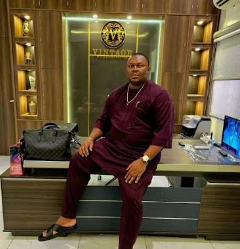
VINTAGE AT 40: I didn’t just become successful, it was intentional
By Charles Kumolu, Deputy Editor
At 40, many people would consider the journey of businessman and entrepreneur, Chief Francis Nwaogwugwu, aka Vintage, a remarkable story of resilience, enterprise and calculated risk. From starting out as a young trader to building a business empire with interests spanning interior decoration, construction, real estate and manufacturing, Vintage has spent two decades navigating the uncertainties of Nigeria’s business environment while steadily expanding his footprint.
As he marks his 40th birthday, Vintage, in this interview, looks back on a journey shaped by the values instilled in him by his parents, particularly hard work, accountability and integrity.
On attaining the age of 40, what does this milestone mean to you, and what are the first thoughts that come to mind as you reflect on the journey so far?
For me, it has been an unimaginable journey so far. Looking at 40, I give God the glory because I never expected to achieve what I have achieved by this age.
My biggest achievement is human empowerment. That is my source of happiness and joy. When I look back at what I have done in my community, outside my community, at my place of work, where I live and in my environment, these are the things that give me boldness and joy at this milestone.
I wouldn’t have imagined that before 40, I would be the first person to construct a proper road in my community. I had never seen a good road there. I saw good roads whenever I travelled to Anambra or went to work, but there had never been a proper road in my community.
I was the first person to construct a 1.5-kilometre road, and I did that when I was just 30 years old. I also have so many graduates who have benefited from my support and foundation, and I believe there is still more to come.
There are people who had lost hope, and with my little resources, I was able to empower them and give them room to hope again. Today, many of them are doing very well in their businesses.
For me, this is my greatest achievement. Of course, the family I have built over the years also gives me joy. I have a beautiful family, and I give God the glory. I have been married for 10 years, and within those 10 years, I have been able to achieve everything I asked God for. It is a thing of joy.
Within these 40 years, can you point out the landmarks that moulded you into who you are today?
I can’t take my parents out of the story. It is said that a child should be trained in the way of God so that he will not depart from it. I always try to give my parents their flowers.
I come from a family that is business-oriented. My parents believed there was no other way to make money than to work. My father was an engineer who owned a factory where he practised mechanical engineering. At the age of 11, or even younger, I started following my father to his factory.
I also have a mother who was a teacher in a government school but, at some point, felt that it was not enough for her. She established a private school while still working at the government school.
I am from a family with a strong hustling spirit. The experiences I had with my parents shaped me into who I am today. I watched my father conduct his transactions every day with tremendous success.
You could give him a job, he would collect your money and tell you, “I will deliver on Sunday.” By the time you came back, your machine would be ready.
He always told me one thing: whatever you do in life, make sure you put in your best.
If you are a shoeshiner, shine shoes well. One day, you may shine the shoes of the President of the country because you have to be at your best.
That is the principle that has guided me. My father also taught me about integrity and accountability. He said it was important to be available and account for whatever you had received.
If you give me a contract and pay me today, I will deliver accordingly. My understanding of accountability is delivering on time according to the agreement. He also taught me integrity.
These are the three things that have guided me over the years: hard work, accountability and integrity.
I started buying and selling as a student in 2006. I started by buying and selling shirts. I have been making money for about 20 years now. That same orientation from my father and mother has guided me all through.
At 40, you are a successful businessman by all metrics. This is happening in an environment that many people consider very difficult. A lot of people see Nigeria as a depressed business environment. What have you done differently?
Like I said, no matter how uncomfortable the environment is for doing business, no matter how difficult or depressed it may be, I still believe in due process. I believe in passion.
People see me today and think I just started. As a student, I had my own business. As a student, Dr ABC Orjiakor, who is the Chairman of Seplat, entrusted a large sum of money to me to execute a project. That was about 20 years ago when I was still a student, and I executed the project to his satisfaction.
I have always been on the ground. I have been in Tejuosho Market since 2011 till date. I believe in process. I didn’t just get here.
I know when I bought my first piece of land in Lagos. I know when I built my first house, my second house, my third house, my fifth house and my sixth house. It has always been a process.
I believe that once you have integrity in what you do, you will succeed. This principle has never failed me.
Whatever uncomfortable process or operating condition exists, you have to factor it into the way you run your business. For instance, if you have to buy diesel to power your factory, everybody understands that the diesel is being purchased to keep the factory running.
If your profit margin is N10, and you remain consistent, maintain proper accountability and exercise discipline in your operations, you can still make money. It may simply take you longer to achieve your desired returns.
The key is to understand the realities of the operating environment and build them into your business model.
The problem comes when you expect the system, simply because it is not working perfectly, to automatically turn you into something else within a short period. That is where people make mistakes.
If you introduce a product to me today, I will look at it and ask myself, “What will this product become in five years?” I am not in a hurry to suddenly make huge profits from the product.
I have always been a process man. But the truth is that people don’t have that patience and understanding.
I know you have Vintage as an interior decoration outfit, which brings fashion into architecture. Tell us more about your business interests…
Vintage is not only into interior decoration. Vintage started with interior decoration, but today, Vintage is a group.
We have a construction firm and we build houses for people. We are currently handling a very massive project for the Enugu State Government, where we are building international markets.
We are also into construction. So, it is not just about interior decoration.
What was actually the trigger for this diversification?
The construction arm of our group has always been there. I read Mechanical Engineering. I didn’t study interior decoration or anything related to it. I studied Mechanical Engineering, and the plan was always to go into construction.
I have a passion for interior decoration, but I have always known that I must eventually come back to what I love doing, which is construction.
When you look at my house, you will see that everything is about luxury, from the interior to the exterior. You have to start from somewhere to get somewhere.
I also have another company that I am unveiling on my birthday, called Vintage After 40, which is about the way forward. We are bringing something big to Nigerians.
We want to introduce a better way to sleep. It is still part of what I do.
Your Lagos story is a success story. Everybody in Lagos has a Lagos story. For people who do not know you or are not familiar with your trajectory, your story might appear to have been a success story all the way. Were there times you faced serious hurdles, and how were you able to overcome them?
At the early stage of my life, I faced serious challenges. To me, challenges are part of our existence. They are there to make you buckle up.
When I came to Lagos for my National Youth Service Corps, NYSC, programme, I did not have any plan of getting a place to stay. I was concentrating on building my business through buying and selling.
During my NYSC days, I was focused on completing my service and raising capital to do what I wanted to do.
At some point, I had an accommodation challenge because my uncle, with whom I was staying, had about four people doing NYSC, including my cousins. I had a home in Onitsha, where my parents lived, so I was not expected to continue adding to the crowd at the time.
What I did was, instead of breaking my head over the accommodation challenge, I got a place of my own.
I knew that returning to Onitsha after my service was not an option. Leaving Lagos was not an option either. So, instead of using the savings I had at the time for my business, I took what you may call a dangerous decision: I got a house.
I rented a three-bedroom flat and moved in. I then got one of my friends to share the flat with me.
My uncle, my mother and others were against the decision. They were worried that I would not be able to sustain it. It was a very difficult decision for me to make, but I had to move.
Even before I found the house, I had gone to LG and started paying for properties. I was no longer thinking about the money I had already saved. I wanted to secure a home in Lagos before concentrating fully on building my business there.
That was one of the biggest decisions I made. Securing a home at such an early stage of my coming to Lagos could easily have been a mistake. I could have gone back to Onitsha. But I knew where I was headed.
The house rent was N650,000. I called someone and asked if we could split the rent and share the flat. I paid for the accommodation and then continued building my business.
So, it wasn’t just a roller coaster?
No, it wasn’t.
When I first started travelling to Dubai to source goods, travelling and getting goods for the first time was also a major challenge. It wasn’t easy for me. But I have always found ways to navigate and overcome certain challenges.
One of the biggest challenges I faced was the fluctuation in the exchange rate. I would buy goods for a particular amount, sell them and then try to restock.
At one point, I bought goods worth $100,000. After selling them, when it was time to convert the proceeds and restock the same $100,000 worth of goods, I discovered that I could no longer raise even $50,000.
That was one of the biggest lessons of my life. It was at that point I understood the extent to which the dollar controls the global market and realised that I could not depend solely on the naira.
That was my biggest lesson.
When we talk about the business environment, this is actually part of it. Most of the things you use in your business are imported. Is there no way to interact with some of the manufacturers of these products to see whether you can actually bring them home?
Some of the things we use, we now produce here. For instance, we produce the beds locally.
When it comes to quality furniture and fabric, I have also started looking at how we can develop a fabric factory here. But it is not a joke. It is going to require a lot, but it is not unachievable.
We have discussed it, and we are working towards it.
Can we know how you are reaching back to lift people you consider to be less privileged, as you grow and succeed?
You might not realise the extent to which you have impacted people’s lives until you reach a milestone like this.
Whatever I do, I do for humanity’s sake. I don’t expect anything from anyone in return.
I build houses for people in my community. I have given out cars in my community, and we are still giving out more.
Last year, we gave out more than 30 tricycles and over 20 motorcycles as part of our empowerment efforts.
I have never said, “This is what my community is going to give back to me,” or, “This is what my old friends are going to give back to me.”
This is simply who I am. Reaching out to people for humanity’s sake gives me personal joy.
What does your traditional responsibility mean to you?
I am a traditional man, and I love my culture. I participate in everything that has to do with our culture, whether at the level of Mbaise, Imo State or Igboland as a whole.
Anything that has to do with culture and tradition, I observe it to the core.
When you come to my place, I am a member of the Igwe’s cabinet. My voice still speaks there at any time. That means a lot to me.
Does it also impose a responsibility on you?
For you to become a clan chief, especially for Mbaise to come together and recognise you as one, is a huge responsibility.
There must be things you have done for Mbaise as a whole for the people to come together and crown you a clan chief.
Were there other people, other giants, that you looked up to while growing up?
My parents were my starting point. They imparted everything to me.
When I got to the university, I looked up to someone, Prof. ABC Orjiakor, who has been my mentor from my university days until now.
He is into oil and gas, and because of him, I have always had it in my head that I would go into that field and also play big.
He has remained one of my mentors, among others.
What is your advice to young people?
Whatever you do in life, put in your best throughout the process. Above all, maintain accountability and integrity.
Once you have these qualities, it is difficult for you to get it wrong.
The post VINTAGE AT 40: I didn’t just become successful, it was intentional appeared first on Vanguard News.