
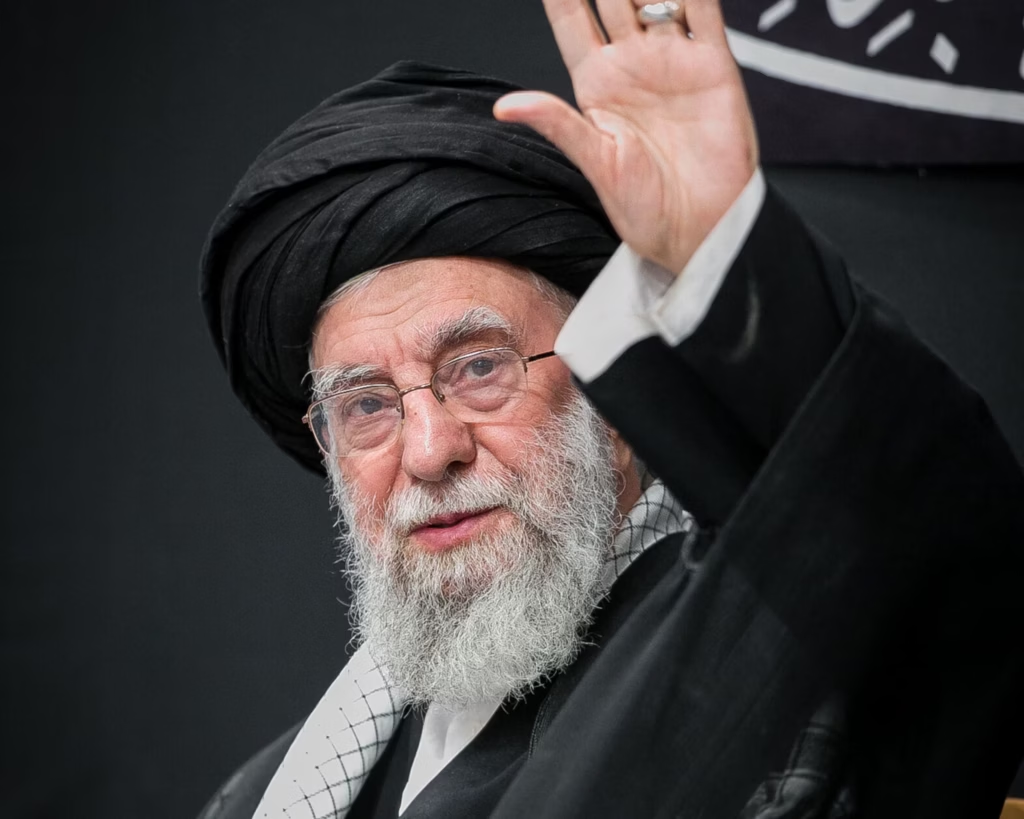
“Operation Epic Fury”: US and Israel Strike Tehran as Rumors Swirl Over Ayatollah Khamenei’s Death
TEHRAN — The Middle East stands on the precipice of a monumental geopolitical shift following a devastating, coordinated military assault on Iran by the United States and Israel.
Early Saturday, February 28, 2026, U.S. and Israeli forces launched “Operation Epic Fury,” an unprecedented wave of precision airstrikes targeting Tehran’s military infrastructure and the highly secure compound of Iran’s Supreme Leader, Ayatollah Ali Khamenei. Now, a fierce battle of narratives is unfolding globally as U.S. and Israeli intelligence presume the 86-year-old Ayatollah is dead, while the Iranian regime frantically denies the claims.
If the Israeli and American intelligence reports prove accurate, Khamenei’s death would throw the Islamic Republic into a severe succession crisis. Having ruled since 1989 with no formally designated successor, his elimination—alongside multiple top IRGC commanders reportedly killed in the initial barrage—could trigger an internal power struggle or a broader regional war. For now, the world waits for definitive proof: either the Iranian regime produces a living Ayatollah Khamenei, or it admits that “Operation Epic Fury” successfully decapitated the Islamic Republic.
The Strike: Decimating the Compound
The joint operation struck deep into the heart of the Islamic Republic.
The Targets: U.S. Central Command confirmed that American forces utilized precision munitions from the air, land, and sea to obliterate Islamic Revolutionary Guard Corps (IRGC) command facilities, air defense systems, and drone launch sites.
The Epicenter: The most critical target was Khamenei’s central compound in Tehran. Satellite imagery released hours after the bombardment shows extensive, catastrophic damage to the Supreme Leader’s offices, triggering immediate global speculation regarding his survival.
Dead or Alive? The Global Intelligence Clash
The fate of the Middle East’s longest-serving head of state remains the biggest question of the hour.
The U.S. and Israeli Assessment: Israeli Prime Minister Benjamin Netanyahu addressed his nation, declaring there are “growing signs that Khamenei is no longer around” and that “all indications show this tyrant is no longer with us.” U.S. President Donald Trump echoed this assessment, telling American media that he feels the reports of Khamenei’s death are correct and that “most of Iran’s senior leadership is gone.”
Iran’s Frantic Denial: In stark contrast, Iranian officials are desperately fighting the “mental warfare.” Iranian Foreign Minister Abbas Araghchi pushed back on the Israeli narratives, telling international networks that the Ayatollah is still alive “as far as I know.” Furthermore, Khamenei’s representatives abroad insist the Supreme Leader is in “good health,” with state media promising an imminent televised address from Khamenei to prove his survival. However, as of Saturday evening, the Ayatollah has yet to make a public appearance.
Trump Urges Regime Change: “Take Over Your Government”
Washington is openly framing the military strikes as an opportunity for the Iranian people to dismantle the current theocracy. President Trump released a video message urging Iranian civilians to rise up amidst the chaos. “When we are finished, take over your government,” Trump stated. “It will be yours to take. This will be probably your only chance for generations.”
Echoes of 1989: How Iran Announces a Supreme Leader’s Death
If Khamenei has indeed fallen, history dictates a very specific, deeply religious protocol for breaking the news to the Iranian public. The regime tightly controls such transitions to prevent power vacuums and civil unrest.
When the Islamic Republic’s founder, Ayatollah Ruhollah Khomeini, died in June 1989, the government did not immediately broadcast the news. Instead, officials secured the political transition behind closed doors first.
The Broadcast Shift: When the time finally came to inform the public, state television and radio abruptly suspended all regular programming. Broadcasters replaced standard shows with continuous, mournful recitations of the Quran.
The Formal Declaration: Following this somber prelude, an emotional news anchor formally declared that the leader’s “righteous spirit has joined his Lord,” sparking days of mass public mourning.
Should the Iranian state confirm Khamenei’s death in the coming hours or days, they will almost certainly replicate this “Khomeini Protocol.” State media will plunge into a sudden blackout followed by Quranic verses, paving the way for a formal declaration by President Masoud Pezeshkian or a senior cleric.
The Constitutional Trigger
Beyond the public announcement, Khamenei’s death would immediately activate Article 111 of the Iranian Constitution.
This article triggers the formation of a provisional three-member council—comprising the President, the head of the Judiciary, and a jurist from the Guardian Council. This emergency trio would temporarily assume the Supreme Leader’s absolute powers to maintain martial order until the Assembly of Experts can rapidly convene to elect a permanent successor.
As the world waits for definitive visual proof of Khamenei’s status, the Islamic Republic faces its most severe existential crisis since the 1979 revolution. Whether Khamenei emerges from a secure bunker to deliver a defiant speech, or state television suddenly cuts to Quranic recitations, the events of February 28 have permanently altered the Middle East.
What Happens Next?
If the Israeli and American intelligence reports prove accurate, Khamenei’s death would throw the Islamic Republic into a severe succession crisis. Having ruled since 1989 with no formally designated successor, his elimination—alongside multiple top IRGC commanders reportedly killed in the initial barrage—could trigger an internal power struggle or a broader regional war.
For now, the world waits for definitive proof: either the Iranian regime produces a living Ayatollah Khamenei, or it admits that “Operation Epic Fury” successfully decapitated the Islamic Republic.