
UNICEF raises alarm over 624,000 out-of-school children
By Musa Ubandawaki, Sokoto
The United Nations Children’s Fund (UNICEF) has raised concerns over the high number of out-of-school children in Sokoto, Kebbi and Zamfara states, disclosing that about 624,000 children have been identified as being outside the classroom across the three states.
The organisation said although about 68,000 children had benefited from interventions to return them to school, the scale of the challenge required urgent government action, increased investment and stronger community mobilisation.
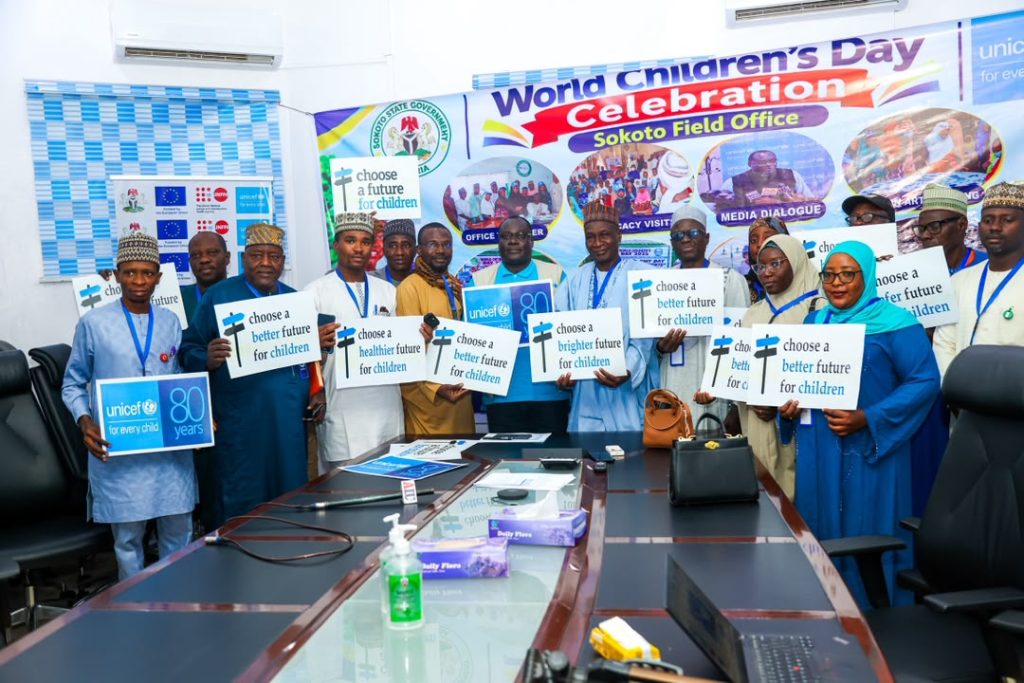
UNICEF’s Chief of Field Office in Sokoto, Dr Michael Juma, made this known at a media briefing organised by the organisation’s Sokoto Field Office as part of activities marking the 2026 World Children’s Day.
He called for coordinated action by governments, media organisations, traditional institutions, religious leaders and community stakeholders to address challenges confronting children in the region.
Juma urged journalists across the three states to intensify public enlightenment, investigative reporting and advocacy to promote children’s rights, strengthen government accountability and ensure access to education, healthcare, nutrition and other essential services.
Describing the media as a critical partner in advancing children’s rights, he said journalists must go beyond reporting events to exposing gaps in service delivery and holding relevant authorities accountable.
“The media are important duty-bearers in advancing children’s rights. Journalists must provide balanced coverage that highlights development achievements while drawing attention to persistent gaps affecting the wellbeing of children,” he said.
He reaffirmed UNICEF’s commitment to strengthening collaboration with the governments of Sokoto, Kebbi and Zamfara, development partners, traditional and religious leaders, and grassroots organisations to guarantee children access to quality and inclusive education, healthcare, adequate nutrition, safe drinking water and social protection.
Providing an account of interventions undertaken through UNICEF’s partnerships with the three state governments, Juma disclosed that approximately 98,000 children had benefited from the Teaching at the Right Level (TaRL) programme, designed to improve foundational literacy and numeracy.
He said the organisation was also supporting teacher professional development, provision of instructional materials, accelerated basic education, integrated Qur’anic education and innovative learning opportunities, including radio-based education and the Nigeria Learning Passport.
According to him, the interventions are particularly targeted at children affected by insecurity, displacement and other emergencies.
On healthcare and immunisation, Juma disclosed that approximately 7.8 million children across the three states had been reached through measles-rubella vaccination, while more than five million children were vaccinated during the last concluded polio immunisation campaign.
He further said Kebbi State had recorded progress in malaria vaccination, with approximately 148,000 children receiving the first dose and 130,000 receiving the second dose.
He stressed that effective healthcare delivery and sustained immunisation campaigns remained essential to reducing preventable childhood deaths and improving children’s survival.
On malnutrition, the UNICEF official commended the Sokoto and Zamfara State Governments for committing approximately N100 million and N500 million respectively towards the procurement of Ready-to-Use Therapeutic Food (RUTF), used in treating children suffering from severe acute malnutrition.
He also acknowledged the Kebbi State Government’s contribution of approximately N540 million towards free medical services for children.
Juma highlighted UNICEF-supported social health insurance interventions, which he said had expanded healthcare access to approximately 86,000 beneficiaries in Zamfara, 18,000 in Sokoto and 10,000 in Kebbi.
In the area of child protection, he said UNICEF had supported the development of child protection legislation, Family Court Rules and social protection policies aimed at strengthening the protection, rehabilitation and reintegration of vulnerable children, including those in conflict with the law.
He also highlighted the establishment of a Special Care Baby Unit in Sokoto, with similar interventions being advanced in Kebbi and Zamfara to improve medical attention for premature and low-birth-weight babies.
Despite the interventions, Juma acknowledged that significant challenges remained, particularly the large number of children still excluded from formal education.
He said the gap between the 624,000 children identified as out of school and the approximately 68,000 reached through re-enrolment efforts required urgent government intervention, increased funding and stronger community participation.
“Identifying these children is only the first step. The real challenge is ensuring that they return to school and remain there to acquire the knowledge and skills necessary for their future,” he said.
Addressing concerns over declining international development funding, Juma explained that the financial challenge was a global development issue and not peculiar to Nigeria.
He said UNICEF was intensifying its resource mobilisation strategies to sustain critical interventions and support state governments, assuring that education programmes across the three states had not been affected by the funding decline experienced earlier in the year.
On the difficulties of delivering services in remote and insecurity-affected communities, he said UNICEF was working through government structures, field facilitators and third-party monitoring arrangements to ensure that interventions reached vulnerable children and women.
He called for stronger coordination at ward and local government levels, stressing that protecting children’s rights was a collective responsibility that should not be left to UNICEF or government institutions alone.
“We need the active participation of government agencies, development partners, civil society organisations, traditional and religious leaders, community structures and parents. Journalists must also use their platforms to educate communities, generate demand for essential services and hold stakeholders accountable for their commitments to children,” he said.
As part of efforts to strengthen media participation, Juma invited journalists to join future field visits to document UNICEF-supported projects and independently assess their impact on vulnerable communities.
He also urged media organisations across the three states to support the December 5 to 11, 2026 polio immunisation campaign through public awareness, pre-campaign mobilisation and community engagement to encourage parents and caregivers to present eligible children for vaccination.
The briefing concluded with a renewed call for collective action as the world marks the 2026 World Children’s Day under the theme, “My Day. My Rights. My Future.”
UNICEF maintained that protecting children’s rights must go beyond policy declarations and public commitments to sustained investment, effective service delivery and measurable accountability, warning that the future of the region depended largely on the commitment of its leaders and communities to protect, educate and empower the next generation.
The post UNICEF raises alarm over 624,000 out-of-school children appeared first on Vanguard News.