
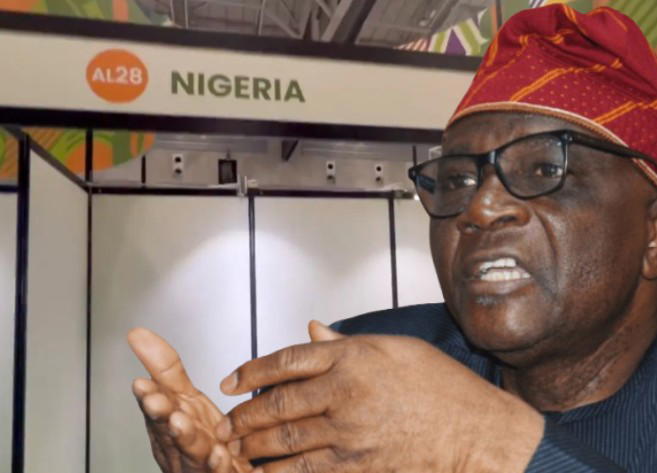
Tinubu’s reforms, temporary pains, lasting gains — Onanuga
*… says APC deserves 2027 benefit of doubt
By Johnbosco Agbakwuru
Mr Bayo Onanuga is Special Adviser to President Bola Tinubu on Information and Strategy. In this interview, he talks about the temporary pains and lasting gains of the Tinubu administration’s reforms. He also speaks on the chances of the All Progressives Congress, APC, in the 2027 elections, as well as state police and the possibility of its implementation before the end of the President’s first four-year tenure.
Excerpts:
The government’s economic reforms appear to be creating hardship for the people. Don’t you think it may affect the ruling APC in the 2027 elections?
Well, I think the message this President, on his own and through the ministers—Finance and others—has been passing on is that there’s no way you can carry out any reform without its attendant pains. This President has been consistent in saying so, consistent in showing empathy and promising to ensure that the gains of the reforms cascade down to the ordinary people.
The President understands the problems of the high cost of living. He is doing a lot to give the vulnerable some relief. Just recently, he launched a $3.5 billion ward-centric programme that will address some of the problems of living and productivity. President Tinubu is optimistic that the pains are temporary and will ease over time.
My advice to Nigerians is to remain positive and look at the bright side of the reforms. If President Tinubu had failed to institute the reforms, the country would have headed for bankruptcy. And there were already signs of the problems when he took over.
People forget that the NNPC, the sole fuel importer, was having problems paying suppliers of refined products. There was fuel scarcity in May 2023. People forget that the CBN was having problems remitting money earned by foreign airlines, about $800 million. We could not fund letters of credit running into over $7 billion, and we had ways and means that had accumulated to about N30 trillion.
Worse was that, contrary to the picture of exchange reserves that Emefiele projected, our net reserve was less than $4 billion. These were signs that we were heading for financial insolvency. President Tinubu had to act fast to save the nation from collapse.
But today, we have moved from the brink of financial collapse. The economy is shaping up well. The country now has $52 billion in reserves. We have a stable exchange rate. We have had trade surpluses since, I think, the third or fourth quarter of 2023. Investors are coming, willing to bet on us.
And if you look at what’s going on with many companies in Nigeria—those which are on the stock exchange—they are making money for their Nigerian investors. When Tinubu came into office, the ASI was about 50,000 points. Today, the All-Share Index has risen more than five times. Our stock market is the best in the world in terms of returns to investors.
Since 2023, we have had NELFUND to help our indigent students; we have introduced free vocational education, with the students given stipends. We have CrediCorp.
Pensioners are being paid about 10 times what they were getting before. Those workers Atiku cast into the cold after selling government companies and assets are now being paid by the Tinubu government. These are the bright sides of the administration.
Yes, the government removed fuel subsidy. But the same government introduced a cheaper, indeed five times cheaper, fuel, Compressed Natural Gas, CNG. Many commercial buses and taxis have converted, and I can tell you that many of them, even though they have not transferred the benefits they enjoy to their passengers, have really benefited from the introduction of CNG and reduced operating costs.
One of my cars is also running on CNG, and I am happier for it in terms of saved costs. So many positive things are going on.
There are other things the government has done, increasing the minimum wage, for instance, reducing the cost of kidney treatment for people who have kidney problems, and so on.
And then you find even at the state level, governors are doing all kinds of empowerment programmes, distributing foodstuffs to vulnerable people. The Ministry of Humanitarian Affairs is also spending billions of naira sending money to vulnerable Nigerians. I think the last time, about eight million households or so were sent money.
So many things are being done because the government realises it has a responsibility to protect the vulnerable in society.
With the high cost of living arising from the reforms, even though there appears to be light at the end of the tunnel, do you think the APC has a chance in 2027?
Well, I think people will look at the balance sheet and compare the bright sides with the temporary pains. They’ve seen the positive side of the reforms, even though, as I say, they have unintended effects.
But I think they will weigh the party on the balance and say, “Oh, yeah, we have some difficulties. But we are hopeful that the challenges will go away.” The reforms are yielding many positive signals, which many international organisations have acknowledged.
Even recently, the outgoing British High Commissioner praised Nigeria, saying we are carrying out reforms that will engender prosperity. Nigeria is being praised as an exemplar in the way the reforms are being implemented.
So I believe that, at the end of the day, people will be able to evaluate the merits of the reforms vis-à-vis the temporary pains that we are going through, and I think they will give the party the benefit—and the President the benefit—of the doubt.
Yeah, there have been problems, but what they are seeing at the end of the tunnel is a lot of light.
And besides, what you find is that the people who are power-hungry now, who want to topple this government, I have never heard them saying, “Oh, this is what we are going to do. This is the alternative policy.”
When they ask Atiku Abubakar, “What is he going to do differently from what Mr President is doing now?” he said, “We will change everything.” Is it going to bring back subsidy? Is he going to reverse or take us back to the era of multiple exchange rates, or what’s he going to do?
None of them, including the talkative Peter (Obi), has released a manifesto. Obi was asked recently what he was going to do about foreign exchange. He rambled and rambled, and ended up saying nothing.
None of these pretenders to the throne has any alternative programme, any viable programme to suggest that they can really run this country better than the incumbent.
You recently said that if Tinubu gets another four years, each state can be a development centre. Can you throw more light on what he meant by that?
What that means is that what this government has done in freeing up resources to the subnationals is that anywhere you go, all the states—especially all the states—so much work is going on there.
Before President Tinubu took over in May 2023, about 27 states were unable to pay salaries. One governor told us recently that in his own state, after paying salaries, what was left was barely about N100 million, which could do nothing.
But today, most of those states are building roads and hospitals; some of them are even building factories to process the raw materials produced in the state, and that way they are creating jobs.
At the subnational level, states are no longer salary-paying centres; they are becoming development centres. That’s what I meant.
With the way things are going, as we deepen the fiscal federalism that we have now, the states are going to get much, much busier than they are now, and they are going to embark on many development programmes.
Some people had expected, because of the position of some Christian leaders in the North, that the 2027 presidential ticket would have a balance of faith, a Muslim-Christian ticket, but it appears the President was not thinking in that direction, and recently he announced his incumbent Vice President as his running mate. What do you think may have influenced that?
You know, in 2023, the President said he didn’t pick Shettima because he’s a Muslim; that position has not changed. People should begin to look at our country beyond religion.
I think we are, first of all, human beings. We are Nigerians before we become either Muslim or Christian. So Shettima is not being picked as a Muslim; he’s being picked as a Nigerian who has a lot to offer.
If you look at it, all those fear-mongering claims the opposition was making—that we are going to Islamise Nigeria—have not happened. Nothing has changed. People are free to uphold their religion, and all these fears about Islamisation are just mere propaganda.
It has never happened, and Christians are practising their religion, Muslims are doing their own, and nobody is being disturbed from practising their faith.
So, as I said, the choice of Shettima is not because he’s a Muslim, but because he has something to offer, and so far he has proven that in the last three years as an able, reliable and very efficient second-in-command.
Some people also expected Mr President to remove some of the ministers who are not performing well because he has an agenda, and some ministers are not helping to translate the agenda into reality.
You have to be specific. Which minister?
Do you think that the ministers are doing well?
Well, if they are not doing well, the President would have removed them. But what I know is that he has not told me that he has a minister who is not performing well.
How can you assess the performance of the ministers of this government?
I’m not their employer. I’m not the person who appointed them. But what I know is that if there’s anyone that you know is not up to the task, let us know.
The issue of state police: Is it possible to implement it before the end of the first four-year tenure of Mr President?
I think it’s possible, given the enthusiasm the states and the National Assembly have shown. We can’t solve the problem of insecurity if we don’t have the states commanding some forces of their own.
Look at the possibility it provides. Number one, it would create jobs for our people, and if every state assembles, say, 10,000 state policemen—multiply it—there are 360,000 jobs that we are going to create easily.
I think, given the enthusiasm that the idea has generated, the states have shown that they are ready once it passes through all this constitutional crucible.
It is irresponsible for some people to link state police with the upcoming election. Our security is more important.
For long, we noticed the lacuna in our present security arrangement. You call the governors chief security officers of their states and they have no troops.
The commissioners of police in their states report to Abuja, and not to the man who’s supposed to be the chief security officer. So this state policing may correct all that.
And I’ve asked some governors, are they ready to fund it? They said yes, that they can fund it, and the President also believes that the resources going to the states under his watch will enable the states to fund state police.
If they need any help, of course they will go to the President and say they need some help. But I don’t see anything stopping it. The election is still six months away. It can happen before the election, or it can happen thereafter.
The President has given enough money to states as a result of subsidy removal, but the states—especially the state governors—are not allowing local government areas to breathe. This issue of local government autonomy: given the enthusiasm shown for state police, is the Federal Government ready to show the same kind of enthusiasm to ensure that local government autonomy is 100 per cent implemented, not haphazardly?
There is a court order that the councils should operate with financial autonomy. We admit that the implementation has been a bit slow, but I think we shall overcome very, very soon. That’s all I have to say.
Any timeframe?
I cannot give a timeframe, but I know that the court order is available that says give the councils financial autonomy.
And some governments—I learned that just last week the Benue governor said, in his own state, he has allowed some autonomy to the council chairmen.
I’m sure many states are beginning to realise why the councils have to be empowered, why we need to allow them to operate, because there are so many ungoverned spaces in our country.
You can go to many councils; the chairman is not in the council; he is either in the capital of the state or in Abuja. We cannot allow this to continue.
So I think everybody is realising that we must give effect to the Supreme Court judgment that the councils must be allowed some financial autonomy.
There was a time Mr President advised state governors to remain in their states to govern, so that people would feel the impact of governance in the state. But it appears the majority of the governors are not obeying that advice. A good number of them are always in Abuja. Is there any way that order or advice from the President could be implemented?
I’m not aware he gave them any order to that effect. I think that is something the people of the state should do.
If their governor is spending more time in Abuja than in the state, they should call him out. That’s my own advice.
Quote: “Well, if they are not doing well, the President would have removed them. But what I know is that he has not told me that he has a minister who is not performing well”
The post Tinubu’s reforms, temporary pains, lasting gains — Onanuga appeared first on Vanguard News.