
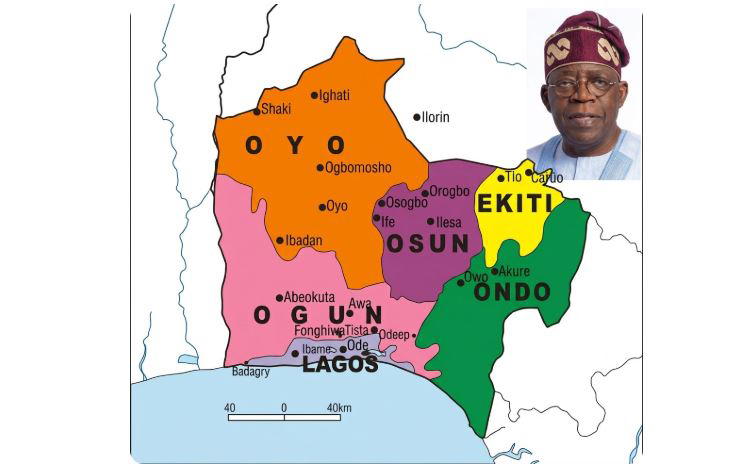
South-West 2027: Can opposition parties breach Tinubu’s political fortress?
By Dayo Johnson, Olasunkanmi Akoni, Rotimi Ojomoyela, Shina Abubakar, James Ogunnnaike & Adeola Badru
By 2027, the battle for the South-West may be less about winning over a hostile electorate and more about whether opposition parties can dismantle an entrenched political network built around President Bola Ahmed Tinubu.
Read Also: I got first private jet at 22 — Dangote
The prominence of South-West politicians in his campaign structure offers a revealing glimpse into how the ruling APC could approach the region. But the crisis in some of the state has become the party’s albatross.
The South-West has long been regarded as the political heartland of President Bola Ahmed Tinubu, but ahead of the 2027 general elections, the region is shaping up to become one of the most closely watched theatres in Nigeria’s political contest.
At the centre of the emerging battle is a fundamental question: can opposition parties penetrate a political territory where Tinubu has cultivated deep networks over decades and where several influential South-West political figures occupy strategic positions in the 2027 campaign structure?
The composition of Tinubu’s campaign team offers an important clue to the answer. The inclusion of prominent South-West politicians and strategists across key positions suggests that the President’s 2027 political machinery is not merely being assembled to prosecute an election.
It is also being positioned to consolidate influence in a region where political loyalties, elite networks, grassroots structures and personal relationships have historically played decisive roles.
South-West reps in Presidential Campaign Council
Names from the South-West region in the 2027 presidential campaign council include, the state governors, Governor Babatunde Fashola, will serve as the Zonal Coordinator for stakeholders’ mobilisation, two ministers, Hon Olubunmi Tunji-Ojo will serve as the Deputy Director Security and Intelligence while the youth development Minister, Hon Ayodele Olawande was appointed as the Director Youth Mobilisation.
Deputy Director General South II — Sen. Bamidele Opeyemi, Deputy Director General Admin — Rt. Hon. Femi Gbajabiamila Deputy Director General Election Planning, Coordination and Monitoring — Hon. James Abiodun Faleke.
Other notable personalities in the South-West figures in the campaign structure are former Osun State Governor, Chief Bisi Akande, and veteran journalist and former Ogun State Governor, Chief Segun Osoba, both serving as members of the Campaign Council’s body of advisers. They were appointed as advisers to the Chairman, President Bola Tinubu.
Akande remains an influential figure in the political evolution of the South-West, particularly within the progressive political tradition that ultimately produced the All Progressives Congress.
Osoba, meanwhile, brings decades of political experience and an extensive network developed through Ogun State politics and national engagements.
Their roles as advisers place institutional memory and political experience around the campaign at a time when the APC will be seeking to defend its dominance across much of the region.
But the South-West presence does not stop at the advisory level. Senator Opeyemi Bamidele, the Senate Majority Leader, has been assigned to support the Deputy Director-General role for the southern zone, placing another prominent politician from the region at a critical point in the campaign’s operational structure.
Also occupying an important position is Senator Ajibola Basiru, the APC National Secretary, who serves as Deputy Secretary of the campaign council.
Then there is Femi Gbajabiamila, one of Tinubu’s most trusted political associates and a former Speaker of the House of Representatives, who oversees administration as a key deputy director-general and leader within the campaign structure.
Gbajabiamila’s importance goes beyond his formal designation. His political journey, particularly his years in Lagos politics alongside Tinubu, gives him an understanding of the organisational architecture that has helped sustain the President’s political influence.
James Abiodun Faleke, another Lagos-based political heavyweight, has been assigned responsibility as Deputy Director-General for Election Planning, Coordination, and Monitoring.
That portfolio could prove particularly consequential. Election planning and coordination are among the most sensitive components of any modern political campaign.
They involve the translation of political popularity into organisational strength: identifying voters, mobilising supporters, coordinating party structures, monitoring electoral processes and ensuring that the campaign’s political reach extends beyond major cities into wards and polling units.
Faleke’s inclusion therefore gives the South-West another influential hand at the operational end of the campaign.
And perhaps equally important in an election increasingly shaped by information, perception and digital communication is Dele Alake, a prominent member of Tinubu’s political establishment and former Lagos commissioner, who occupies a key strategic communication and media role.
Alake’s presence underscores another reality of the 2027 contest: political battles are no longer fought solely through rallies and traditional party structures.
They are equally fought through narratives, media platforms, social media and the ability of campaigns to define the meaning of government policies in the minds of voters.
Taken together, these appointments reveal a campaign structure in which South-West political experience is represented across advisory, administrative, electoral, organisational and communication functions.
That breadth matters
The Zonal Director Election Planning Coordination and Mobilisation-SW — Sen. Olushola Adeyeye, Director Legal — Muiz Adeyemi Banire, SAN,, coordinating Director Media/Strategic Communication, III — Bayo Onanuga, coordinating Director Media/Strategic Communication, IV — Lanre Isa Onilu, coordinating Deputy Director Media/Strategic Communication, I — Tunde Rahman, coordinating Deputy Director Media/Strategic Communication, II — Sunday Dare
Zonal Director Youth Mobilisation SW — Moyosore Ogunlewe, Deputy Director Women Mobilisation II — Sen. Abiodun Olujimi
The Deputy Director Financial and Tech Services Sector Mobilisation II — Adeyemi Daniel Adeboyejo, Director Extractive Industry Sector Mobilisation — Dele Alake, director Education Sector Mobilisation — Dr Maruf Tunji Alausa, Zonal Coordinator Support Group Coordination SW — Hon. Akinlade Abiodun Isiaq, Deputy Director Special Duties II — Bibopere Ajube, secretary Stakeholder’s Mobilisation I — Chief Mutiu Are
Sen. Teslim Folarin, was appointed the zonal Secretary for Stakeholder’s Mobilisation SW,
Mobilisation I — Oluwajomiloju Fayose.
For Stakeholder’s Mobilisation, former deputy governor, Yomi Awoniyi, former governor. Niyi Adebayo, former governor Isiaka Oyetola, senator Gbenga Daniel and Bunmi Onabanjo
For security Femi Adekanbi (SW), contact Mobilisation, former governor Akinwumi Ambode, Sen. Tokunbo Afikuyomi, Yinka Agboola and Hafiz Oladejo, were appointed.
For Parliamentary Mobilisation, Rt. Hon Dimeji Bankole CFR (Fmr Speaker House of Representative) and Sen. Smart Adeyemi, were appointed while Lateef Olasunkanmi Fagbemi, SAN, was appointed as legal adviser.
More than regional symbolism
It would be tempting to interpret the presence of these figures simply as a reward for loyalty or an attempt to project regional inclusion. But such an interpretation would overlook the strategic implications.
The South-West is not merely another geopolitical zone for Tinubu. It is the political environment in which his career was built.
From Lagos, where his political machinery became one of the most formidable in Nigeria, to the broader South-West progressive political tradition, Tinubu’s political rise has been closely connected to the region’s political networks.
That history gives the President a structural advantage that opposition parties may find difficult to neutralise.
Political organisations are built over time. They depend on relationships between party leaders, elected officials, traditional institutions, community influencers, grassroots organisers, business interests and ordinary voters.
In this regard, the presence of experienced South-West politicians around Tinubu’s campaign is potentially more important than the titles attached to their positions.
They represent networks. They represent institutional memory. They understand the political terrain.And, crucially, many of them understand the language of the region’s politics. This could give the APC an advantage as the 2027 contest intensifies.
But is the South-West still politically impenetrable?
Yet, writing off the opposition in the South-West would be equally premature. Political strongholds are rarely permanent.
The region has demonstrated repeatedly that voters can surprise political establishments when economic conditions, internal party conflicts, candidate quality or local grievances become sufficiently influential.
The APC’s strength in the South-West also contains vulnerabilities. The most obvious is the difference between political loyalty to Tinubu and satisfaction with his administration.
The two are not necessarily the same. A voter may have strong historical or political affinity with Tinubu while simultaneously expressing dissatisfaction with inflation, unemployment, insecurity, electricity challenges, food prices or the general cost of living.
This is where the opposition parties may seek an opening. Their challenge, however, will be converting dissatisfaction into votes.
That requires more than criticising the Federal Government. It requires credible candidates, coherent policy alternatives, disciplined party structures and the ability to establish grassroots networks capable of competing with the APC’s formidable machinery.
The opposition’s difficult assignment
For opposition parties hoping to penetrate the South-West, the task is complicated by the fragmentation of the opposition itself.
Rather than confronting the APC through one unified political platform, opposition forces are likely to operate across several parties, each with its own ambitions, candidates and political structures.
This fragmentation could work to the advantage of the ruling party. If opposition votes are divided among multiple candidates, the APC could retain significant electoral advantages even where dissatisfaction with the government exists.
The real question, therefore, is not simply whether there is discontent in the South-West. It is whether opposition parties can organise that discontent into a coherent political movement. And that is a considerably harder task.
Lagos: The ultimate test
Nowhere will the contest be more symbolically important than Lagos. The state has been central to Tinubu’s political identity and remains one of the APC’s strongest electoral bases.
Any opposition party seeking to demonstrate that the President’s political fortress can be breached will have to make a serious showing in Lagos.
But defeating the APC there would require overcoming a political organisation that has evolved over decades.
The opposition would need to penetrate not only the urban electorate but also the intricate ward-level structures through which elections are mobilised.
The same challenge applies, albeit in different forms, across Ogun, Osun, Oyo, Ondo and Ekiti states.
Each state has its own political dynamics, personalities and grievances. This means that a successful opposition strategy cannot simply be built around a single anti-Tinubu message. It must recognise the differences within the South-West itself.
Oyo and Osun could provide interesting battlegrounds
Oyo and Osun, in particular, could provide important tests of whether the APC’s regional dominance can be challenged.
Both states have strong political traditions and electorates capable of making independent choices.
Osun’s political environment has often been fiercely competitive, while Oyo has witnessed significant shifts in political allegiance over the years.
For opposition parties, these states could offer opportunities to build narratives around local governance, economic hardship and dissatisfaction with the ruling establishment.
But the APC will equally be seeking to deploy its own networks and national political influence to retain its position.
The presence of figures such as Akande and Osoba in the broader campaign structure could therefore become important in a region where personal relationships and political history remain significant.
The Tinubu factor
Ultimately, the 2027 South-West contest will be heavily influenced by one factor that no opposition strategy can ignore: Tinubu himself.
The President is not entering the region as an ordinary incumbent seeking re-election. He is a politician whose political identity is deeply intertwined with the South-West.
His supporters can point to his decades of political investment in the region, while his opponents can point to the economic difficulties confronting Nigerians under his administration.
The election will therefore become, in part, a referendum on whether Tinubu’s political legacy and regional connection remain stronger than the frustrations generated by the realities of governance.
The South-West figures surrounding his campaign are positioned to help make that case. Akande and Osoba offer experience and political history. Bamidele and Basiru provide legislative and party machinery.
Gbajabiamila brings organisational experience and longstanding political association. Faleke offers election planning and coordination, while Alake brings strategic communication and media expertise. It is a formidable combination.
A battle of structures and narratives
The opposition’s best chance may therefore lie in fighting the election on two fronts simultaneously.
First, it must challenge the APC’s political structures.
Second, it must challenge the narrative surrounding Tinubu’s presidency.
If opposition parties focus exclusively on the latter without building the former, their criticisms may generate public attention without translating into electoral gains.
Conversely, a strong grassroots structure without a compelling national message may struggle to overcome the President’s incumbency advantage.
The APC understands this equation, which is perhaps why the emerging campaign structure combines political veterans with figures responsible for election planning, administration and communication.
The message is clear: the battle is expected to be fought as much at the organisational level as at the level of public opinion.
What 2027 could ultimately reveal
The South-West is therefore likely to emerge as one of the defining political battlegrounds of the 2027 presidential election.
Tinubu’s extensive political network gives him an obvious head start, while the presence of prominent South-West figures in his campaign structure demonstrates an attempt to convert that historical advantage into an organised electoral machine.
But political history also teaches that no electoral fortress is completely impregnable. Economic conditions can alter loyalties. New alliances can reshape political calculations. Candidates can outperform expectations.
Internal divisions can weaken established parties, while a sufficiently compelling opposition coalition can transform voter dissatisfaction into electoral change.
For the opposition, the challenge is formidable but not impossible. To penetrate Tinubu’s South-West base, it will need to convince voters that the election should be decided not by political history, regional identity or longstanding allegiance, but by the quality of leadership Nigerians want for the next four years.
For Tinubu and the APC, the task is equally clear: demonstrate that the political capital accumulated over decades still commands the loyalty of the region, while persuading voters that the administration’s policies justify another mandate.
That makes the South-West’s 2027 contest much more than a regional struggle. It could become a referendum on the durability of political loyalty in an era of economic pressure, changing voter expectations and increasingly competitive electoral politics.
And with some of the region’s most experienced political figures already embedded in Tinubu’s campaign architecture, the opposition will have to do far more than enter the South-West. It will have to find a way through the fortress.
Former Ondo SDP chairman, Hon Stephen Adewale said that ” the large number of South-West figures in President Tinubu’s campaign council certainly gives him a formidable political structure, but elections are decided by voters, not by the size of a campaign council. The South-West electorate is politically sophisticated and cannot be treated as a permanent voting bloc for any individual or party. In 2023, Tinubu lost Lagos and Osun, despite his deep political roots in the region. That alone shows that his home base is open to competition.
Can opposition penetrate South-West
The opposition can penetrate the South-West, especially if economic hardship and dissatisfaction with the government persist. However, public frustration by itself will not win an election. The opposition needs a credible candidate, a united platform, strong grassroots structures and polling agents capable of protecting its votes. Therefore, penetration is possible, but dislodging Tinubu across the entire South-West will be difficult. The more realistic contest may be over how many states the opposition can win and how substantially it can reduce his overall margin in the region.
Rt Hon Bakkita Bello, former Speaker, Ondo state House of Assembly and Secretary of Ondo state Afenifere says “Oftentimes, extraneous factors and issues, well beyond the capacity management of party strategists and loyalists, do unexpectedly impact unwholesomely on the outcomes of buildups to Party campaigns and subsequent elections.”
The strength, spread and effectiveness of the campaign machinery of the opposition parties, will determine how far they will or can unsettle the President’s team in the South West.
The President’s Campaign Council, as constituted, is a heavy deployment of formidable Party men and women, holding key Party or Government positions, not only in the South West, but across the board in the other five geopolitical zones of the country.
The implications could be far-reaching, and enormous, and worse still, capable of resulting in a blowout win for the President and the APC, over a disunited opposition, many of whom today, are still grappling with internal cohesion issues, and/or litigations over controversial Primaries, or, in some cases, Party leadership legitimacy!
In spite of vote buying and financial inducement during elections, hunger, insecurity, economic bleeding and general hopelessness, may as yet penetrate deeper than the reach of the opposition Parties, thus causing voter apathy and an anti-establishment backlash.
The President and his government, as well as the opposition Parties, still have a lot of work to do, if they desire to change the mood of the nation, by reaching out to the people more meaningfully and positively than hitherto, all before the forthcoming General Elections.
‘Every region represented in Coincil’
A public analyst, Ayo Fadaka said that “Firstly, I think every part of Nigeria is adequately represented the recently constituted Campaign Council. So it’s not about the preponderance of Yoruba people over others in the arrangement.
However, I want to believe that that it is only President Bola Tinubu that is contesting the Presidential election from the South West, though I am not totally discarding the fact that there are a number of fringe candidates, equally representing a number of mushroom parties, they should be regarded as mere discounts that will certainly not affect the prospect of a good outing for the President in the South West.
They are not taken serious by the people, one of them is perceived as a complete protestant whose world view does not align with the current political realities on ground, another is a very deep economic strategist who in spite of his technocratic credentials is completely disconnected from the electorate, while yet another, a beautiful politician with good credentials and achievements is not perceived to be ripe for the Presidency and cannot convince the South West to take more than a cursory glance at him, none of them towers above Tinubu in the region.
President Bola Tinubu must win the election massively in the South West as that must be his launching pad for ultimate victory, however I see a little challenge from some undisciplined elements within the Party that are intent on prosecuting anti-Party actions, they must be checkmated forthwith, and firmly too, there is enough time to do that now, and action must be taken with dispatch.
The quality of opposition that once confronted Tinubu in the South West has since watered down, what is left can cause no damage, but actions must still be prosecuted towards generating a massive win for the President.
Potential vulnerability – Former Ekiti commissioner
A former Commissioner in Ekiti State, Lanre Ogunsuyi, described the large number of South-West political figures in Tinubu’s 2027 campaign council as both an electoral opportunity and a potential vulnerability for the ruling All Progressive Congress, APC.
Ogunsuyi said Tinubu was conscious of the strategic importance of the South-West to his re-election bid, stressing that the region could serve not merely as the President’s political home base but as a major reservoir of votes for the APC.
He pointed to the party’s reported mobilisation target of 10 million votes in the South-West, saying such an ambition showed that the APC was not merely seeking to ensure that Tinubu won his home region but wanted to turn the six-state region into a massive vote bank capable of compensating for potential vulnerabilities elsewhere.
His words, “The large number of political bigwigs from South West in Tinubu’s 2027 Electoral Campaign Council can both be an electoral advantage and a potential vulnerability. The more important question is whether those figures can convert elite political support into actual pluralistic votes at what level.
“But it must be understood that Tinubu knows that his home region is strategically indispensable. The APC currently controls Lagos, Ogun, Ekiti and Ondo while Oyo is PDP-controlled and Osun political situation is becoming more fluid.
“It is also about political ownership, not merely symbolism. APC’s own mobilization target is according to the Senate Leader, Opeyemi Bamidele, 10 million votes that tells you how the APC is thinking about the region not merely Tinubu should win his own region but that the southwest should be the the portfolio of massive vote banks that will compensate for vulnerabilities from elsewhere.
“The appointments are also about managing internal disputes in the South West. The region is not politically homogeneous, lagos political politics is different from Oyo, Osun and elsewhere.
“Can the opposition penetrate Southwest? Yes, but penetrating the southwest is much easier than taking the southwest, that is the distinction that we must fully understand. If Tinubu wins three or four southwest states and the opposition substantially reduces his votes here in lagos or Oyo; it is already evidence that the region simply cannot be treated as an automatic APC possession politically.”
On his part, the Secretary of Ekiti Council of Elders, Niyi Ajibulu said oppositions seeking to make significant inroads into the South-West against President Bola Tinubu in the 2027 general elections are prone to experiencing uphill tasks.
Ajibulu explained that the political strength enjoyed by Tinubu in the region, coupled with his administration’s reforms and performance, would make it difficult for opposition parties to dislodge the President’s influence in the South-West.
The Secretary stressed that the apparent strength of Tinubu and the support he enjoys in the region should not lead to complacency, urging members of his campaign council to remain conscious of the need to consolidate their support across the country.
“I don’t think it should take chances though, honestly. You see the way we are playing our politics in Nigeria, I don’t think anybody should take chances.
“As far as I’m concerned, I think it’s prerogative. The one we know is in weak areas and strong areas. So, the prerogative of picking a campaign council is basically on him and his team.
“With his performances so far and his reforms, I don’t think it should be easy for his opponent to penetrate the Southwest that easily.”
Mr. Adebare Olufemi, Political Analyst
“First and foremost, the fact that the “think-tank” and political advisers of President Bola Ahmed Tinubu allowed the APC Presidential Campaign Committee to comprise more than 70 members from Yorubaland clearly indicates that the Nigerian political landscape is still struggling to free itself from the ethnocentric tendencies that contributed to the crisis of 1966, which eventually snowballed into the Nigerian Civil War of 1967–1970.
“This development speaks volumes about the thinking and calculations that may have informed Mr. President’s decision, particularly as he seeks a second term in office.
“I must also point out that such a disproportionate ethnic representation could be interpreted as a reflection of a lack of trust in other members of the APC who are not from Yorubaland. This perceived lack of trust may not be entirely unconnected with the growing agitation in parts of Northern Nigeria, where some groups are already calling on Mr. President to vacate office after his first term.
“Beyond the issue of trust within the party and the agitation in the North for a return of power to the region, there is also the familiar concern about the cost of running what many Nigerians perceive as a wasteful administration. A substantial number of members of the Nigerian elite have accused the ruling party of being insensitive to the economic hardship and difficulties confronting ordinary Nigerians.
“A Presidential Campaign Committee of more than 230 members is, in my view, unnecessarily large. Such a structure only reinforces the perception that Nigeria continues to operate an excessively expensive presidential system of government.”
On whether opposition politicians can penetrate the South-Western electorate: “The real issue to bear in mind is that voters in South-Western Nigeria are among the most politically sophisticated in the country. Once they make up their minds about a particular candidate, there is often very little room for political gimmicks to change their position.
“South-Western voters are generally difficult to manipulate, even after they have been mobilised or offered financial inducements. Therefore, irrespective of political rhetoric and sweet promises, voters in the region tend to consider the values, competence, character and overall worth of the individual personalities seeking elective office.
“Consequently, if the expected block votes for Mr. President are to be properly analysed, the analysis should not be based solely on the assumption that the South-West will automatically vote as a bloc for him.
“Another important factor is that, by all indications, opposition politicians have already made inroads into the President’s expected block of votes in the South-West. This is particularly significant given that the outgoing Governor of Oyo State, Engr. Seyi Makinde, is expected to contest against Mr. President from the same region.
“Ultimately, factors relating to the individual personalities, credibility, competence and track records of candidates seeking elective positions will undoubtedly come into play. The electorate should therefore not be viewed simply as a predetermined voting bloc. Their decisions are likely to be influenced by a combination of political performance, individual candidates, prevailing circumstances and the issues that matter most to them at the time of the election.
Moruff Balogun Esq.
For Moruff Balogun Esq., a legal practitioner and former Vice Chairman, NBA Ijebu-Ode Branch, Ogun State, “From both a legal and political standpoint, the constitution of the committee falls within the constitutional framework governing freedom of association under Section 40 of the 1999 Constitution. Legally, therefore, there is nothing inherently unlawful about the APC establishing such a campaign structure.
“However, the composition and size of the committee reveal, in my humble view, at least three strategic legal-political objectives:
- Consolidation of the Electoral College Base
“Under Section 134(2) of the 1999 Constitution, a presidential candidate must secure the majority of votes cast and not less than one-quarter of the votes cast in at least two-thirds of all the States of the Federation and the Federal Capital Territory, where applicable under the constitutional formula.
“The South-West comprises six States. By deliberately strengthening its political structure across the region, the APC is seeking to consolidate a significant portion of the geographical spread and voting strength required for victory. In political terms, this amounts to early risk mitigation and the protection of its traditional electoral base.
- Deployment of Political Structure as an Electoral Asset
“The electoral process places considerable importance on party organisation, voter mobilisation, polling-unit coverage, and the deployment of duly accredited party agents. The 70-member committee, comprising traditional rulers, party leaders, elected officials, and other influential stakeholders, appears designed to strengthen the party’s grassroots presence and coordination across the region.
“In that sense, what politicians ordinarily describe as “political structure” is being transformed into an organised and visible electoral machinery.
- Pre-emption of Internal Party Disputes
“A fractured political base can create significant difficulties before and during an election, including internal disputes, competing interests, and litigation.
“By bringing together different political tendencies and influential stakeholders within the South-West, the APC appears to be attempting to minimise internal disagreements and create a more unified platform ahead of 2027. Whether that strategy will succeed, however, will ultimately depend on how effectively the interests of the various stakeholders are managed.
“As a lawyer, my view is that it is legally feasible, although politically difficult.
Legal and Political Factors Working in APC’s Favour
- Incumbency and Executive Advantage
“The advantage of incumbency cannot be ignored. The Federal Government controls significant appointments, public policy, and the implementation of federal programmes and projects. These realities give the incumbent party considerable political visibility and an opportunity to present the administration’s achievements to the electorate.
“However, such advantages do not constitutionally guarantee electoral victory. Ultimately, the electorate retains the power to accept or reject the incumbent at the ballot box.
- Established Party Structure
“With APC controlling the government in a substantial number of South-West States, the party possesses an extensive network of elected officials, party leaders, grassroots organisers, and political actors.
“This gives the party a considerable advantage in voter mobilisation, election-day coordination, monitoring, and party-agent deployment.
- Regional and Ethnic Sentiments
“Regional solidarity and appeals to shared identity are not, in themselves, unlawful. Although Section 42 of the 1999 Constitution prohibits discrimination on specified grounds, political appeals based on regional identity, shared heritage, or the argument that a candidate is “one of our own” remain powerful features of democratic politics.
“The effectiveness of such appeals, however, depends ultimately on the mood and priorities of the electorate.
Political Openings Available to the Opposition
- Economic Hardship and the Politics of Performance
“The Constitution recognises the welfare and security of citizens as fundamental objectives of government under Section 14(2)(b).
“If the electorate perceives that the government has failed to adequately address economic hardship, insecurity, unemployment, inflation, or the rising cost of living, those concerns can become powerful drivers of electoral change.
“In particular, urban voters in Lagos, Ogun, Oyo, and other major centres may place economic realities above traditional political loyalties.
- Quality of Candidates and Manifestos
“If opposition parties present candidates who satisfy the constitutional requirements for election and offer credible programmes capable of addressing the concerns of Nigerians, there is nothing in law preventing voters from changing their political allegiance.
“In a democracy, the people are the ultimate arbiters of political power. They determine who governs through the ballot.
- Internal APC Tensions
“The larger and more diverse a political structure becomes, the greater the possibility of competing interests within it.
“A 70-member committee may therefore strengthen APC’s structure, but it can also create competing expectations and, where grievances arise, the possibility of internal disputes and litigation. If such disputes are poorly managed, they could weaken the very structure the committee was created to consolidate
“The opposition can legally and politically penetrate the South-West. However, it will require more than criticism of the incumbent.
“It will require credible candidates, a compelling message, effective grassroots organisation, and a broader coalition capable of satisfying the constitutional requirements for presidential victory.
“Elections are ultimately determined by voters, not campaign committees.
“A significant shift in voter preference remains possible and, in my humble view, will depend principally on three democratic variables:
- Government Performance
“The primary purpose of government includes the promotion of the welfare and security of the people.
“If, by 2027, voters do not perceive meaningful improvements in the economy, security, employment opportunities, purchasing power, and the general cost of living, they may use their constitutional and democratic power to vote for change.
- Credibility of the Electoral Process
“The credibility of the electoral process will be crucial. The effective deployment of technologies such as BVAS and the electronic transmission and publication of election results, together with transparent procedures by INEC, can strengthen public confidence in the electoral process.
“If the election is substantially free, fair, transparent, and credible, voter sentiment can translate into electoral outcomes irrespective of the strength of any political structure.
- Quality of Opposition and Ballot Choices
“Under Sections 131–134 of the 1999 Constitution, the constitutional requirements for presidential election remain central to the contest.
“A strong opposition candidate with broad national appeal—and particularly one capable of attracting substantial support in the South-West—could significantly alter the regional political equation.
“Without such a candidate, however, the incumbent’s traditional “home-base” advantage may remain formidable.
My Legal and Political Projection
“It is my considered view that the South-West is unlikely to deliver a total rejection of an incumbent Yoruba President in 2027, particularly given the historical, political, and identity factors at play.
“However, if economic conditions and other key social indicators do not improve significantly, the region could witness a substantial reduction in the incumbent’s margin of victory.
“The real battleground may increasingly be the urban centres, where the politics of “bread and butter” can override the politics of “son of the soil.”
“Ultimately, the APC’s 70-member South-West campaign committee may be viewed as both a political and organisational insurance policy—a strategy that is constitutionally permissible, politically calculated, and potentially effective.
“But there is one fundamental principle that no campaign committee, political structure, party machinery, or incumbent advantage can permanently override – the sovereign will of the people.
“Under Section 14(2)(a) of the 1999 Constitution, sovereignty belongs to the people of Nigeria, from whom government derives its powers and authority.
“If the people conclude that their welfare, security, and economic well-being have not been adequately prioritised, they retain the ultimate democratic instrument — the ballot — to express that judgment.
“In the final analysis, committees organise elections; political parties contest them; candidates seek victory— but the people decide.”
Abdullateef Olalekan, Coordinator, Yoruba Progressive Forum
“The composition of the President Bola Tinubu’s 2027 campaign organisation in the southwest depict strength and inclusivity.
“However, composition of the campaign organisation may not necessarily transform to electoral success, but with the way and manner the President is running the country and the ethnic sentiment of the nation’s political atmosphere, it is not unlikely that his opponent penetrate his base like it happened in 2023.
“The President in my view has been able to penetrate the region with developmental projects to attract the elite class to himself while the masses basked on the euphoria of ethnic ownership of the Presidency.
“Besides, the southwest is one of the most complex region in terms of political sophistication, hence, the people attachment to the Presidency may see the President coming out dominant in 2027 poll.”
Nelson Ekujumi, human rights activist
“The South West is President Bola Ahmed home base and in view of his political penetration in his home base, his political structure here in the South West is solid, it means the South West will deliver for their own.
“The South West is going to be very difficult for the opposition to penetrate, it will be a tall order for them to have any foothold in the South West. President Bola Ahmed will win convincingly in the South West, there’s no doubt about that going into the 2027 presidential election.”
Vanguard News
The post South-West 2027: Can opposition parties breach Tinubu’s political fortress? appeared first on Vanguard News.