
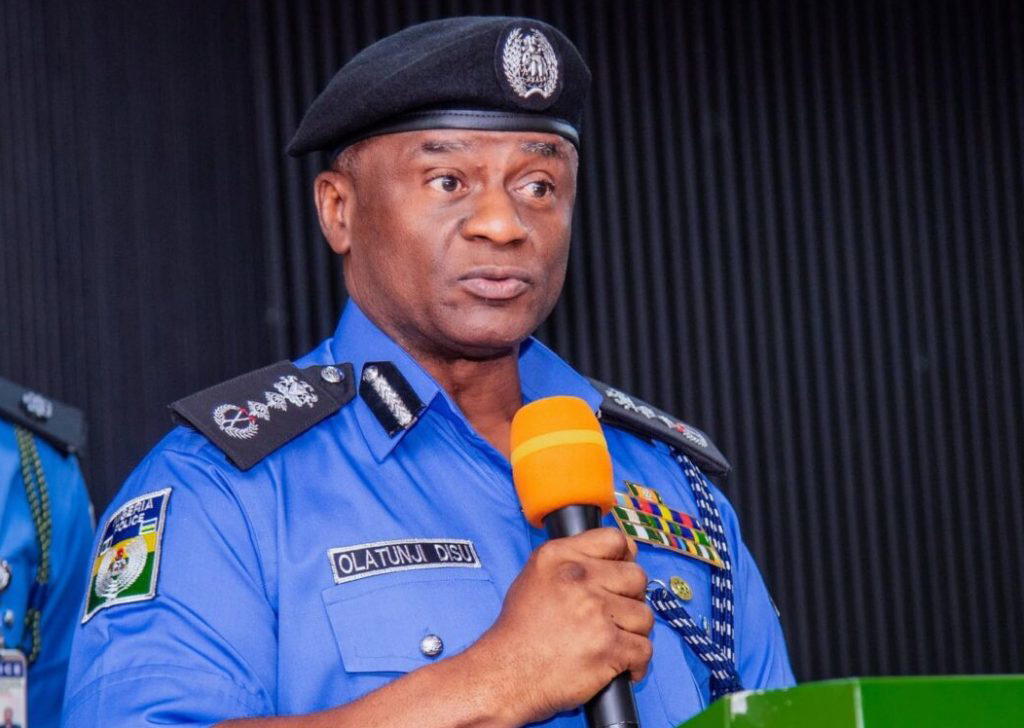
Six months of Tunji Disu: Will he write his name in gold?
By Austen Yong
On August 25, Nigeria’s Police Chief, Inspector-General of Police Olatunji Rilwan Disu, will clock six months in office. Six months is certainly not enough time to measure the full performance of a public servant, particularly the head of an institution as large and complex as the Nigeria Police Force. But in policing, six months is long enough to reveal direction. Indeed, in security, 30 seconds can sometimes make the difference between life and death.
When Disu assumed command of the Nigeria Police Force on February 25, 2026, he appeared to understand that he had been handed more than a powerful office. He had been handed an opportunity. In his maiden speech, he said the confidence reposed in him was one he would “neither squander nor take lightly.” Those words provide an appropriate yardstick for assessing his first six months.
Has he used the opportunity? The answer, at least for now, appears to be yes.
Confronting the State Police question
One of the most significant things Disu did almost immediately was to confront an issue that several of his predecessors approached with considerable caution: State Police.
At his inaugural conference with senior police officers on March 4, barely a week after assuming office, Disu inaugurated a Steering Committee, headed by Prof. Ogunsakin, on the establishment of State Police. The committee was mandated to examine policing models, community security needs, recruitment, training, standards, resource allocation and accountability mechanisms.
That was an acknowledgement that Nigeria’s security architecture is changing and that the Nigeria Police Force cannot afford to sit on the sidelines while the country debates its future.
If State Police eventually becomes a reality, as it is wont to be, the Federal Police will have to lead by example through professionalism, national standards, impartiality, intelligence capability and institutional integrity. Disu appears to understand this.
The end of police impunity?
His second defining feature has been accountability within the Force. From the beginning, he directed senior officers to lead by example and strengthened the Complaints Response Unit and X-Squad.
Then came a significant demonstration of intent.
Following the extrajudicial killing of a suspect in Delta State, Disu publicly described the action as unlawful and announced that the officers involved had been dismissed from the Force, while the case was forwarded for criminal prosecution.
That sent a powerful message: the uniform does not place anyone above the law. It soon became a defining mantra of the Complaints Response Unit under Iniedu Inietie, now Force Public Relations Officer, that the era of police impunity had come to an end.
The principle is simple. The police cannot demand respect for the law from citizens while appearing unable or unwilling to discipline officers who violate it. If Disu can sustain this principle, he may eventually change one of the most damaging perceptions surrounding Nigerian policing.
Building policing capacity
Accountability is only one side of professionalism. The other is capacity. The first six months have also produced measurable operational activity. In April alone, according to the Nigeria Police Force, intelligence-led operations resulted in the arrest of 28 suspected terrorists, 85 suspected kidnappers, 62 armed-robbery suspects, 51 murder and culpable-homicide suspects and 54 suspected cultists.
The Force also reported the rescue of 189 kidnapped victims and the recovery of 140 firearms and 1,074 rounds of ammunition.
The establishment of the Violent Crime Response Unit is another institutional development deserving attention. It represents an attempt to provide a specialised response to serious and violent crimes rather than relying exclusively on conventional policing structures.
The same thinking is visible in counter-terrorism. Disu approved additional Counter-Terrorism bases in Madagali, Adamawa; Ikot Odo in Cross River; and Ode-Remo in Ogun State, alongside additional CTU personnel. These initiatives suggest an IGP trying to move the Force towards specialised, intelligence-led and proactive policing.
Policing with the people
Perhaps the most interesting aspect of the Disu administration, however, is that it has not treated policing merely as a contest of arrests, weapons recovered and suspects paraded. There appears to be a conscious effort to reconnect the police with the people.
In six months he has engaged the leadership of the Police Community Relations Committee, a record three times. This is significant. In April, while receiving the PCRC leadership, Disu described the organisation as an important partner in intelligence gathering and grassroots security. He has also directed Commissioners of Police to strengthen town-hall engagements with traditional rulers, religious leaders and community groups, while making their contact details accessible to community leaders.
His engagement with young Nigerians on August 20 at the Police Resource Centre, Jabi, Abuja, further demonstrated this philosophy. This was the occasion of the National Youth Leadership and Security Dialogue, organised by the Nigeria Police Force as part of the 2026 International Youth Day programme, built around the United Nations theme, “ Different Contexts, Common Aspirations.”
Disu’s message was clear: young Nigerians must not allow themselves to be used as instruments of violence, particularly political violence, as the country moves towards the 2027 elections.
Politicians contest elections, but young Nigerians live with the consequences. Political actors may reconcile after an election, but ordinary Nigerians can lose their lives through electoral violence.
His warning therefore, extended beyond thuggery to carrying weapons for politicians, misinformation, digital intimidation and other forms of political violence. This is the philosophy of modern policing.
Sir Robert Peel’s famous principle that the police are the public and the public are the police is not merely a quotation for police academies. It is a practical security doctrine.
The police cannot secure communities that distrust them. Communities, on the other hand, cannot expect sustainable security while treating crime prevention as somebody else’s responsibility.
That is why Disu’s emphasis on community intelligence, public engagement and policing by consent may ultimately prove more important than the number of suspects arrested.
The human side of policing
There is also a human side to Disu’s leadership that deserves recognition. Despite the enormous demands of his office, he has demonstrated personal concern for officers and people beyond operational statistics. His visit to an ailing Assistant Inspector General of Police and his earlier conduct as Commissioner of Police in Rivers State, including his personal visit to one of the surviving pioneer women police officers, reflect a conception of policing that sees the human being behind the uniform. That matters. It shows that a police organisation is ultimately made up of human beings. An IGP who understands compassion, welfare and institutional memory is more likely to understand that officers cannot be expected to give their best to the country when the institution does not care for them.
His approval of the promotion of 17,952 junior police officers is another indication of attention to the human-resource dimension of policing.
There has also been emphasis on professional development, strategic communication and modern policing methods, with the administration pushing intelligence-led, evidence-based and technology-driven policing.
The 2027 test
Then there is the electoral question. Disu has already had important tests in Ekiti and Osun. The Osun experience, in particular, demonstrated how quickly political violence can become a policing crisis.
Disu personally intervened, ordered a crackdown on political thuggery and insisted that perpetrators and sponsors of violence should be arrested and prosecuted irrespective of political affiliation.
This is important because 2027 will be the real examination. The police must not only secure elections. They must convince Nigerians that they are professionally neutral before, during and after the ballot.
That will be one of the defining tests of Disu’s tenure.
Not yet Uhuru
But the IGP cannot solve Nigeria’s security problems in six months. Nobody honestly expects him to. However, he has established a direction. He has confronted the State Police question. He has spoken firmly about accountability. He has created new operational structures. He has pursued intelligence-led policing. He has paid attention to community partnerships. He has shown concern for police welfare. He has demonstrated a willingness to engage stakeholders outside the traditional police establishment.
Most importantly, he appears to understand that public trust is itself a security asset.
But expectations must now rise. The PCRC should expect deeper institutional partnership. Civil society should demand greater accountability. Police officers should expect better welfare, but also higher professional standards. Victims should expect investigations. Communities should expect responsiveness. And Nigerians should expect a police force capable of saying no to political pressure.
A test case for Disu’s legacy
The statistics of arrests, weapons recovered and suspects prosecuted will always matter. But they are not the ultimate measure of policing. The ultimate test is whether Nigerians begin to feel safer. Can a woman travel at night with less fear? Can a community report suspicious activity without fearing retaliation? Can a young Nigerian walk into a police station and expect to be treated with dignity?
Can a police officer refuse an unlawful political instruction, as outlined in section 137 of the Nigeria Police Act 2020? Can the police conduct the 2027 elections without becoming an instrument in the hands of politicians? These are the questions that will eventually determine Disu’s legacy. His six-month anniversary, therefore, should not be treated merely as a celebration. It should be treated as a checkpoint
The IGP does not need to be remembered as the man who solved every security problem in Nigeria. That would be an impossible and unfair expectation. He should strive instead to be remembered as the man who left the Nigeria Police Force better than he found it. He has been given the opportunity. He has shown evidence that he understands its importance. The remaining question is whether he can sustain the momentum.
Nigerians are hoping. And they are beginning to expect a different Nigeria Police Force. If he continues in the direction he has begun, history may eventually give him something every public servant craves but very few attain: a name written in gold.
The post Six months of Tunji Disu: Will he write his name in gold? appeared first on Vanguard News.