
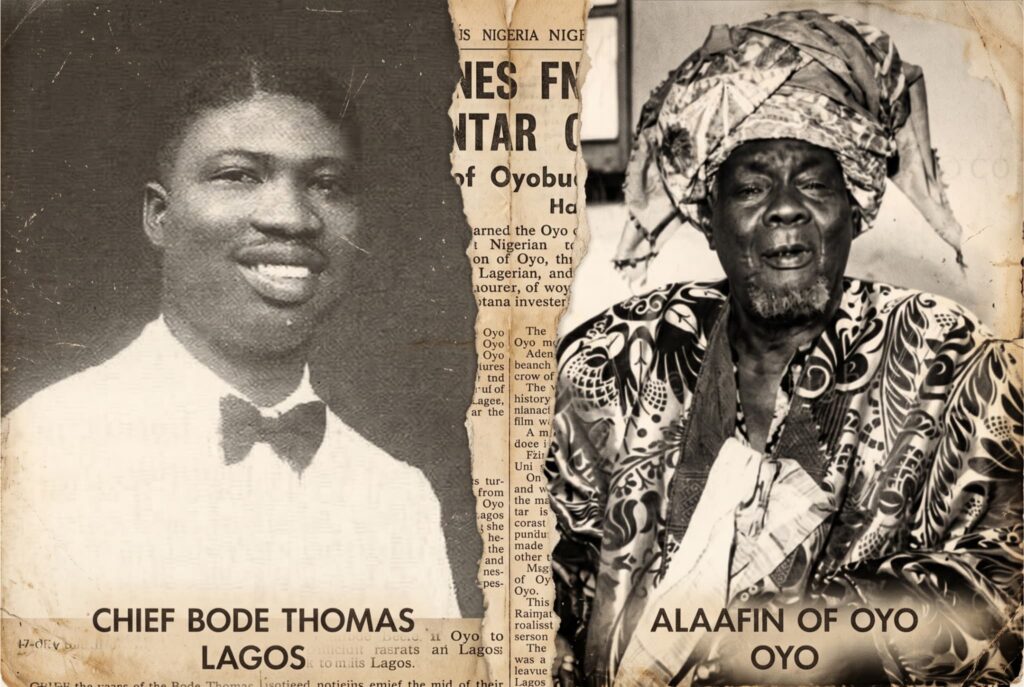
ROYAL CURSE OR KILLER FEVER? Inside the Explosive 1953 Feud Between the Alaafin of Oyo and Chief Bode Thomas That Ended in a Tragic Mystery!
OYO & LAGOS — Few chapters in Nigeria’s pre-independence history blur the line between raw political ambition, ancient palace mysticism, and human tragedy quite like the final days of Chief Olabode Akanbi Thomas. For over seven decades, a chilling urban legend has gripped the popular imagination across Yorubaland: that the brilliant 34-year-old lawyer, Action Group deputy leader, and Nigeria’s first Central Minister of Transport died “barking like a dog” after publicly humiliating the revered Alaafin of Oyo, Oba Adeniran Adeyemi II.
Behind the sensational folklore of royal curses and supernatural vengeance lies a gripping human drama—a clash between the old guard of traditional monarchy and the fiery, Western-educated architects of modern Nigeria, alongside a grieving family and a personal physician whose eyewitness testimony tells a vastly different story.
The Clash of Titans: Modern Politics vs. Ancient Crown
In late 1953, the Western Region of Nigeria was in the throes of a massive power shift. Chief Bode Thomas was at the absolute peak of his powers. Born in October 1919 to a wealthy Lagos merchant, Andrew Thomas, young Bode had studied law in London, been called to the English Bar at the Middle Temple in 1942, and returned home to build a formidable legal and political empire.
A co-founder and Deputy Leader of the Action Group (AG) under Chief Obafemi Awolowo, Thomas was also installed as the Balogun of Oyo in 1949—a prestigious traditional military title connecting him to his ancestral roots. However, the sweeping local government reforms championed by the Action Group in the early 1950s were designed to transfer administrative and tax-collecting powers away from sole native authorities (traditional rulers) to elected divisional councils.
This policy placed Chief Bode Thomas, who had assumed the chairmanship of the Oyo Divisional Council, on a direct collision course with Oba Adeniran Adeyemi II, the Alaafin of Oyo, who was in his 60s and sat upon one of the most sacred thrones in West Africa. Tensions in Oyo town were already boiling over taxes, political party rivalries between the Action Group and the NCNC, and the diminishing veto power of the palace.
According to entrenched historical folklore, the breaking point occurred on November 22, 1953, during a tense sitting of the Oyo Divisional Council in Oyo town. As the 34-year-old Chairman Bode Thomas strode into the council chamber, the seated councillors rose to their feet to accord him official protocol. Only one man remained seated: the elderly monarch, Alaafin Adeyemi II.
In the traditional Yoruba worldview, the Alaafin is Iku Baba Yeye (Death, the Father and Mother of all, Second only to the Gods)—a sovereign before whom even the highest chiefs prostrate. Yet, in the heat of the new constitutional order, Thomas reportedly viewed the monarch’s refusal to stand for the Council Chairman as a personal and official slight.
Eyewitnesses to the folklore claim the hot-tempered young lawyer snapped at the elderly king, demanding in English: “Why were you sitting when I walked in? Why can’t you show me respect?”
Stung by the public effrontery from a man young enough to be his son—and one who held a chieftaincy title under his own domain—Oba Adeyemi II reportedly fixed his gaze on Thomas and replied in deep Oyo Yoruba:
“Ṣé èmi ló ń gbó mó báun? Èmi ni ó ń gbó bí ajá mó báun? Máa gbó lọ!”
(Is it me you are barking at like that? Is it me you are barking at like a dog? Keep on barking!)
A Night of Terror at Araoti Street: The Myth vs. The Medical Record
As the popular street legend goes, the Alaafin’s words carried the lethal weight of Àṣẹ (spoken spiritual authority). Upon returning to his residence on Araoti Street in Yaba, Lagos, Chief Bode Thomas was said to have been struck by a mysterious affliction that caused him to bark uncontrollably like a hound throughout the night, defying all spiritual and medical remedies until he breathed his last on November 23, 1953.
For decades, this cautionary tale was used by elders across Nigeria to warn the youth against arrogance and disrespecting traditional rulers. However, investigative scrutiny of primary historical records reveals a heartbreaking, deeply human medical crisis rather than a supernatural execution.
The most authoritative eyewitness account comes from Chief Bode Thomas’s close friend and personal physician, Dr. Moses Adekoyejo Majekodunmi (who later became Nigeria’s Federal Minister of Health and Sole Administrator of the Western Region). In his acclaimed 1998 autobiography, My Lord, What a Morning, Dr. Majekodunmi documented the exact timeline of his friend’s final hours, dismantling the rumour that Thomas barked to death.
According to Dr. Majekodunmi’s medical and personal testimony: The Urgent Call from Yaba: Towards the end of November 1953, after returning from a grueling political trip to Oyo, Bode Thomas telephoned Dr. Majekodunmi at his No. 2 Force Road, Lagos residence, urgently requesting that the doctor send his car to bring Thomas over.
A Delirious Father and Husband: When Thomas failed to arrive after an hour, Dr. Majekodunmi drove straight to Thomas’s home on Araoti Street, Yaba. There, in the sitting room, the doctor found a visibly weakened Bode Thomas alongside his distraught mother and his devoted wife, Lucretia Shobola (“Subo”) Thomas (née Odunsi).
Fear of Poisoning: Thomas informed the three of them in the sitting room that he had developed a severe fever while in Oyo and had rushed back to Lagos. Crucially, because of the bitter political hostility in Oyo, Thomas was terrified that he might have been poisoned or targeted by political enemies. Before slipping into heavy delirium, he issued one strict instruction to his wife and mother: no medicine or treatment was to be administered to him unless personally approved by Dr. Majekodunmi.
The Medical Diagnosis: Dr. Majekodunmi examined his friend, diagnosed a severe bout of malaria (later complicated by cerebral symptoms/delirium), and administered anti-malarial drugs alongside a sedative to help him rest through the night.
The Tragic Transfer: The following morning (a Sunday), Dr. Majekodunmi traveled to Abeokuta for a scheduled family meeting. By the time he returned to Araoti Street later that day to check on his patient, a massive crowd of anxious political associates and sympathizers had besieged the Yaba residence. Overwhelmed by the visitors and panicking as Thomas’s feverish delirium worsened, extended family members and associates had taken him out of Lagos toward Ijebu-Igbo / Ibadan for alternative intervention, depriving him of continuous specialist monitoring. He died shortly thereafter on November 23, 1953, at the age of 34.
Medical historians note that acute cerebral malaria or severe respiratory distress accompanied by high-fever delirium can cause convulsive gasping or hoarse vocal spasms—symptoms that superstitious onlookers and political rivals easily sensationalized into “barking like a dog.”
The Aftermath: A Widow’s Grief and a King’s Exile
The human toll of that fateful November weekend devastated both camps. In Lagos, Chief Bode Thomas’s sudden death plunged the Action Group and the legal fraternity into mourning. His funeral along Ikoyi Road drew one of the largest crowds in the history of colonial Lagos, bringing traffic to a complete standstill as thousands wept for a brilliant statesman cut down in his prime. He left behind his young widow, Subo, and their young children, including Eniola and Dapo. Today, the bustling Bode Thomas Street in Surulere, Lagos, stands as a permanent monument to his brief, meteoric life.
Yet, the Alaafin of Oyo did not escape the political hurricane that followed. Far from cementing his untouchable status, the death of Bode Thomas intensified the hostility between the Action Group-led Western Regional Government and the Oyo Palace.
In 1954, violent clashes erupted in Oyo town between supporters of the traditional palace (aligned with the NCNC) and Action Group loyalists, leading to the setting up of the Lloyd Commission of Inquiry. By 1955, the Western Regional Government officially suspended and subsequently deposed and banished Oba Adeniran Adeyemi II from the throne of Oyo. Stripped of his crown and exiled to Lagos, the aged monarch lived out his remaining years away from his ancestral palace until his passing in 1960—though his son, Oba Lamidi Olayiwola Adeyemi III, would eventually reclaim the throne in 1970 and reign for 51 historic years.
Ultimately, the 1953 confrontation in Oyo was never a simple tale of a rude young man and a vengeful wizard-king. It was a tragic collision of two eras—one armed with the British constitution, the other with centuries of sacred tradition—leaving behind a dead prodigy, an exiled monarch, and an immortal Nigerian legend.