
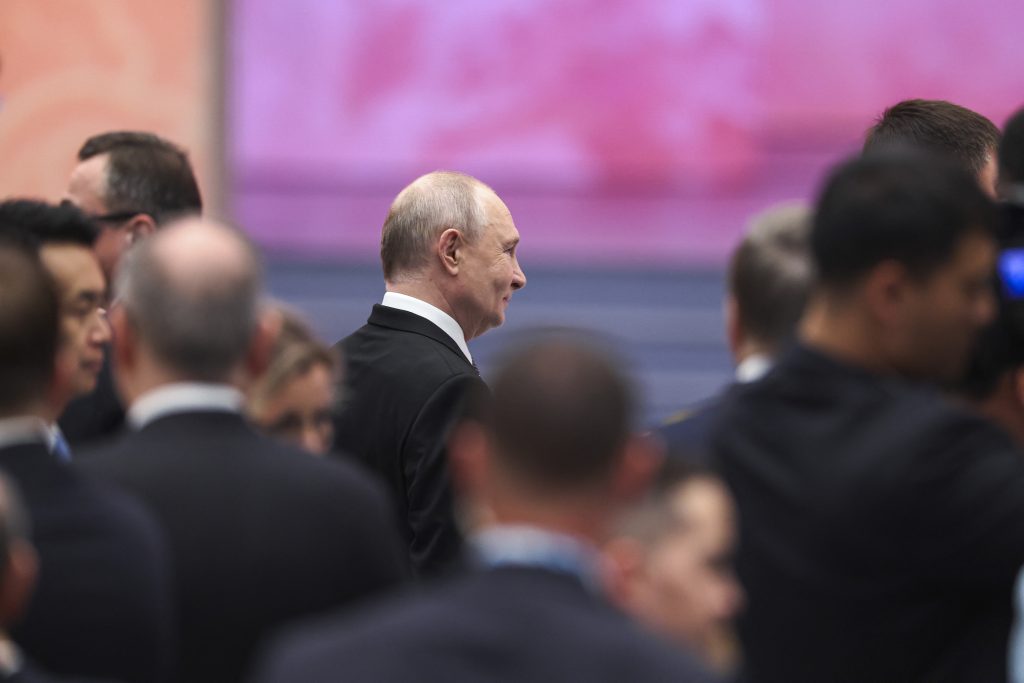
Putin-Trump-Xi: Three men, three different agendas
An unprecedented trilateral summit of the leaders of China, Russia and the US will provide startling images and unsettle Europe this week, but all three presidents are approaching the meeting with starkly different agendas.
Donald Trump, Vladimir Putin and Xi Jinping will meet Thursday on the sidelines of the APEC summit in the Chinese city of Shenzhen for talks that have echoes of the US-UK-USSR February 1945 “big three” summit in Yalta.
At that meeting, which took place months before the end of World War II, the leaders of Britain, the Soviet Union and the US agreed the postwar division of Europe.
Europe, which will not have a representative at Thursday’s talks, will be eyeing them warily. The smiles and friendly handshakes may also cause chills in Ukraine, after almost half a decade of war with Russia, and Taiwan, the democratic island viewed by China as part of its territory.
But analysts say it is unlikely that the meeting will result in a landmark breakthrough on key issues such as Ukraine, nuclear disarmament and AI, even if the fact it is taking place at all is remarkable.
Here AFP looks at what the three men will want from the meeting.
Putin: imagery and Ukraine
On paper, Putin will be in the meeting as the junior partner, presiding over a country whose population, let alone economy, is dwarfed by both the United States and China.
But the war sparked by Moscow’s invasion of Ukraine, which Trump famously vowed to resolve in 24 hours, will be at the centre of the talks as the conflict grinds towards its fifth anniversary.
Putin will be buoyed by being able to set out his conditions for ending the war without Kyiv’s chief allies, the Europeans, or Ukraine being at the table.
“He wants Russia, the US and China to decide everyone else’s geopolitical fate. But in the end it’s impossible to decide on the fundamentals of European security without Europeans,” said Fredrik Wesslau, senior policy fellow at the European Council on Foreign Relations (ECFR).
The optics of the meeting, set to be relayed extensively by Russia’s state-controlled media, are also very important for Putin who has always pressed for Moscow to be seen as a great global power even after the collapse of the USSR.
“A seat alongside the American and Chinese presidents would affirm Russia’s status as a global power, despite its much weaker economic position,” said Tsiporah Fried, senior fellow at the Hudson Institute.
“Political rehabilitation would be a gain even without concessions on territory, sanctions, or Ukraine’s future alignment,” she added.
Trump: nuclear and overcoming midterms
Trump and the White House have framed the trilateral summit as a way of advancing nuclear arms control, although the president himself admitted before leaving Washington “it’s a tough subject because it’s very hard for any of us to say we’ll get rid of our nukes.”
The imagery is also important for Trump as the 80-year-old contemplates his last two years in office as a lame-duck president following his Republican Party’s brutal defeat in the US midterm elections earlier this month.
Opponents also accuse Trump of having little to show for the hugely costly war against Iran, although the president insisted “we have Iran in very good shape.”
In an early win for Trump, Xi took the unusual step of personally greeting him on arrival in Shenzhen.
“Typically after bad midterms, this is how presidents reset and remind other leaders that they’re still in charge on foreign policy,” said Edgard Kagan, senior adviser at the Center for Strategic and International Studies (CSIS).
Trump will be wary of suggesting any easing of the restrictions on the export to China of the technology that powers AI, with the summit coming on the heels of the resignation of Jensen Huang, chief executive of AI chip giant Nvidia, over an affair with an alleged Chinese agent.
“The room for manoeuvre for the Americans is constrained by the Nvidia scandal,” said Mathilde Velliet, a researcher at the French Institute of International Relations (IFRI), saying it had already led to a “hardening” of the US stance.
China: glory for host, Taiwan and stability
As host, Xi knows “the meeting could place China at the centre of global diplomacy and reinforce its standing alongside the United States,” said Fried, while cautioning “Beijing has reasons to avoid an ambitious agenda”.
Beijing has maintained a careful stance throughout the Ukraine war, staying officially neutral while rejecting accusations of offering more than just tacit support to Russia including the alleged export of dual-use technology.
“Xi does not want Russia to lose since this would be an overall win for the West,” said Wesslau.
Chinese foreign ministry spokesman Mao Ning described the summit as being of “groundbreaking significance” with the three men due to have an “in-depth exchange of views on safeguarding world peace and enabling strategic stability in major-country relations.”
On the nuclear issue, “China prefers bilateral nuclear talks with the United States over a trilateral format involving Russia,” said Tong Zhao, senior fellow at the Carnegie Endowment, saying this allows Beijing to exercise leverage on matters it regards as “higher-priority” issues such as US arms sales to Taiwan.
Vanguard News
The post Putin-Trump-Xi: Three men, three different agendas appeared first on Vanguard News.