
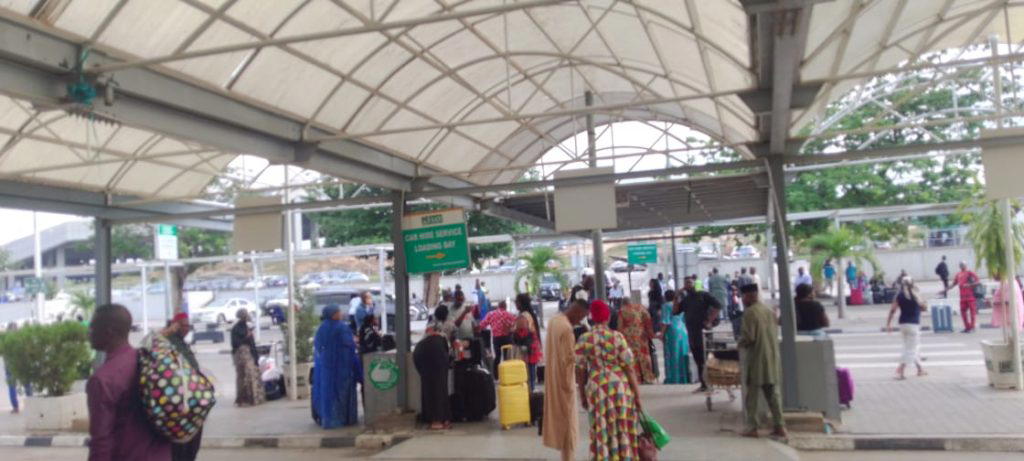
Passengers fear proposed biometric checks may cause chaos at domestic airports
By Dickson Omobola
Federal Government’s proposed mandatory biometric checks for domestic air passengers from January 1, 2027, have come under scrutiny less than five days after the plan was announced, with passengers and industry observers warning that the policy could make air travel more difficult.
They insisted that the plan appeared rushed and had not been properly thought through, particularly as the festive travel season would still be ongoing when the policy takes effect.
They also feared that its implementation could trigger a repeat of the chaos that followed the introduction of the Go Cashless payment system, which caused hours of gridlock at airports in Lagos and Abuja.
In March, the Federal Airports Authority of Nigeria, FAAN, introduced an electronic payment system known as Go Cashless at the toll gate of two of the country’s busiest airports.
Its rollout left passengers travelling through the airports in Lagos and Abuja stranded for hours, triggering massive gridlock, missed flights and widespread frustration.
While some travellers abandoned their vehicles at airport entrances after encountering difficulties completing payments, others said they missed scheduled flights after spending hours trying to gain access to the airports.
The disruption prompted President Bola Tinubu to order the Minister of Aviation and Aerospace Development, Mr Festus Keyamo, to announce a suspension of the system on the fourth day of its implementation.
With the busy Yuletide travel period extending into January, passengers and industry observers fear that a similar situation could unfold at the Lagos airport, the country’s busiest, especially as Keyamo has given domestic airlines until December 31, 2026, to integrate their operations with the system that will facilitate the biometric checks.
Keyamo warned that airlines that fail to comply with the directive would not be allowed to board passengers from January 1, 2027.
Known as the Airport Passenger Verification System, v-PASS, the biometric identity verification system is linked to the National Identification Number, NIN, of Nigerians.
It is designed exclusively for domestic flights, with all passengers required to provide their NIN during check-in. Passengers are also expected to pay additional charges for the service.
Speaking during the unveiling of the system at the domestic terminal of the Murtala Muhammed Airport, Lagos, Keyamo said: “I am giving the airlines till the end of December. I repeat it. From the 1st of January, no airline will be allowed to board their passengers if they don’t key into the v-PASS.”
X-raying v-PASS
Approved by the Federal Executive Council, FEC, v-PASS is a private-sector investment aimed at modernising airport operations through private-sector participation.
Managing Director of FAAN, Mrs Olubunmi Kuku, said the system is designed to provide passengers with a single digital identity that can be used at different stages of airport processing, from security access to boarding.
Passengers will enrol using their NIN. After registration, they will be able to enter the last four digits of their NIN at designated security access points.
At boarding gates, the identities of travellers will be verified through facial recognition, iris biometrics or QR codes displayed on boarding passes.
Concerns
Reacting to Keyamo’s announcement on X, formerly Twitter, a lawyer and frequent traveller, Dr Charles Omole, questioned how the system would accommodate foreigners and Nigerians travelling with foreign passports who do not have NINs.
He asked: “What happens to foreigners (Nigerians who travel in with foreign passports and pure non-Nigerians) who do not have a NIN? Does that mean they cannot fly on domestic flights?
“As Nigerians are allowed to fly into the country on expired passports, what happens to those who fly into the country that way (most do not yet have a NIN) but need a local flight to their final destination? Will they be stuck at the arrival airport?
“What happens to Nigerian children who do not have NIN? What happens to adult Nigerians who have not yet obtained a NIN but have other IDs? Is NIN now a compulsory requirement to fly in Nigeria? Is this backed by any law?
“These clarifications are important. A valid ID is the normal practice in most countries, not a national identification number. But your clarification will help us understand.”
Another passenger on X, Kelechi Nwachukwu, was particularly interested in the cost implications of the system, saying: “PPP arrangement? Surely, the private partners will recoup their investment. Nigerians are already paying so much for local flights. Hope the benefit outweighs the additional cost implication of flight fares.”
Rewarding cronies
Another user, Yagazilum, also expressed concern, saying: “I have my driver’s licence, passport and voter’s card all linked to NIN but there are still ticket racketeering and beggy-beggy at the airports. I guess this is another means of rewarding cronies with juicy contracts that add no value but rather create more problems, delays and avenues for extorting the public.”
Defence layers
For his part, aviation security expert, Group Captain John Ojikutu (retd), warned of the security implications of relying on a single service provider and the extent to which relevant aviation security agencies had been consulted.
He said: “Access into the Nigeria civil aviation security network cannot be restricted to only one service provider but must integrate them all. The NASC through the Nigeria Civil Aviation Authority, NCAA, must set the standard. Aviation security membership mainly include the NCAA, government security agencies working in the airport and the representative of the Airline Operators of Nigeria, AON.
“Would the v-Pass exclude or include the Airlines boarding pass and the airport ODC? What are the inputs of the national aviation security committee, NCAA and the airport security committee in this new regulation for passengers facilitation?
“This is a job of national aviation security that must be networked and not for airport security alone otherwise while looking for default airline passengers, a non-passenger will pass through with his NIN and commit an unlawful act on aviation systems. NIN alone cannot deter unlawful act without intelligent information about passengers on watchlist or those on no-fly-list. The defence layers begin with shared intelligence from the NCAA with airlines and airport operators and others within the six defence layers.”
Dumping ground
An aviation stakeholder, who spoke on condition of anonymity, said: “For visitors who are here on holiday for a short period will have to obtain NIN to do their local flight. You should not turn Nigeria into a police country. What happens to students with their University ID cards and companies’ identity cards? Whenever there is a new technology that is not acceptable in the Western world, Nigeria is always the dumping ground. Our airports are already a difficult place to fly from, complex and expensive. I think we should focus on making life easier for an average citizen of this country.”
Air Peace boosts domestic operations
Nigeria’s largest carrier, Air Peace Limited, has expanded its domestic network with the introduction of daily flight connections from Asaba, Anambra, Benin, Enugu, Owerri, Ibadan, Port Harcourt and Warri to Kano.
The airline has also strengthened air connectivity between Lagos and Abuja by increasing flight frequencies to up to nine daily services.
The new connections from Asaba, Anambra, Benin, Enugu, Owerri, Ibadan, Port Harcourt and Warri to Kano took effect on November 20, 2026.
The airline’s spokesperson, Mr Efe Osifo-Whiskey, in a statement, said the development reflected Air Peace’s sustained drive towards network optimisation, capacity enhancement and service excellence, as it continues to consolidate its position in Nigeria’s aviation industry through strategic route expansion and increased flight frequencies.
He said: “Air Peace remains committed to providing safe, reliable and convenient air travel while continually expanding its operations to meet the evolving travel needs of passengers across Nigeria and beyond.”
The post Passengers fear proposed biometric checks may cause chaos at domestic airports appeared first on Vanguard News.