
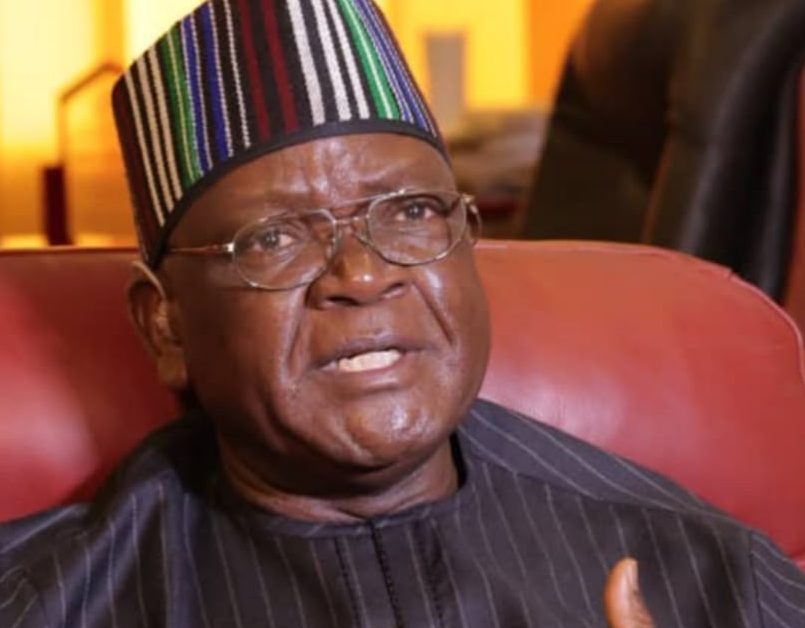
Ortom hits back at ex-envoy Tarzoor, highlights governance achievements
By Peter Duru, Makurdi
Former Benue State Governor, Chief Samuel Ortom, has challenged Ambassador Terhemen Tarzoor to account for his record in public office, accusing him of sustained attacks on his person over the defeat he suffered during the 2015 governorship election in the state.
Recall that the former Nigerian envoy to Namibia had, during a recent media outing criticised the former governor over what he described as uncomplimentary remarks about Governor Hyacinth Alia and his administration.
Ortom described Tarzoor’s criticism as “a manifestation of the bitterness he has harboured since his defeat in the 2015 governorship election,” alleging that the former governorship candidate had consistently used media engagements to attack him more than a decade after the election.
He said Tarzoor’s latest comments, ostensibly in defence of Governor Hyacinth Alia, were an attempt to remain politically relevant. He added that the ambassador had misrepresented his remarks by claiming that he described the actions of the people of Benue as “shenanigans.”
“Chief Ortom could never have used such a term to disparage the people of Benue State. If anything, his reference was to the antics of individuals like Tarzoor, whose utterances and conduct appear calculated to sow discord, deepen divisions and breed acrimony in the polity,” he said.
Ina statement.by his media Aide, Paul Zege, the former governor questioned Tarzoor’s record as Speaker of the Benue State House of Assembly, asking him to identify the developmental projects he attracted to his constituency and the achievements he could point to as evidence of his contributions to the people.
He also raised questions about the controversial creation of a Fulani ward in Makurdi Local Government Area, LGA, which he said was subsequently reversed after the exercise was reportedly found to be fraudulent.
Ortom further questioned Tarzoor’s record as Nigeria’s ambassador to Namibia, alleging that his tenure failed to establish a notable diplomatic legacy, urging the former Speaker to focus on issues affecting the state rather than engage in what he described as persistent attacks on him.
Defending his administration’s record, Ortom said security was one of the defining issues of his tenure, particularly his opposition to open grazing and the repeated attacks on farming communities.
He said his administration “enacted the Open Grazing Prohibition and Ranches Establishment Law of 2017, established the Benue State Livestock Guards, supported the Community Volunteer Guards and provided logistics to security agencies.
“He could have chosen the politically convenient path. He could have remained silent, avoided confrontation with powerful interests and maintained cordial relations with the Federal Government of the day. Instead, he chose to stand with his people and defend their lands when he believed the survival of his people was at stake,” he said.
On education, Ortom listed the execution of more than 1,000 primary school projects in collaboration with the Universal Basic Education Commission, the provision of desks and other learning materials, the renovation of secondary schools and the upgrading of some tertiary institutions.
He said his administration also ‘introduced a first-line funding arrangement for Benue State University, BSU, to improve its financial stability and supported the accreditation of its College of Health Sciences, enabling medical students to graduate.”
On healthcare, Ortom said his administration supported the revival and accreditation of the Schools of Nursing and Midwifery in Makurdi and the School of Health Technology, Agasha.
Other interventions, according to him, included the establishment of the Benue State Health Insurance Scheme and the Primary Health Care Board, the provision of 42 health centres, ambulances and medical equipment, as well as investments in facilities at the Benue State University Teaching Hospital.
Ortom also disputed allegations that he failed to execute infrastructure projects during his eight years in office, listing roads constructed or rehabilitated in Makurdi, Gboko, Otukpo and other parts of the state.
Among the projects he cited were the 47-kilometre Zaki-Biam-Gbeji-Afia Road, the Agatu-Oshigbudu-Obagaji Road, the 30-kilometre Gbajimba-Iordye-Akaahena feeder road, as well as several urban roads and rural bridges.
On agriculture and rural development, he said his administration provided fertiliser to farmers at a 50 per cent subsidy for eight cropping seasons, acquired 50 tractors for distribution at a 60 per cent subsidy and collaborated with the International Fund for Agricultural Development on farmer training and the provision of improved seedlings.
He also cited the revival of the fertiliser blending plant, the construction of agro-processing factories in six LGAs and the introduction of a Friday work-free farming initiative during critical agricultural seasons.
The former governor further listed the provision of more than 1,000 motorised and hand-pump water schemes, the completion of over 60 electricity projects, the rehabilitation of public facilities and the construction of palaces for the Tor Tiv in Gboko and the Och’Idoma in Otukpo.
He said his administration also established the Benue Geographic Information Service, strengthened public procurement and debt management institutions, domesticated the Treasury Single Account and introduced reforms aimed at improving government revenue administration.
Ortom acknowledged that his administration had shortcomings but argued that these should not be used to dismiss its entire record.
He said his administration faced difficult economic conditions,”including two recessions and the COVID-19 pandemic, while grappling with insecurity and the displacement of farming communities.”
According to him, salaries were paid for 91 of the administration’s 96 months despite the fiscal challenges.
“Ortom was not a perfect governor. He has never claimed to be perfect. No honest assessment of his administration should pretend otherwise,” he said, adding that there was a difference between arguing that the former governor could have achieved more and claiming that he did nothing for eight years.
He also cited his longstanding provision of free treatment for snakebite victims, which he said dated back to 2000 and continued throughout his years in public service.
On the controversy surrounding the entitlements of former governors, Ortom said the matter should be determined by the applicable law rather than Tarzoor’s personal recollection of the legal framework during his tenure as Speaker.
He challenged Tarzoor to identify the specific claims he considered false and provide verifiable evidence to contradict them, while urging the Alia administration to subject its own performance to public scrutiny. “Public accountability does not expire at the end of an administration, and criticism of a sitting governor is not proof of bitterness,” he said, urging Tarzoor to move beyond the 2015 governorship election and focus on issues affecting the development of Benue State.
Ortom maintained that his record should be assessed on the basis of policies, projects, institutional reforms and the circumstances under which his administration operated, rather than political accusations.
The post Ortom hits back at ex-envoy Tarzoor, highlights governance achievements appeared first on Vanguard News.