
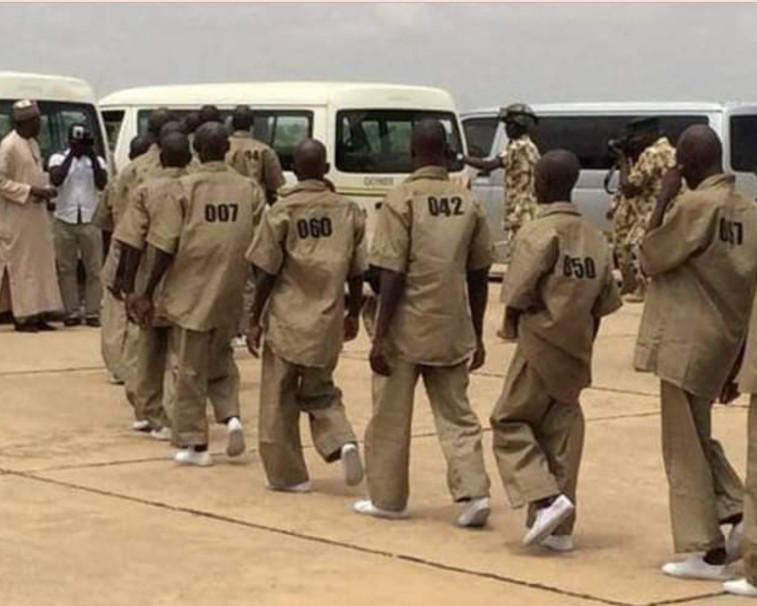
‘Operation Safe Corridor’ under the spotlight: Success, failure, search for accountability
By Esther Onyegbula
For years, Aisha Umar slept with one eye open. She survived the attack that destroyed her village in Nigeria’s North-East. Her husband never returned. Her children grew up inside an internally displaced persons, IDPs, camp, where survival became a daily struggle rather than a temporary reality.
Read Also: ‘We’ll marry beautiful ones, kill the rest’ — Terrorists threaten 176 woro captives
Then one day she heard the news that unsettled her more than the gunfire she had once fled.
Some of the men who had surrendered after fighting for Boko Haram were completing rehabilitation programmes and preparing to return to society.
The announcement divided the country. To some, it represented hope, proof that guns could be silenced without endless bloodshed. To others, it felt like a painful betrayal.
How, many asked, could those accused of destroying lives receive counselling, vocational training and government support while countless victims remained displaced, traumatised and forgotten?
That question has continued to define one of Nigeria’s most controversial counter-terrorism policies. More than a decade after the government embraced rehabilitation and reintegration for repentant insurgents, the debate remains unresolved.
Has the programme reduced violence, has it strengthened national security? Or has it sacrificed justice in the pursuit of peace?
An examination of expert opinions, government policy and years of implementation reveals a programme that was conceived with noble intentions, but weakened by poor execution, limited accountability and a failure to carry victims and communities along.
The birth of a controversial policy
Nigeria’s formal deradicalisation and rehabilitation effort gained momentum between 2015 and 2016 under the administration of former President Muhammadu Buhari.
At the centre of the initiative was ‘Operation Safe Corridor’, launched in 2016 as a non-kinetic strategy designed to rehabilitate low-risk Boko Haram members who voluntarily surrendered.
The programme sought to combine military pressure with psychological counselling, religious reorientation, education and vocational skills before former fighters returned to their communities.
Over time, similar thinking influenced some state-level amnesty initiatives for armed bandits operating in parts of North-West Nigeria.
The philosophy appeared straightforward. Rather than relying solely on military force, government hoped to weaken insurgent groups by encouraging defections, reducing recruitment and creating opportunities for former fighters to abandon violence permanently.
A global strategy with local complications
Defence and Counter-Terrorism Specialist, Dr Hashim Saludeen, argues that one of the biggest misconceptions is that Nigeria rehabilitates every terrorist.
“The government focuses on low-risk individuals,” he explained.
“There is a misconception out there about the government rehabilitating the entire terrorist institution.”
According to him, only carefully profiled individuals considered low-risk enter the rehabilitation pathway, while others are expected to pass through the criminal justice system.
Participants undergo deradicalisation programmes designed to challenge extremist ideology and prepare them psychologically for civilian life.
Globally, such programmes are not unusual.
Countries confronting violent extremism increasingly combine military operations with deradicalisation, recognising that ideology cannot always be defeated by bullets alone.
But while the philosophy may be internationally recognised, implementation determines success.
That, experts say, is where Nigeria encountered serious problems.
One criticism echoed repeatedly by security experts, human rights advocates and policy analysts is that victims appeared forgotten.
Dr Saludeen believes this imbalance became the programme’s greatest weakness.
“Most of the victims have not been fully attended to and they don’t get the kind of attention that this particular group of individuals get,” he said.
“So it creates this uneven approach where the perpetrators get full government attention, while the victims are left to languish in IDP camps.”
That perception, he argued, fuelled widespread resentment.
For families who lost loved ones, homes and livelihoods, rehabilitation often appeared less like reconciliation and more like reward.
The absence of visible support for victims undermined public trust long before debates about effectiveness even began.
Perhaps the strongest criticism emerging from experts is that rehabilitation was not sufficiently balanced with accountability.
Dr Saludeen insists that even individuals classified as low-risk may have participated in crimes against the state.
“No matter how low-risk they are… justice should be served. If you do the crime, you should face justice.”
He argues that Nigeria’s programme largely omitted this critical pillar. Without justice, reconciliation becomes fragile. Without accountability, victims feel abandoned. Without truth, communities struggle to forgive.
Another major concern is the absence of independent evaluation.
Years after ‘Operation Safe Corridor’ began, critics question whether government has adequately measured its effectiveness.
“I’m not sure any sort of mid-term evaluation has been carried out to check the functionality of this programme,” Dr Saludeen observed.
Without transparent assessments, Nigerians remain uncertain about critical questions. How many participants successfully reintegrated? How many returned to violence? How many remain under supervision? How many communities accepted returning fighters?
These unanswered questions continue to cloud public confidence.
Did rehabilitation achieve its objectives?
Technical Partner at Davijey Integrated Services Ltd, Job Inegbenijie, believes the answer is largely no.
“The primary aim was to restore peace, disarm the insurgents, reduce violence and ultimately end the killings.
“Unfortunately, the killings have not abated.”
He argues that insecurity persists partly because economic incentives continue attracting new recruits: “If people have no jobs or economic opportunities, they become vulnerable.”
He also questioned the programme’s transparency.
“What is the actual rate of disarmament? How many weapons are being recovered daily? What is the total number of weapons surrendered?”
“Without publicly available data,” he argued, “meaningful assessment becomes nearly impossible.”
Human rights advocate and Executive Director of RULAAC, Okechukwu Nwagunma, believes reintegration cannot succeed if receiving communities reject it.
He argues that victims were rarely involved in planning rehabilitation.
“Victims and affected communities were largely excluded from the process. Reintegration cannot succeed where communities are unwilling or unprepared to receive former fighters.”
According to him, rehabilitation should never replace justice. Instead, prosecution and rehabilitation should complement one another.
Those responsible for murder, rape, terrorism and kidnapping, he argues, must face prosecution.
Rehabilitation should remain limited to genuinely low-risk individuals, including those forcibly recruited, women, children and people with peripheral involvement.
Former Commissioner of Police Akika Austines offers rare insight into the programme’s early development.
He recalled participating in committee discussions around 2016 when government, encouraged by international partners including the European Union, explored deradicalisation strategies.
“The objective was actually the thought of Islamic radicalism,” he explained. “The belief was that if they are deradicalised, Boko Haram will stop.”
Yet despite participating in the process, he remains unconvinced. “Anybody who has committed an offence must be punished.”
His position reflects a wider national dilemma. Can peace endure without justice? Or can justice alone ever end an insurgency driven by ideology, poverty and decades of instability?
Experts identify several interconnected reasons for Operation Safe Corridor’s shortcomings.
First was the perception that government rewarded perpetrators while victims remained neglected.
Second was weak transparency. Third was inadequate post-reintegration monitoring. Fourth was poor community engagement. Fifth was the failure to tackle deeper causes of extremism, including unemployment, poverty, weak governance, injustice and the widespread availability of illegal arms.
Dr Saludeen also identifies another overlooked weakness. Skills training often failed to match local economic realities.
Teaching trades with little market demand, he argues, leaves former fighters unemployed and vulnerable to returning to crime.
“That, therefore, creates room for recidivism.”
Recently, government signalled that it would no longer invest resources in rehabilitating bandits, insisting instead that they should face the full weight of the law.
For Inegbenijie, the shift reflects public exhaustion. “Many Nigerians are tired of seeing people kidnapped and killed.
“They are tired of waking up every day to reports of communities being attacked.”
However, he cautions that tougher rhetoric alone cannot defeat terrorism.
Military operations must become intelligence-driven. Border security must improve. Justice must become visible. Public confidence must be rebuilt.
Despite widespread criticism, none of the experts advocates abandoning rehabilitation completely.
Instead, they call for comprehensive reform.
Dr Saludeen recommends transferring leadership from the military to civilian institutions, as is common internationally.
He also proposes stronger justice mechanisms, better skills matching, independent evaluations and long-term monitoring after reintegration.
Nwagunma recommends restricting rehabilitation to genuinely low-risk individuals while ensuring serious offenders face prosecution.
He also advocates psychological counselling, truth-telling processes, community participation, compensation for victims and stronger intelligence gathering.
Inegbenijie believes government must simultaneously strengthen military operations, block terrorist financing, improve emergency response to kidnappings and tackle poverty through employment and economic empowerment.
What next for the ‘Operation Safe corridor’ experiemtn?
Nigeria’s rehabilitation experiment has exposed one difficult truth. Counter-terrorism is not simply about defeating armed groups. It is about rebuilding broken communities. Military victories may reclaim territory.
Justice restores public confidence. Victim support heals wounds. Rehabilitation reduces future threats. Development addresses the conditions that allow extremism to flourish.
Remove any one of these pillars and the entire strategy becomes unstable. Perhaps that is the lesson Nigeria has learned after nearly a decade. Peace without justice breeds resentment. Justice without reconciliation may prolong conflict.
Military action without development leaves recruitment pathways open. Rehabilitation without accountability undermines public trust.
The challenge is no longer choosing one approach over another. It is finding the difficult balance where security, justice, compassion and accountability reinforce one another rather than compete. For thousands of victims still rebuilding their lives, that balance cannot come soon enough.
Vanguard News
The post ‘Operation Safe Corridor’ under the spotlight: Success, failure, search for accountability appeared first on Vanguard News.