
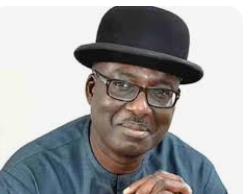
Nwuche to traditional rulers: Be consistent, non-selective in condemning insecurity
…Commends Tinubu on state police push
…Urges Nigerians to support President’s re-election bid
By Clifford Ndujihe
FORMER Deputy Speaker of the House of Representatives and Chairman of the Governing Board of the South-South Development Commission, SSDC, Prince Chibudom Nwuche, has urged traditional rulers and ethnic leaders to be consistent and non-selective in condemning insecurity, regardless of the administration in power.
Nwuche, in a statement, commended the Emir of Katsina, Alhaji Abdulmumini Kabir Usman, for speaking out against insecurity and its devastating impact on farming, economic activities and industrial development in Northern Nigeria.
However, he urged the monarch to extend similar counsel to political leaders across party, ethnic and regional divides, questioning why comparable public expressions of concern were not heard during the eight-year administration of former President Muhammadu Buhari, when insecurity remained a major national challenge.
The Emir had reportedly raised concerns about farmers’ inability to access their farmlands and the deteriorating economic and industrial situation in parts of Northern Nigeria when a delegation of the All Progressives Congress, APC, Presidential Campaign Council, led by its Director-General, Senator Abdul’aziz Abubakar Yari, visited his palace last Thursday.
He also reportedly cautioned the campaign leadership against misleading Nigerians ahead of the 2027 general elections.
While acknowledging the importance of the Emir’s intervention, Nwuche warned that selective criticism of national challenges during electioneering could create misleading impressions, fuel political tensions and undermine national cohesion.
He stressed that banditry, farmer-herder clashes, mass kidnappings, community raids and insurgency predated President Bola Tinubu’s administratio.
According to him, Northern Nigeria has endured years of devastating violence involving Boko Haram, the Islamic State West Africa Province (ISWAP), armed bandits and other extremist and criminal groups, with the insurgency reaching alarming proportions by 2012.
The subsequent fragmentation of Boko Haram and the emergence of ISWAP, he added, further complicated the security situation.
“There was a time in this country, not too long ago, when an Abuja-Kaduna-bound train was forcibly derailed, and passengers were abducted. Military facilities were repeatedly attacked, while communities were compelled to pay levies to bandits to secure their safety.
“Although these challenges somewhat persist, the Tinubu administration, through the military and other security agencies, has made significant efforts to stem the tide of insecurity, contain the activities of criminal elements, and check the expansion of terrorist networks across the country,” Nwuche said.
He also recalled reports alleging that the proliferation of armed bandit groups in parts of Northern Nigeria was linked, in part, to the recruitment and movement of foreign elements into the country ahead of the 2015 general elections, who were allegedly not properly managed after the polls and subsequently became vulnerable to recruitment by criminal networks.
The former Deputy Speaker said Tinubu deserved commendation for his efforts to reform Nigeria’s security architecture, particularly his push for a constitutional amendment to enable states to establish their police forces.
He noted that more than 24 of the 36 states had endorsed the proposed state police constitutional amendment, describing the development as evidence of growing support for decentralised policing.
According to him, state police would complement the Nigeria Police Force, strengthen local intelligence gathering and enable more effective responses to the distinct security challenges confronting different parts of the country.
Nwuche said successive administrations had failed to muster the political will to advance the initiative, adding that Tinubu’s commitment to the reform was a strategic step towards addressing structural weaknesses in the country’s centralised policing system.
He argued that the existing arrangement had hindered effective responses to Nigeria’s diverse security threats, making decentralisation necessary.
The SSDC chairman urged Nigerians across ethnic, religious and political divides to support and vote for Tinubu in the January 16, 2027 presidential election.
He said the country needed continuity, consistent policies and sustained implementation of reforms to enable citizens to benefit from the administration’s economic, social and political programmes.
The post Nwuche to traditional rulers: Be consistent, non-selective in condemning insecurity appeared first on Vanguard News.