
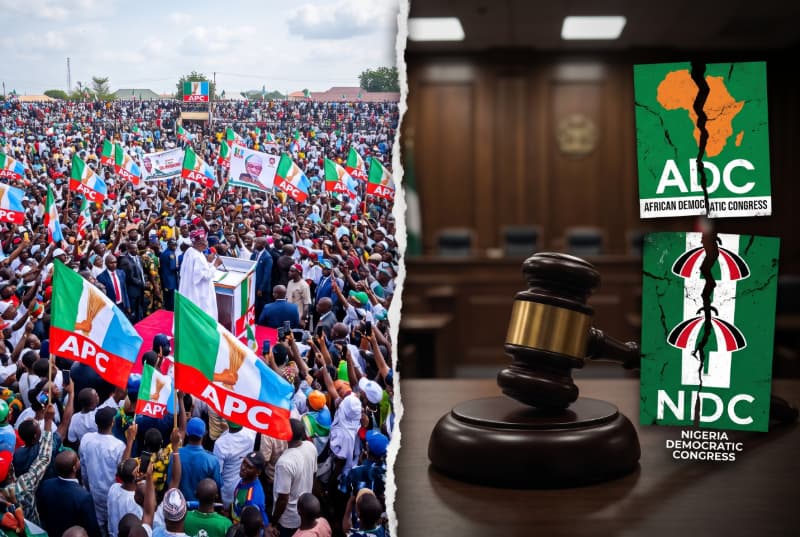
FULL THROTTLE VS. FREEFALL: How Tinubu’s APC Juggernaut Is Crushing a Fractured ADC and NDC Ahead of January 16 Polls!
With fewer than 55 days remaining before Nigerians march to the polling units on Saturday, January 16, 2027, the country’s political airspace is witnessing a stark, unmistakable divergence. On one side of the tarmac, the ruling All Progressives Congress (APC) has pushed its campaign engines to full throttle, rolling out a relentless, well-funded nationwide blitz. On the other, Nigeria’s leading opposition platforms—the African Democratic Congress (ADC) and the Nigeria Democratic Congress (NDC)—appear trapped on the runway, desperately searching for campaign headwinds amidst crippling court verdicts, funding controversies, and eleventh-hour coalition scrambles.
ADESIDA OLUWASEUN
For the everyday Nigerian—the petty trader in Kano calculating the daily cost of rice, the commuter in Lagos navigating transport fares, and the farmer in Plateau State praying for secure farmlands—this lopsided race is more than just elite political theater. It is a defining moment for Nigeria’s democratic balance. When an opposition fails to mount a cohesive, issue-driven challenge, the electorate is left with a shrinking marketplace of ideas at a time when citizens desperately need concrete economic alternatives.
The APC Juggernaut: Structural Dominance at Full Throttle
Since the Independent National Electoral Commission (INEC) lifted the ban on presidential campaigns on August 19, 2026, President Bola Ahmed Tinubu and his running mate, Vice President Kashim Shettima, have operated with the disciplined precision of a party determined to leave nothing to chance. Buoyed by a massive direct primary victory in May 2026—where Tinubu polled over 10.9 million votes—the APC is weaponizing its unmatched institutional footprint.
The ruling party’s advantage is rooted in cold, hard geopolitical arithmetic. By consolidating control over more than two-thirds of Nigeria’s states—fortifying its legacy South-West and Northern strongholds while aggressively absorbing strategic territories across the South-South and North-Central—the APC has systematically squeezed the opposition’s logistical oxygen supply.
In recent days alone, the pace of the APC’s ground game has been punishing:
- Battleground Push: On November 16, President Tinubu took his campaign directly to Plateau State, wooing voters with targeted pledges on security and infrastructural development.
- Closing Ranks: By November 22, the President was actively rallying APC governors and party chieftains to forgive internal grievances and present an ironclad, united front.
- Poaching Opposition Fractures: Capitalizing on rival disarray, the ruling party has even begun harvesting endorsements from splintered opposition camps, including the Julius Abure-led faction of the Labour Party.
With APC Presidential Campaign Council spokesperson Dele Alake and presidential aide Daniel Bwala publicly taunting the opposition as “not ready,” the ruling party is dictating the tempo, framing the 2027 race around its ongoing macroeconomic reforms and infrastructural rollout while its rivals fight fires in their own backyards.
ADC in Quicksand: Atiku’s Campaign Paralysed by Courtroom Warfare
While the APC floods the airwaves and town halls, the African Democratic Congress (ADC)—the vehicle housing former Vice President Atiku Abubakar and his running mate, former Rivers State Governor Rotimi Amaechi—is fighting for its very legal survival.
The campaign’s momentum suffered a catastrophic blow on November 5, 2026, when Justice Peter Lifu of the Federal High Court delivered a bombshell judgment sacking the Senator David Mark-led caretaker committee of the ADC. The court invalidated every action taken under Mark’s leadership—effectively stripping Atiku Abubakar of his 2027 presidential nomination under the party—and recognized Nafiu Bala Gombe.
Although the Atiku-backed faction has appealed the verdict and sought a stay of execution, the political damage is already bleeding out in public. Rather than mobilizing voters across Nigeria’s 774 local government areas, the ADC is embroiled in bitter public mockery. Just hours ago, factional chairman Nafiu Bala Gombe deepened the feud by publicly telling Atiku to formally register afresh with the party so he might be “considered” for appointment as Chairman of the ADC Presidential Campaign Council. For grassroots supporters who hoped to see a vigorous northern and national mobilization, the sight of their flagbearer’s party tearing itself apart in courtrooms has bred deep exhaustion and cynicism.
NDC’s Rough Skies: Funding Denials and Eligibility Battles
Meanwhile, the Nigeria Democratic Congress (NDC)—the newly minted platform founded in February 2026 by Senator Henry Seriake Dickson and now fielding the high-profile ticket of former Anambra State Governor Peter Obi and former Kano State Governor Rabiu Kwankwaso—is struggling to translate its star power into frictionless campaign lift.
From its inception, the NDC has been forced to fly through turbulent skies. In June 2026, a Federal High Court in Lokoja ordered INEC to deregister the party over logo infringement—a ruling the party had to fiercely challenge to stay on the ballot. Now, with less than two months to election day, the APC is actively challenging the eligibility of NDC candidates, while internal friction has spilled into the headlines.
On Monday, November 23, 2026, the NDC leadership was forced into emergency damage control, issuing statements to flatly deny widespread reports of a bitter rift between the party and Peter Obi over 2027 campaign funding. Even as the party attempts to launch its Kano State campaign with promises of local government autonomy, the constant need to extinguish fires over finances, legal standing, and party cohesion is draining precious time and energy from voter outreach.
The November 30 Gamble: A Last-Ditch Search for Headwinds
Recognizing that a divided opposition is sleepwalking into a landslide defeat, leaders of the ADC, NDC, Allied Peoples Movement (APM), and Social Democratic Party (SDP) have scrambled to announce a rescheduled “grand coalition” summit for Monday, November 30, 2026. In a telling sign of their predicament, the parties have agreed to suspend nationwide campaign activities on that day so their leaders and presidential candidates can sit at the negotiating table to forge a “common front.”
Yet, even before the summit convenes, the cracks in the proposed alliance are glaringly obvious:
- The NDC’s Red Line: NDC insiders are adamant that the Obi/Kwankwaso ticket represents the strongest pair on the ballot and are demanding that all other opposition parties collapse their structures to back them.
- The APM’s Wildcard: Conversely, APM chieftains are openly floating Oyo State Governor Seyi Makinde as a potential consensus candidate, arguing that age, performance, and regional balance favor him.
- Atiku’s Legal Limbo: With Atiku’s ADC ticket tied up in appellate courts, his bargaining leverage at the coalition table is severely weakened.
The Human Cost of an Asymmetric Race
In every functioning democracy, a vibrant, organized opposition is not a luxury—it is the ultimate safeguard for the common citizen. Across Nigeria’s bustling markets and quiet rural communities, families are navigating the harsh realities of economic restructuring. They are looking for a fierce, disciplined contest of ideas that forces the ruling party to sharpen its social safety nets and account for every naira spent.
Instead, ordinary voters are watching a stark mismatch. As the APC’s campaign machinery accelerates across the federation, the ADC and NDC are burning through the final weeks of 2026 in courtrooms, press briefings, and suspended-campaign summits. Unless the opposition can miraculously resolve its legal nightmares and ego-driven deadlocks on November 30, the January 16, 2027 presidential election risks becoming a one-horse race before the first ballot is even cast.