
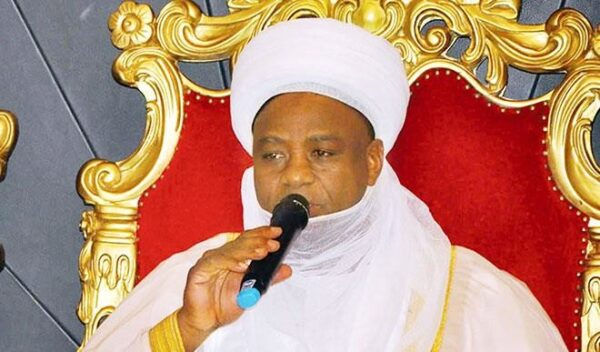
Nigeria’s unity must rise above ethnic, regional divisions – Sultan
By Adeola Badru
The Sultan of Sokoto, Alhaji Muhammad Sa’ad Abubakar III, has challenged Nigerian Muslims to rise above ethnic, regional and social divisions and take greater responsibility for safeguarding national unity, promoting religious tolerance and confronting the security challenges threatening the country.
The revered monarch warned that ethnicity, regional affiliations and differences in social backgrounds must never be allowed to undermine the unity of the Muslim Ummah or the collective responsibility of Nigerians to build a peaceful, stable and prosperous nation.
He stressed that Muslims, irrespective of their ethnic origins or geographical locations, shared a common religious identity and must demonstrate, through their conduct and relationships, the unifying principles of Islam.
The Sultan made the call on Sunday in Ibadan, Oyo State, while addressing participants at the 11th General Assembly of the Muslim Ummah of South-West Nigeria (MUSWEN), held at the M.O. Abdul Hall, University of Ibadan Central Mosque Auditorium.
The assembly, which attracted Islamic leaders, traditional rulers, government representatives and other dignitaries, was held under the theme, “Insecurity in Nigeria: A Technology-Driven and Collective Approach for National Development.”
Abubakar, who is also the President-General of the Nigerian Supreme Council for Islamic Affairs (NSCIA), maintained that the survival and progress of the Muslim community depended largely on its ability to preserve its common identity and resist divisive tendencies capable of weakening its collective strength.
According to him, the Almighty Allah created humanity as one family, making it imperative for Muslims to place their religious obligations and shared humanity above ethnic sentiments and other considerations.
“We are one big family. Ethnicity should never be a determining factor in identifying who is a Muslim and who is not. Almighty Allah created us as one human family and commanded us to worship Him alone and glorify His name,” the Sultan said.
He insisted that Islam must remain the guiding principle of Muslims’ lives, urging them not to allow political, ethnic or regional interests to displace the fundamental teachings of their faith.
“It must be Islam first, Islam first, Islam first, and Islam last,” he declared.
The Sultan further noted the equality of all human beings before Allah, explaining that neither ethnic background, social standing nor material possessions determined an individual’s worth in the sight of God.
He said righteousness, piety and the fear of Allah remained the true standards by which human beings should be judged.
“Before Allah, we are all equal. The best among us is the one who possesses the greatest degree of piety and righteousness,” he said.
The monarch consequently urged Muslim leaders, religious institutions and organisations across the country to remain committed to the service of Islam and humanity, warning against the danger of allowing ethnic and regional loyalties to erode the unity and collective aspirations of the Ummah.
He also called for a stronger commitment to peaceful coexistence and religious tolerance, stressing the importance of translating Islamic teachings into practical contributions towards the stability and development of Nigeria.
In his remarks, the Chairman of the MUSWEN Board of Trustees, Dr Olawale Babalakin, SAN, called for greater institutional cooperation and a stronger sense of collective responsibility among Muslim organisations in the South-West.
Babalakin argued that the ability of the Muslim community to make meaningful contributions to national development depended on its capacity to overcome internal divisions, strengthen its institutions and pursue clearly defined common objectives.
He identified education, technological advancement and sustainable funding as critical pillars for the organisation’s growth, urging Muslim stakeholders to invest in initiatives that would strengthen the community’s intellectual, economic and institutional capacity.
The legal luminary also cautioned against extremism, calling on Muslims to embrace moderation, peaceful engagement and constructive participation in national affairs.
He maintained that a more robust institutional structure would enable MUSWEN to achieve its objectives, respond effectively to the needs of its members and contribute more meaningfully to the wider society.
The outgone MUSWEN President, Alhaji Rasaki Oladejo, used the occasion to present an account of his six-year stewardship, highlighting achievements in property development, financial management, educational interventions and conflict resolution.
Oladejo said his administration had prioritised the strengthening of the organisation’s financial foundation and the establishment of sustainable structures to support its long-term activities.
He explained that the administration pursued investments and programmes designed to improve the organisation’s capacity to deliver on its mandate and provide tangible benefits to the wider Muslim community.
As part of its educational intervention, the outgone president announced plans to award scholarships to 12 female medical students under the Sultan Abubakar Female Medical Student Scholarship Scheme.
The beneficiaries, he explained, would be drawn from the six South-West states, with two students selected from each state.
He also disclosed that MUSWEN planned to award 120 bursaries in 2027, in furtherance of its commitment to educational development and support for young people.
In his acceptance address, the new MUSWEN President, Alhaji Rafiu Adisa Ebiti, pledged to build on the achievements of his predecessor and reposition the organisation as a stronger institution capable of addressing the educational, healthcare, economic and social challenges confronting Muslims in the South-West.
Ebiti said his administration would pursue a more people-oriented agenda, with particular attention to education, healthcare delivery, economic empowerment and the development of women and young people.
He explained that the organisation must move beyond institutional activities to initiatives capable of producing measurable improvements in the lives of its members and contributing to the development of the country.
“We want a MUSWEN that is more responsive to the needs of the people, particularly in education, healthcare, economic empowerment and the development of our youths and women. Our responsibility is to build on the achievements of the past and make the organisation more effective,” he said.
On Nigeria’s worsening security situation, the new president condemned banditry, kidnapping, terrorism and communal violence, describing the challenges as issues requiring coordinated responses from government institutions, security agencies and local communities.
He called for improved intelligence-sharing, stronger collaboration between security agencies and community stakeholders, and greater accountability within the country’s security architecture.
Ebiti also advocated consideration of constitutionally grounded decentralised policing as part of a comprehensive strategy for addressing the country’s security challenges, arguing that Nigeria’s diverse security realities required effective responses that reflected the peculiarities of different communities.
He maintained that security agencies must develop stronger relationships with local populations to improve intelligence gathering, prevent criminal activities and ensure timely interventions when threats emerge.
“Security cannot be left to government agencies alone. There must be effective cooperation between security institutions and local communities, supported by timely intelligence, accountability and a system that can respond adequately to the peculiar security needs of different areas,” he said.
The MUSWEN president further stressed the need for Nigerians to approach the 2027 general elections with a commitment to peace, tolerance and democratic responsibility.
He called on political actors and their supporters to shun violence, inflammatory rhetoric and other activities capable of threatening national stability, assuring that MUSWEN would retain its non-partisan position while continuing to advocate the interests of Muslims within the broader framework of national unity.
Ebiti said the organisation would not abandon its responsibility to speak on issues affecting the Muslim community and the country at large, but would discharge that responsibility without compromising its commitment to peaceful coexistence.
Also speaking at the assembly, the All Progressives Congress governorship candidate in Oyo State, m Sarafadeen Alli, emphasised the importance of moral and religious education in tackling the social challenges confronting Nigeria, particularly among young people.
Alli, drawing from his experience growing up in a religiously diverse community, said the ability of people of different religious persuasions to live together peacefully was rooted in tolerance, mutual respect and a willingness to understand one another.
He maintained that religious differences should not become instruments of hostility or division, insisting that Nigerians must recognise their shared humanity and embrace peaceful coexistence irrespective of their faith.
“Growing up in a community where people of different religions lived together taught me the importance of tolerance and mutual respect. Our religious differences should not divide us; rather, we should learn to understand one another and live together in peace,” he said.
The APC governorship candidate called for renewed emphasis on moral and religious instruction in schools, arguing that the challenges of indiscipline and other social vices confronting the country could not be addressed without paying adequate attention to the moral upbringing of children and young people.
He said sound moral education remained essential to producing responsible citizens who would contribute positively to society, respect the rights of others and uphold the values necessary for a peaceful and progressive nation.
Ends
The post Nigeria’s unity must rise above ethnic, regional divisions – Sultan appeared first on Vanguard News.