
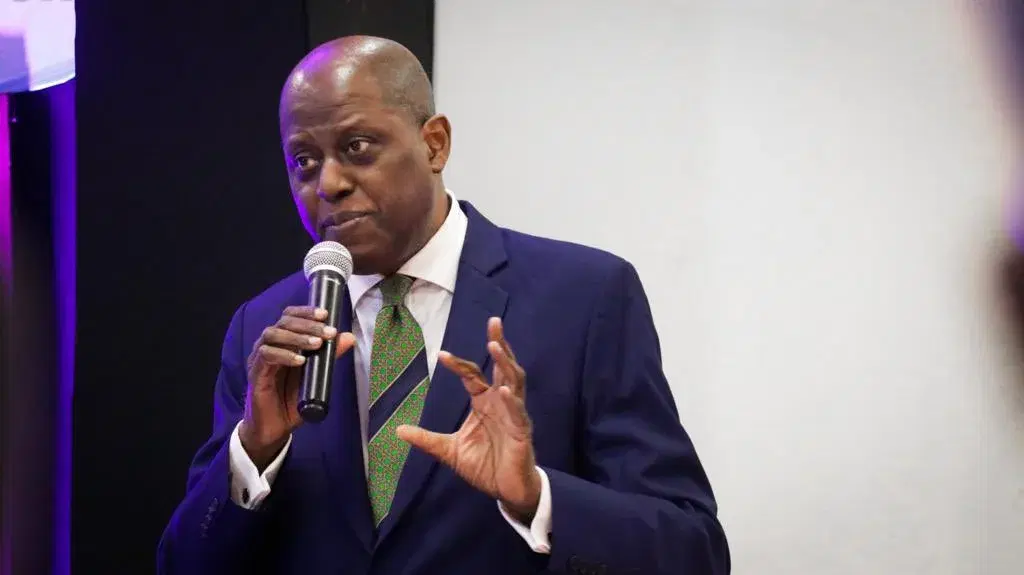
Nigeria’s stability will attract long-term investment — Cardoso
By Babajide Komolafe, Economy Editor
Governor of the Central Bank of Nigeria, CBN, Olayemi Cardoso, has said sustained macroeconomic stability, declining inflation and confidence in policy direction will attract long-term investment into Nigeria, boosting production and creating jobs.
Cardoso, who spoke alongside the Minister of Finance and Coordinating Minister of the Economy, Mr. Taiwo Oyedele
at the 2026 IMF/World Bank Annual Meetings said Nigeria’s economic recovery was creating opportunities to deepen investor confidence and mobilise capital for productive activities.
According to him, “The global economy has shown resilience in the face of fragmentation and significant headwinds, but the environment remains fragile. What is important for Nigeria is to sustain the progress we have made and create the conditions for private investment to flourish.”
He said the CBN would continue to pursue policies aimed at restoring price stability, strengthening the foreign exchange market and improving the economy’s capacity to withstand external shocks.
“We are focused on price stability. Our decisions are data-dependent, and we will continue to communicate clearly so that businesses, households and investors understand the direction of monetary policy,” Cardoso said.
The governor stated that the decline in inflation provided an opportunity to recalibrate monetary policy while maintaining a sufficiently tight stance to consolidate the gains achieved.
“Inflation has come down significantly from the levels we saw previously. Headline inflation was 14.63 per cent in September 2026, compared with about 34.8 per cent at the end of 2024. That is an important development, but we must ensure that the decline is sustained,” he said.
He added that lower inflation would help businesses plan more effectively, improve investment decisions and support production and employment.
“When inflation is high and unpredictable, businesses find it difficult to plan. It affects their costs, their pricing decisions and their willingness to invest. Our objective is to achieve price stability that supports sustainable growth and allows businesses to make longer-term decisions,” he said.
Cardoso said the CBN’s medium-term objective remained the achievement of single-digit inflation, stressing that monetary policy would be guided by economic conditions rather than pressure to follow the decisions of other central banks.
“We cannot simply copy what other central banks are doing. Our decisions must reflect Nigeria’s circumstances, the structure of our economy and the evidence before us. The objective is to make decisions that are appropriate for our economy while maintaining credibility,” he said.
On foreign exchange, the governor said improved stability was strengthening confidence in the naira and providing a more predictable environment for investors.
“Our external reserves are now above $55 billion, the highest level in 18 years. That gives us a stronger buffer against external shocks and helps to support confidence in the economy,” he said.
He added that the CBN was working to strengthen formal diaspora remittances as part of efforts to diversify Nigeria’s foreign exchange earnings.
“Formal remittances are approaching $1 billion monthly. We want to build on that progress because remittances are an important source of foreign exchange for Nigeria. We must continue to improve the channels through which these funds enter the formal financial system,” Cardoso said.
The governor also highlighted the need to mobilise long-term domestic and foreign capital to finance infrastructure, businesses and other productive sectors.
“We need to deepen our capital markets and create more opportunities for long-term investment. Stability is important because investors need confidence that the rules will remain predictable and that their investments can be managed within a credible policy environment,” he said.
He said the CBN would strengthen collaboration with development finance institutions, including the Africa Finance Corporation, AFC, to support investment and economic development.
“The role of the CBN is to maintain monetary and financial stability. Development finance institutions have their own mandates to support productive investment. We need to work together more closely so that stability can translate into financing for the real economy,” he said.
Cardoso noted that the banking sector had also made progress through the recapitalisation exercise, which attracted substantial domestic investment.
“Banks have raised about ₦4.65 trillion in fresh capital, and just over 70 per cent came from domestic investors. This is significant because it shows that Nigerian investors are willing to commit capital to the banking system,” he said.
He said the stronger capital base would improve the resilience of the financial system, while emphasising the need for banks to remain well governed and capable of supporting economic activity.
“Our task is to sustain confidence, maintain financial stability and ensure that the financial system remains strong enough to support the economy through changing conditions,” Cardoso said.
He added that the ultimate objective was to ensure that macroeconomic stability translated into higher investment, stronger production and more employment opportunities for Nigerians.
The post Nigeria’s stability will attract long-term investment — Cardoso appeared first on Vanguard News.