

ILLUSION OF PROSPERITY: Inside the Great Economic Disconnect—Why Paper GDP Can’t Feed a Hungry Nation
The Mirage of Growth: When Spreadsheets Flourish While Families Famine
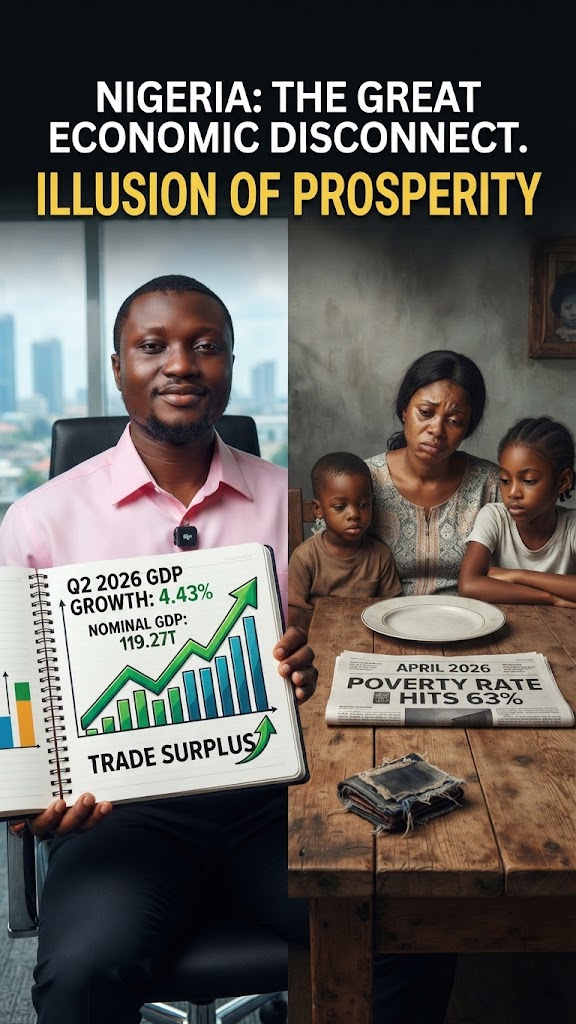
To the detached observer gazing at raw fiscal metrics, Nigeria’s economic ledger looks like a textbook success story. The figures glow with technical validation: a gross domestic product growth rate ticking upward to 4.43%, nominal GDP scaling past 119 trillion Naira, and foreign reserves hitting milestones unseen in nearly two decades. Yet, these impressive data points mask a profound national dissonance.
When analysts and critics attempt to dismantle the administration’s claims by pointing to worsening poverty rates, they often commit a fundamental category error: they treat transitional structural pain as permanent structural failure, ignoring the foundational lag inherent in macro-level economic therapy. But understanding why Nigeria’s current trajectory cannot be dismissed as a mere “statistical illusion” requires looking past the superficial talking points and examining the complex mechanics of national transformation.
Dissecting the Critique: Where the Pains of Transition Outpace the Data
Critics often leverage international reports—such as World Bank updates highlighting high poverty footprints or out-of-school children metrics—to argue that the administration’s Renewed Hope agenda is completely decoupled from reality. The narrative is emotionally potent: If the economy is expanding, why are millions sinking deeper into hardship?
However, this critique crumbles under rigorous economic scrutiny when compared with historical precedents and international realities:
The Lag Effect of Macroeconomic Rebalancing: Major structural surgeries—such as the removal of historic fuel subsidies and foreign exchange market harmonizations executed by President Tinubu—are designed to correct decades of artificial fiscal suppression. Economists universally recognize a J-curve effect in structural adjustments: performance indicators dip or strain at the micro-level before stabilizing and trickling down. Evaluating a three-year reform cycle without accounting for the multi-decade accumulation of systemic debt is analytical shortsightedness.
Global Benchmarks of Pain vs. Progress: Critics frequently invoke foreign economic utopias or compare Nigeria’s transition to nations with vastly different economic complexities. Yet, every major economy that successfully overhauled its currency and energy sectors—from India to Indonesia—faced severe interim cost-of-living shocks. Growth does not instantly manifest on the dinner table the morning a reform policy is gazetted; it requires capital accumulation, infrastructure maturation, and localized production scaling, which are precisely the sectors currently registering upward trajectories.
Confusing Symptoms with Root Causes: Pointing out inflation and food security challenges as an indictment of current reforms ignores the alternative. Returning to the “dark past” of heavily subsidized, debt-financed consumption was leading the country toward imminent fiscal insolvency. The current hardship is not manufactured by the reforms; rather, the reforms are exposing the raw, unmasked reality of years of deferred economic reckoning.
Humanizing the Ledger: Bridging the Gap Between Policy and the People
At its core, governance is indeed about human lives, not merely spreadsheet rows. President Tinubu himself noted that economic growth must ultimately translate to the dinner table and the pocket.
For the average Nigerian navigating the transition, patience feels like an elite luxury. Mothers managing tight household budgets and young graduates seeking stability cannot eat GDP percentages. Yet, sustainable wealth cannot be distributed until it is first generated. With trade surpluses turning positive, credit ratings improving, and targeted interventions like student loan frameworks (NELFund) and upcoming agricultural ramp-ups taking root, the architecture for long-term stability is being laid.
The path forward requires holding the government accountable not by rejecting growth metrics, but by demanding that the burgeoning macroeconomic stability aggressively accelerates social safety nets for the vulnerable.
As Nigeria stands at this critical economic crossroads, how can the federal administration more effectively bridge the gap between impressive macro-level recovery and immediate micro-level relief for struggling households?
Written by Adesida Oluwaseun
Oluwaseun is a seasoned financial journalist and public relations consultant specializing in economic analysis and strategic communications.