
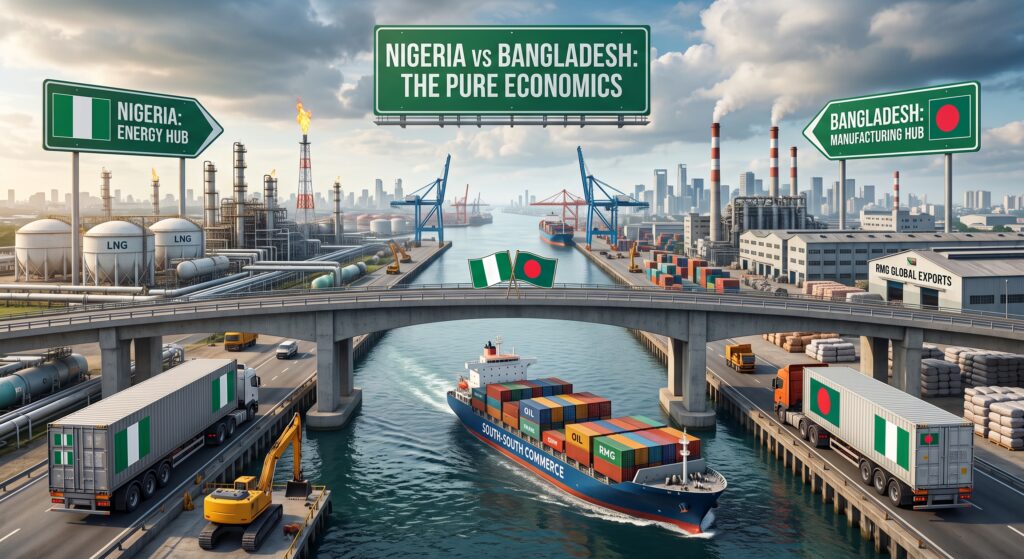
EXCLUSIVE: Beyond the Talking Points: How Nigeria and Bangladesh Built a $100M+ Trade Bridge
Breaking: As Political Figures Debate Comparisons, Bilateral Trade Surpasses the $100 Million Benchmark Driven by LNG, Textiles, Concrete Agritech and Rice Alliances
For years, Bangladesh served as the ultimate political metaphor in Nigerian election debates. Opposition leader Peter Obi routinely wielded the South Asian nation’s staggering rice output—producing tens of millions of metric tons annually on a sliver of land—as a rhetorical indictment of Nigeria’s untapped agricultural potential.
Today, that comparison has pivoted from political campaign platforms into practical economic reality. Rather than remaining a punchline on Nigeria’s agricultural deficits, Abuja and Dhaka are operationalizing bilateral trade and agro-processing frameworks designed to transform Nigeria’s rice belt into a high-yield powerhouse.
The Pivot from Metaphor to Machinery
Bilateral trade between Nigeria and Bangladesh has officially surpassed the $100 million benchmark, with diplomatic and commercial missions shifting focus toward deep agricultural synergy.
| Metric / Framework | Bilateral Realities |
| Bilateral Trade Volume | Exceeded $100 Million (up from ~$50M–$65M in prior cycles). |
| Key Agricultural Strategy | Cross-border Contract Farming and high-yield seed technology transfer. |
| Nigeria’s Supply Line | Exporting raw cotton, soybeans, and energy commodities (LPG/LNG) to feed Bangladesh’s industries. |
| Bangladesh’s Agri-Tech Input | Deploying climate-adaptive cultivation techniques and mechanized agro-processing in Nigeria. |
| Institutional Platforms | Developing-8 (D-8), Commonwealth Enterprise and Investment Council, and the OIC. |
Unlocking the Land: Contract Farming and Seed Tech
The core catalyst behind this evolving partnership is a mutual recognition of resource complementarity:
High-Yield, Climate-Resilient Cultivation: While Nigeria possesses over 34 million hectares of arable land, its average rice paddy yield has historically hovered between 1.5 and 2.5 tonnes per hectare due to traditional inputs and flood vulnerability. Bangladeshi agronomists are introducing flood-tolerant, high-density cultivation methods capable of doubling local yields.
Institutional Contract Farming: Bilateral envoys, led by Bangladesh’s High Commissioner Miah Md. Mainul Kabir and Nigeria’s Minister of Foreign Affairs Yusuf Tuggar, have prioritized direct private-sector contract farming agreements, connecting Nigerian landowners with Bangladeshi technical expertise.
Securing Industrial Synergies: The partnership operates as a two-way corridor. While Nigeria leverages Bangladeshi agritech to bridge domestic rice deficits, Nigerian raw cotton and agricultural commodities continue to supply Bangladesh’s global garment and manufacturing mills.
The Operational Reality
While political rhetoric framed Bangladesh as a symbol of Nigeria’s missed opportunities, the current diplomatic trajectory proves that closing the agricultural gap requires technology transfer, private-sector capital, and institutional policy—not just podium comparisons. By embedding Bangladeshi cultivation models directly into Nigerian soil, both nations are translating abstract campaign statistics into actual food security and industrial growth.