GLOBAL COLLAPSE! Global Microsoft Server Shutdown Paralyzes Nigerian Banks and Big Corporates
In what is rapidly escalating into one of the most severe digital catastrophes of the year, a massive global Microsoft server shutdown is currently tearing through the corporate world. From the bustling financial hubs of Lagos and Abuja to boardrooms across 74 countries, businesses are waking up to a terrifying reality: the digital backbone of their daily operations has collapsed.
The unprecedented disruption, which began wreaking havoc on Thursday, November 12, 2026, and has spilled over into today, has effectively paralyzed critical Microsoft 365 services. Millions of users worldwide find themselves completely locked out of Outlook mailboxes, Microsoft Teams virtual meetings, SharePoint data, and even the flagship AI assistant, Copilot.
Applying the rigorous investigative framework detailed in a deep dive into this unfolding tech disaster reveals that this is not just a localized glitch, but a fundamental infrastructure breakdown exposing the fragile underbelly of the global cloud economy.
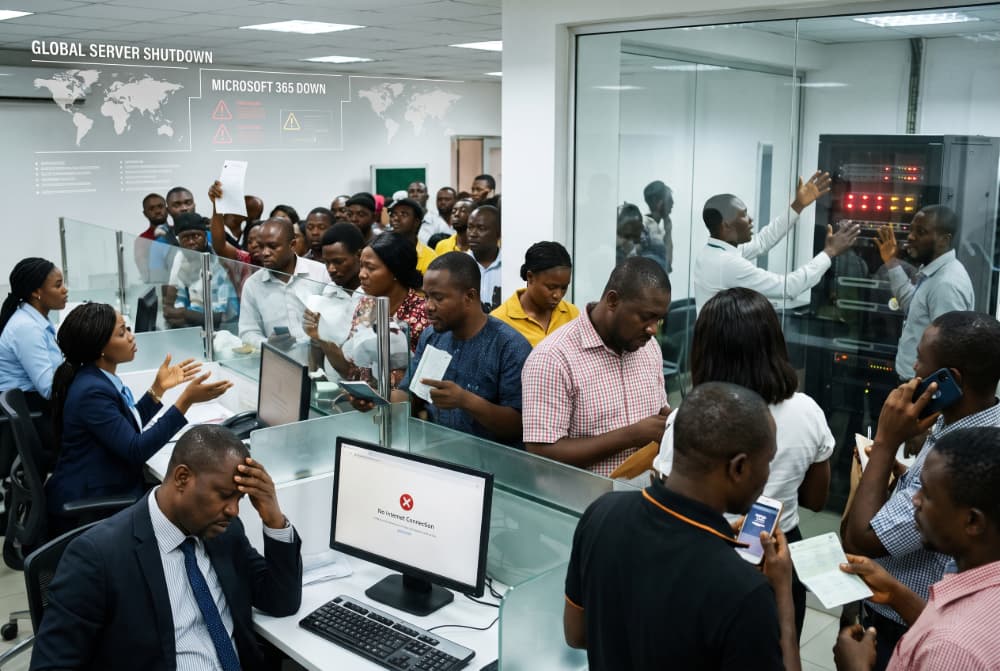
The Nigerian Corporate Blackout For Nigeria’s tier-one commercial banks, federal government institutions, and large-scale manufacturing corporates, the over-reliance on Microsoft 365 has triggered a localized crisis. Inside the air-conditioned banking halls of Victoria Island and corporate headquarters nationwide, customer service workflows are stalling, intra-branch communications have flatlined, and massive institutional data transfers are hitting a digital brick wall.
Without access to Outlook and Teams, the traditional corporate hustle of Lagos has ground to a painful halt. IT departments across the country are scrambling to find workarounds, while executives are resorting to WhatsApp and traditional phone calls just to keep basic logistics moving. The human cost of this disruption is profound: stressed employees are unable to deliver critical reports, supply chains are left stranded in communication voids, and there is mounting anxiety over the security and accessibility of institutional data.
The Global Domino Effect The shutdown is not just a Nigerian problem; it is a global hemorrhage. Independent outage-tracking platforms like Downdetector recorded a tidal wave of panic as the disruption spread across the Americas, Europe, Asia, and Africa in under an hour. The fallout has been staggering:
Corporate Earnings Delayed: In Europe and the US, major financial disclosures, including the third-quarter earnings report of electric truck maker Workhorse Group, were forced to reschedule due to the sheer inability to access data.
Educational and Institutional Paralysis: In Australia, students and teachers were locked out of online classes, while businesses were completely incapable of printing invoices. Even court livestreams were aggressively disrupted.
AI Integrations Broken: The outage aggressively crippled the Microsoft connectors utilized by major AI firms like OpenAI and Anthropic, proving that even cutting-edge artificial intelligence is instantly rendered useless when the foundational servers die.
The Technical Crisis: Fixes “Not Taking as Expected” What exactly caused this unprecedented digital blackout? Microsoft has firmly stated that they have “no indication” of malicious activity or a cyberattack. Instead, the tech giant is battling a severe, self-inflicted infrastructure collapse.
According to technical dispatches, a significant portion of Microsoft’s server infrastructure experienced an “elevated load,” causing critical servers to unexpectedly fail during automated health checks. As engineers desperately attempted to reroute traffic away from the dead zones and restart the systems, they hit a terrifying roadblock: the resurrected servers immediately became unresponsive again the moment new traffic hit them.
With fixes reportedly “not taking as expected” and the recovery process delivering only “marginal success,” the global tech titan is fighting a rolling, unpredictable crisis. While rival Amazon Web Services (AWS) proudly announced they were “operating normally,” the message to the corporate world is chillingly clear.
The era of blind trust in a single cloud provider is officially over. As Nigerian businesses bleed productivity by the hour, this global Microsoft shutdown forces a bitter reckoning: when the cloud evaporates, the modern economy falls straight to the ground.