
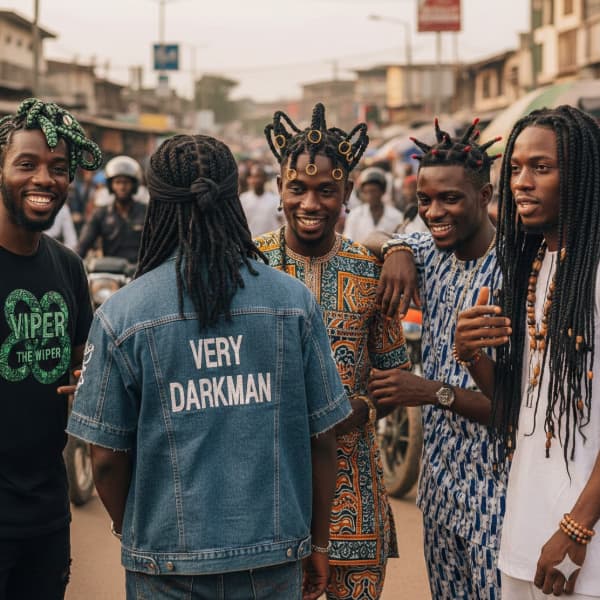
Battle for the Scalp: Why Male Hair Braiding is Tearing Nigerian Generations Apart
LAGOS — A profound cultural shift is rewriting the rules of masculinity on the streets of Nigeria. Once strictly reserved for women or niche entertainment figures, intricate hair braiding has exploded as a mainstream fashion statement among young Nigerian men.
However, this surging Gen Z and millennial trend has ignited a fierce culture clash. From corporate boardrooms and university lecture halls to church altars and mosques, traditionalists are actively pushing back against what they view as a dangerous erosion of African values.
As parents increasingly march their young sons to salons to get their hair braided, the lines in this cultural war continue to blur. Whether society eventually accepts male braids as a legitimate evolution of African self-expression or permanently outlaws them as a moral failure remains the defining cultural question of 2026.
The Origin: From Resistance to Runways
To the young men sitting in salon chairs, braiding is not a rebellion; it is a reclamation. Historically, braids in ancient African societies served as complex communication tools, indicating a person’s tribe, age, and social status. During the era of slavery, braided patterns even mapped out escape routes.
Today, modern youth frame the trend as a revival of indigenous artistry. Driven by the global influence of Afrobeats and fashion influencers, young men use braids, cornrows, and dreadlocks as a deeply personal expression of identity and creativity.
The Corporate and Cultural Pushback
Despite its rising popularity, conservative society violently rejects the aesthetic. Community elders and traditionalists routinely label male braiding a “taboo” and a direct import of misguided Westernization.
Corporate professionals actively enforce these conservative norms. In fields like medicine, law, and engineering, human resource managers routinely discard resumes of men sporting braids. “Our traditions have been replaced by modern civilization,” lamented Michael Samson, a civil servant who strongly opposes the trend. Many elders echo this sentiment, warning that such hairstyles invite unnecessary harassment and suspicion from law enforcement agencies, who often profile braided youths as cybercriminals or cultists.
Teachers Crack Down: The Academic Ban
The culture clash has turned university campuses into active battlegrounds. Educational administrators argue that male hair braiding violates institutional dress codes and moral standards.
Recently, authorities at universities like the Obafemi Awolowo University (OAU) proposed severe restrictions targeting Gen Z fashion. Drafted policies explicitly ban male hair braiding alongside dreadlocks and colored hairstyles. Students who violate these strict grooming rules face severe sanctions, including a two-semester rustication, proving that academic institutions are aggressively policing male appearances.
The Pulpit Divide: Pastors and Imams Weigh In
Religious leaders are spearheading the moral opposition. In Christian and Islamic circles, clerics preach that male hair braiding violates scriptural modesty and blurs gender lines.
Recently in Lagos, Rev. Hezekiah Duro-Aina of the Conquerors Assembly explicitly instructed his congregation that Christian men must avoid plaiting their hair. “We, Christians, are meant to be different from the world,” the cleric preached. “I can’t plait my hair and go on the streets and want to preach the Word of the Lord. It is my head that people will be looking at.”
Islamic scholars equally condemn the practice, citing teachings that forbid men from imitating the adornments of women. They urge parents to reclaim their households from the grip of social media influences.
Yet, a few modern religious figures challenge this orthodox stance. Prominent young clerics like Pastor Jimmy Odukoya of the Fountain of Life Church openly wear dreadlocks, arguing that spirituality stems from the heart, not the scalp, and even citing biblical figures like Samson who never cut their hair.
A Generational Standoff
As parents increasingly march their young sons to salons to get their hair braided, the lines in this cultural war continue to blur. Whether society eventually accepts male braids as a legitimate evolution of African self-expression or permanently outlaws them as a moral failure remains the defining cultural question of 2026.