“Linguistic Flourish” on Trial: Inside El-Rufai’s High-Stakes Retraction and Echoes of Obasanjo’s Warning
In the quiet formality of a Federal High Court courtroom in Abuja, bravado has a way of evaporating under oath. On Wednesday, November 25, 2026, former Kaduna State Governor Nasir El-Rufai—a politician long defined by his sharp tongue and combative television appearances—found himself dismantling his own televised boast. Facing trial over the alleged unlawful interception of National Security Adviser (NSA) Nuhu Ribadu’s telephone communications, El-Rufai took the witness stand before Justice Joyce Abdulmalik and told the court that his explosive public claim of tapping the nation’s top security chief was never meant to be taken literally.
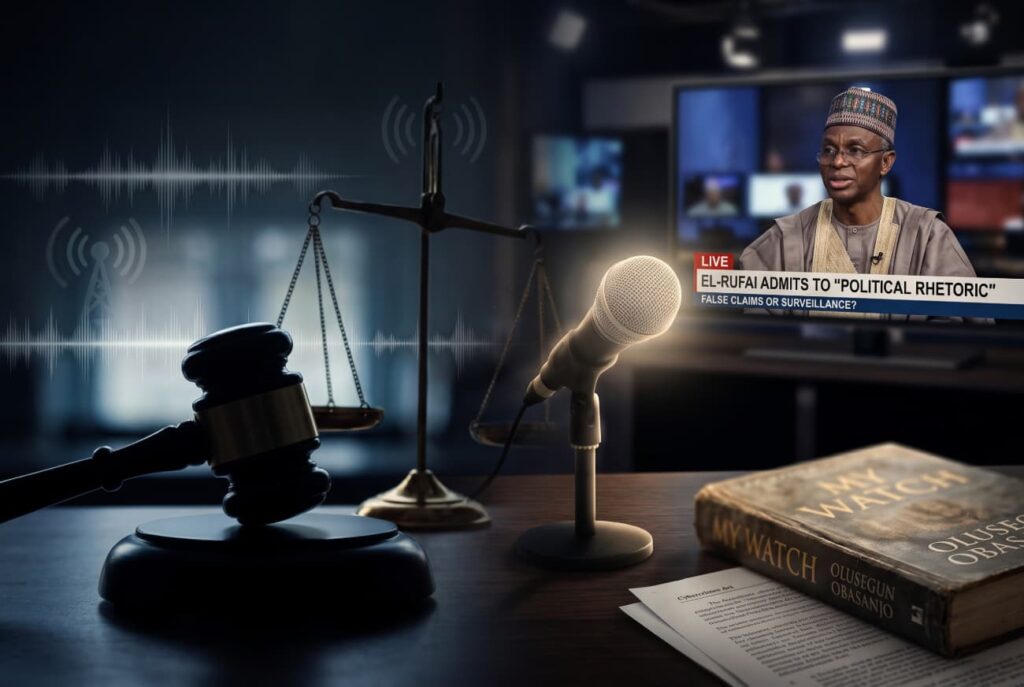
“What I wanted to say was that the government was monitoring opposition figures and that we knew what they were doing,” El-Rufai testified after his counsel played the broadcast recording in court. “I used the word ‘tap’ as political rhetoric to make them uncomfortable. It was rhetorical, not literal. It was linguistic flourish, just to make the government uncomfortable.”
El-Rufai
The admission—made as El-Rufai opened his defence following the court’s October 26 rejection of his no-case submission—instantly reframed one of Nigeria’s most closely watched political trials. Yet for longtime observers of Nigerian politics, the spectacle of El-Rufai retreating from a sensational public claim carried an uncanny echo of a blistering character assessment written more than a decade ago by his former boss and political mentor, former President Olusegun Obasanjo.
In Volume 2 of his memoir, My Watch (pages 110–112), Obasanjo acknowledged El-Rufai’s intellect while delivering a scathing verdict on his relationship with the truth and his impulse to exaggerate his own stature. “He was described as a malicious liar. He was more than that; he is a pathological purveyor of untruths and half-truths with little or no regard for integrity,” Obasanjo wrote. “In all of this, he unwittingly does more harm than good to himself. He’s always playing himself up to give himself more ‘height’ than he has.” Elsewhere in the same passage, the former president remarked that while El-Rufai was brilliant and capable of delivering under close supervision, “Character wise, Nasir has not much going for him.”
Obasanjo
Today, that alleged habit of “playing himself up” sits at the heart of a fascinating split legal scenario under Nigerian law. By recasting a national security claim as mere theatrical exaggeration, El-Rufai has mounted a calculated legal shield against the wiretapping charges—even as he opens a fresh debate over whether a senior political figure can be criminally prosecuted for misleading the public on live television.
The Retraction Defence: Shifting the Burden Back to the State
At first glance, admitting on the witness stand that one fabricated a televised claim sounds like a courtroom disaster. Legally, however, El-Rufai’s testimony strikes directly at the prosecution’s burden of proof on the specific charges before the court.
Under the Nigerian Evidence Act, a televised statement admitting to an offence is classified as an extra-judicial admission. While Nigerian courts possess the legal authority to convict a defendant on a retracted confession, appellate courts have consistently warned that it is unsafe to do so without independent corroborating evidence. In his testimony, El-Rufai insisted under oath that he neither owns surveillance equipment nor possesses the technical knowledge required to intercept telephone communications.
That denial forces the Federal Government into a corner. To secure a conviction on the wiretapping counts, prosecutors must prove beyond reasonable doubt that an actual interception occurred. Unless the state can tender forensic telecommunications logs, seized surveillance hardware, or credible technical witnesses establishing that Ribadu’s line was genuinely breached, the court is legally bound to acquit El-Rufai of unlawful interception—even if the presiding judge concludes that he lied on national television.
Still, the strategy carries a steep reputational cost inside the courtroom. Admitting to making a fabricated claim on air inevitably damages a defendant’s credibility as a witness. That tension was palpable during cross-examination when El-Rufai maintained that every other assertion he made in the same broadcast—including his claims that he never stole public funds and knew nothing about the disappearance of Kaduna activist Abubakar Idris, popularly known as Dadiyata—was completely factual and true, carving out only the Ribadu phone-tapping remark as rhetorical flourish.
Can the State Prosecute Him for the Lie Itself?
As news of the backtracking spread, a central question dominated public discourse: if El-Rufai admits he misled Nigerians about a breach of the National Security Adviser’s communications, can he be convicted for lying?
The legal answer is nuanced. A Nigerian court can only convict a defendant of the exact offences listed on the charge sheet. Because El-Rufai is currently standing trial for unlawful interception of communications—with Justice Abdulmalik adjourning the matter to February 15 and 16 for the continuation of his defence, during which his legal team intends to seek the attendance of Ribadu and the ICPC Chairman as witnesses—the judge cannot simply pivot and convict him of spreading falsehoods.
Nor does the televised exaggeration constitute perjury. Under Nigerian law, perjury applies strictly to lying under oath, such as in a courtroom or a sworn affidavit. Ironically, had El-Rufai repeated the wiretapping claim on the witness stand and been disproven by technical evidence, he would have risked a perjury charge. By disavowing the TV boast under oath, he sidesteps perjury while undermining the core wiretapping allegation.
That does not mean a false public statement carries zero legal exposure. If the Federal Government or the Department of State Services (DSS) chooses to pursue El-Rufai for the falsehood itself, prosecutors would have to formally amend the existing charges or file a fresh suit under two primary statutes:
- Section 418 of the Penal Code Act: Applicable in Abuja and Northern Nigeria (with Section 59 of the Criminal Code Act serving as its Southern equivalent), this provision criminalizes publishing or circulating any false news, rumour, or report likely to cause fear and alarm to the public or disturb the public peace. Security agencies actively deploy this statute—most notably in July 2025, when the DSS invoked Section 418 to prosecute a TikTok creator who spread a false rumour about President Bola Tinubu’s death.
- Section 24(1)(b) of the Cybercrimes (Prohibition, Prevention, etc.) (Amendment) Act, 2024: Because national television interviews are routinely streamed and redistributed online, prosecutors can invoke this section, which makes it an offence to knowingly transmit a false message via a computer system or network for the purpose of causing a breakdown of law and order or posing a threat to life.
The High Bar of Criminal Intent and Free Speech
Even if prosecutors decide to file fresh charges under either statute, converting a televised political boast into a criminal conviction is legally arduous. Both the Penal Code and the narrowed 2024 Cybercrimes Act require the state to prove far more than mere dishonesty; prosecutors must establish criminal intent beyond reasonable doubt.
To win under Section 24(1)(b), the government would have to prove that El-Rufai claimed Ribadu’s phone was tapped specifically to incite public disorder or endanger lives. El-Rufai’s careful courtroom phrasing—framing his words as “political rhetoric” meant “just to make the government uncomfortable”—appears tailor-made to neutralize that intent threshold.
Moreover, any prosecution for false news immediately collides with Section 39 of the 1999 Constitution, which guarantees freedom of expression. While that right is not absolute, Section 45 mandates that any legal restriction on speech must be reasonably justifiable in a democratic society in the interest of defence, public safety, or public order. Defence lawyers routinely argue that political hyperbole—even reckless or fabricated boasts by opposition figures—falls within protected political speech unless the state can demonstrate tangible public panic or a breakdown of order.
Outside the criminal courts, two secondary avenues exist, though neither offers an easy sanction against El-Rufai personally. First, Ribadu or another affected party could file a civil defamation lawsuit arguing that the false claim portrayed the Office of the National Security Adviser as compromised or incompetent; however, proving quantifiable reputational damages from political rhetoric in civil court is notoriously difficult. Second, under the National Broadcasting Commission (NBC) Code, regulatory liability for airing unverified, sensational claims touching on national security falls on the television station that failed to moderate or challenge the guest, rather than on the interviewee himself.
A Defining Test of Rhetoric and Accountability
As the Federal High Court prepares to reconvene in February, El-Rufai’s trial has evolved into something larger than a dispute between two former allies who have known each other since 2003, when El-Rufai led the Bureau of Public Enterprises. Unless the prosecution produces concrete forensic evidence that Nuhu Ribadu’s phone was actually tapped, the case is no longer a straightforward cybercrime trial. Instead, it has become a defining legal test of where Nigeria draws the line between reckless political theatre and criminal public alarm—and a stark reminder of how words spoken for television applause can return to haunt a politician under the unforgiving glare of the witness box.