
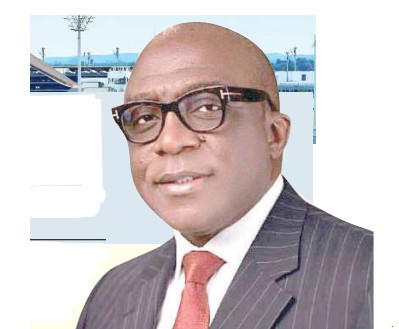
How aircraft financing, insurance costs, others weigh down airlines — Okonkwo
By Dickson Omobola
Professor Obiora Okonkwo is spokesperson for the Airline Operators of Nigeria, AON, and the Chairman of United Nigeria Airlines, UNA. He was a panelist at the 2026 edition of International Air Transport Association, IATA, Focus Africa Conference, themed: ‘Elevating Aviation Safety, Connectivity, and Operational Efficiency in Africa,’ held in Addis Ababa, Ethiopia. During the event, he identified challenges faced by airline operators, particularly Nigerian operators, pointing to aircraft acquisition, high insurance and operating costs and infrastructure deficits, among others, as issues that should be looked into to enable them compete.
Background:
From the operator’s perspective, I can tell you that we are the cash cow of the entire ecosystem. If the Original Equipment Manufacturers, OEMs, manufacture, the lessors pick up their credit. If it does not get to the operators to sell the tickets and return the money, they do not make money from the banks. The banks will lend capital, whether it is to the lessors or anybody buying the equipment; if the aircraft do not get to the operators to sell tickets, they do not make money. The ground operators, even IATA, if they do not get their own cut on every single ticket sold, there is no IATA. So, the entire aviation ecosystem depends on the operations of the operators.
Tilted against
But what I have seen from my experience in the industry over the last six years is that everything about this policy and growth is skewed against the operators. It is only the operators that do not have their own rules in terms of aircraft purchase, leasing conditions and everything else. We only sit back and ask: what do the rules say? What conditions are the OEMs expecting? What are the rates from the banks? It makes it very difficult.
Breathe
If we have this hope and expectation, and it does not allow the operators to succeed, then we will all fail. The OEMs are cashing billions of dollars, while the operators are left with $1.3 per seat. Everything that has been said here is choking us. We are not breathing, and we need to breathe, especially when it comes to financing. I have seen a whole lot of banks that have been… But at the end of the day, when all the major policy frameworks are in place and it comes to implementation, the … are huge.
Everyone secures their own comfort. The OEMs spread out every term in the aircraft acquisition process and map out DPP timelines. The lessors seal all aspects of their protection, layer upon layer. When they are done, they add risk. I can go on and on. The only party that does not have a say, but must comply, is the operator.
Boeing
As much as I acknowledge that the OEMs have done a lot, the support we need is for them to come down to our level. With all sense of appreciation, we would not be where we are in Nigeria today without the support of Boeing. Boeing stepped down, came to Nigeria, studied the problem and realised that there must be a change in policy.
The success we attribute to the minister today is based on the roadmap we developed together with Boeing. A lot still needs to be done. Our situation in Nigeria was different. There was a total blockade on aircraft leasing to Nigeria for the past 15 years, not due to our fault, but because of past issues.
Thank God we are over it now. However, some of us assumed it would be like the period of liberalisation in Russia, when people were suddenly allowed to travel abroad without understanding the requirements: no visas, no passports, no tickets. Some of us, in the process of implementing these changes, have now come face-to-face with those requirements.
The list is endless. Today, lessors in Nigeria do not just release funds easily. At the end of the day, when we carry out the economic calculations for dry leasing aircraft, it sometimes makes more sense to remain, in some cases, on wet leases.
What is the point? They continue to add layers of protection. What I am saying at this summit is that operators need to be protected in this entire process.
Financing
For OEMs, take Boeing as an example. For new aircraft, the American EXIM Bank only accepts sovereign guarantees from governments. This excludes us.
Today, the appetite of Nigerian banks is limited. Policymakers need to consider how to integrate commercial banks into this structure. That could enable operators with ambition to access aircraft financing.
Bird strikes
From January to April, we have had seven bird strikes. As we speak now, we have two aircraft on AOG. So, I am calling on the OEMs.
You might also help us with equipment to combat bird strikes. I know this has been done in other regions; we need that in Nigeria. We want you to get involved because it will help us. 40 to 50 per cent of our downtime is caused by bird strikes. It is a special appeal.
High operating cost
Across the country, there is no Maintenance Repair and Overhaul, MRO, facility where we can carry out C-checks on Embraer, Boeing, or Airbus aircraft. This shows that despite all the efforts mentioned, a lot still needs to be done.
We want to be able to fly.
I have just acquired six 737-800 aircraft from Southwest. As we speak, two are airborne, currently in the United States for painting and routine checks, after which they will be ferried to Nigeria. At today’s fuel costs, ferrying alone is extremely expensive. Because of these factors and others, our insurance costs are very high.
Insurance
For six aircraft, my insurance is about $2 million. In Europe, that amount could insure about 20 to 25 aircraft. But here, it is just six.
When aircraft are not flying, especially under dry lease, you are not making money but still have obligations to meet.
Under Aircraft, Crew, Maintenance and Insurance, ACMI, agreements, minimum hours are enforced. There is rarely a clause to reduce obligations during downtime. You end up paying more than you fly just to maintain industry standing.
Despite this, we have remained resilient and continue to keep aircraft flying. Operational reliability remains high, but disruptions are costly.
We aim to minimise these disruptions, especially non-routine checks. However, regional capacity limitations mean we need additional support, including from Boeing.
Policy support
Given the urgency, policy support must go beyond technical advice. Direct investment, especially in MRO facilities, is critical.
What Nigerian airlines need to do
We must improve corporate governance, maintain financial discipline, and become more attractive to lenders. We must also stand up for our rights within the aviation ecosystem.
Currently, operators are the least considered. We are often told what to do without input.
If this changes, it will create a more balanced, win-win system, improving efficiency, service delivery and industry growth.
Projection
Ethiopian Airlines has operated for about 80 years with just over 160 aircraft, while Southwest, in about 70 years, operates around 1,000 aircraft.
I believe in the potential of this market, that a lot needs to be done to actualise it. Like Southwest, we (United Nigeria Airlines) have the same history. Maybe in 70 years, United will be talking about 1,000 aircraft but that won’t be possible if we don’t do these things and correct them.
Nigeria among Africa’s top aviation safety performers — AFCAC
African Civil Aviation Commission, AFCAC, Wednesday, said Nigeria has emerged as one of Africa’s leading aviation safety performers, even as the continent is increasing efforts to make air travel affordable.
AFCAC’s Secretary General, Funke Adeyemi, said this while identifying the progress made in aviation safety, security and connectivity across Africa, adding that Nigeria currently ranks among countries with safety implementation scores in the 90 per cent range.
Adeyemi also said the continent’s average effective implementation score improved from 56 per cent to 62 per cent following coordinated safety interventions across multiple countries.
She spoke at the 2026 edition of IATA Focus Africa Conference, themed: ‘Elevating Aviation Safety, Connectivity, and Operational Efficiency in Africa,’ being held in Addis Ababa, Ethiopia.
She said: “Through the African and Indian Ocean Cooperative Inspectorate Scheme, AFI-CIS, 36 safety missions have been conducted across 14 African countries, directly targeting issues and deficiencies that have been identified in these countries. As a result, the effective implementation score on average for the continent improved from 56 per cent to 62 percent.
“Now, you may wonder, why these numbers, 62 percent? Well, let me tell you this: we have some countries in Africa, Nigeria, at 91. Many of the countries in Africa are actually leading the charts in terms of safety in the entire world.
“Many of those countries are in the high 90s, many more in the 80s and so on and so forth. But when you average out the numbers, that is why we are looking at 60-something per cent. But with Nigeria’s progress, and I congratulate the Minister and the team in Nigeria, it will help to increase that number as well.
“This just goes to show us that safety is not just a coordinated effort, but a joint one as well, that we all succeed together.”
Meanwhile, Minister of Aviation and Aerospace Development, Mr Festus Keyamo, restated Nigeria’s continued commitment to strengthening regulatory oversights and adherence to global best practises, among others.
Speaking at the conference, he said: “Nigeria continues to prioritise the strengthening of regulatory oversight, adherence to global best practices and collaboration with international partners to ensure the highest levels of aviation safety. Just last week, after our ICAO Safety Audit, we got the highest score in our history at 91.4 per cent. We recognise that a safe aviation system is the foundation upon which trust, growth and sustainability are built.
“Nigeria remains fully committed to working with all stakeholders, governments, industry players, and development partners to drive sustainable growth innovation. We believe strongly in partnerships, knowledge sharing and collaborative frameworks that will accelerate progress across the continent. The future of African aviation depends on our ability to translate ideas into measurable progress that benefits our people and our economies.”
Vanguard News
The post How aircraft financing, insurance costs, others weigh down airlines — Okonkwo appeared first on Vanguard News.