
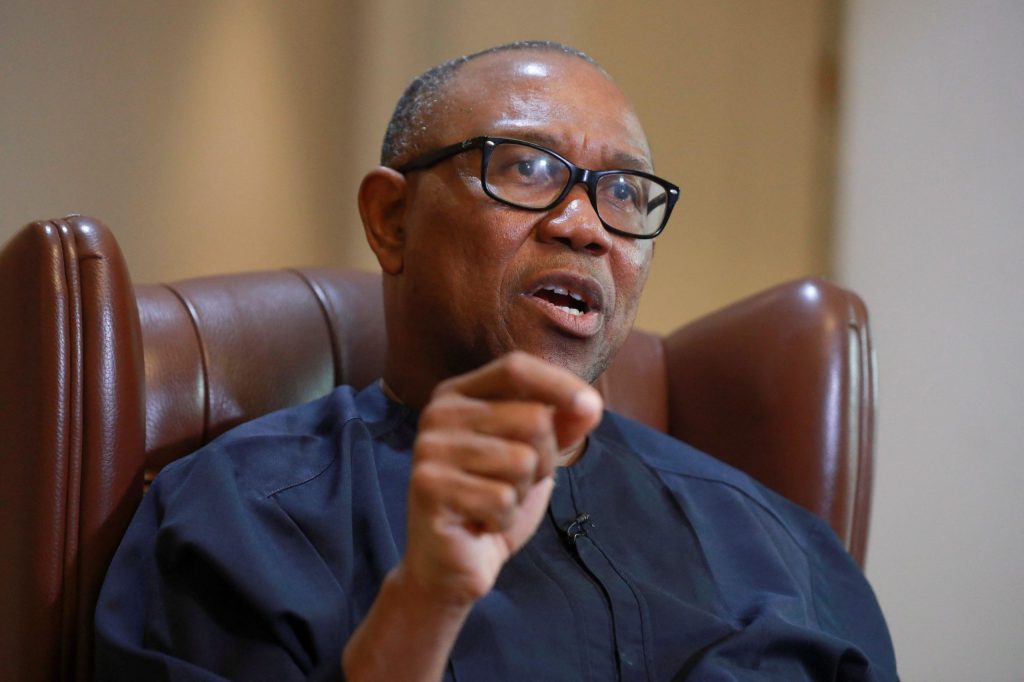
Why does Obi avoid party primaries? Critics, analysts differ
By Juliet Umeh
As political realignments ahead of the 2027 general elections intensify, fresh debate has erupted over the political style of Peter Obi, particularly his long history of avoiding fiercely contested party primaries.
Read Also: Obi-Kwankwaso Alliance: NDC surge rattles APC, reshapes 2027 battle lines
The controversy gained momentum after senior journalist and media executive Sumner Sambo argued during a political analysis programme that Obi has consistently avoided highly competitive national primaries throughout his political career.
According to Sambo, Obi’s political trajectory reveals a pattern of moving away from political platforms whenever internal structures appear unfavourable to his ambitions.
“Obi has not been someone who has faced a major national political primary before,” Sambo said.
Tracing Obi’s political journey, Sambo recalled that before the 2023 elections, Obi initially aligned with the Peoples Democratic Party, PDP, where former Vice President Atiku Abubakar had already emerged as a dominant force ahead of the party’s presidential primary.
According to him, Obi publicly attended Atiku’s declaration and described him as a “senior brother,” but eventually exited the PDP when it became clear the party structure did not favour his ambition.
“People had been calling on him from the South-East to contest, but when he saw that the political realities did not favour him in the PDP, he took the easy way out,” Sambo stated.
Obi later moved to the Labour Party where he eventually secured the presidential ticket with little internal resistance.
“There were other contestants already there, people like Pat Utomi, but he got an easy way out and secured the ticket,” Sambo added.
The analyst also revisited Obi’s earlier political history during the 2003 Anambra governorship race, noting that Obi moved from the PDP to the All Progressives Grand Alliance, APGA, where he benefited from the influence of the late Chukwuemeka Odumegwu Ojukwu.
“From 2001 to 2002 when he was in the PDP, he eventually left and joined APGA, latching on to the wings of Ojukwu and eventually got the ticket,” Sambo noted.
According to him, Obi’s anticipated participation in the coalition around the African Democratic Congress, ADC, would have provided the first genuine test of his political strength in a highly competitive national primary involving heavyweights such as Atiku, Rotimi Amaechi and Rabiu Musa Kwankwaso.
“This is the first time we were supposed to interrogate the political credentials of Peter Obi as a national political figure in the ADC,” he said.
Sambo further argued that intelligence reports surrounding ADC membership registration may have contributed to Obi’s eventual withdrawal from the coalition, particularly amid indications that northern states recorded stronger registration figures than the South-East.
“If you go through direct primaries, you won’t win,” he stated. Yet, while some critics interpret Obi’s pattern as political weakness or strategic avoidance, supporters insist the narrative ignores the deeper realities of Nigeria’s political culture. According to many of Obi’s loyalists and political sympathisers, the former Anambra governor avoids delegate-driven contests not because he lacks popularity, but because he refuses to participate in the monetised internal politics associated with Nigerian party primaries.
They argue that modern political primaries in Nigeria are often determined less by ideology or competence and more by the ability to influence delegates financially. Obi, they say, will never pay delegates to vote for him. “Obi will fail any primary against almost anybody because delegates can easily be induced financially,” one analyst sympathetic to Obi argued.
“But he will never participate in that process. He is not the kind of politician that bribes delegates.”
Supporters insist Obi represents a different political tradition built around issue-based campaigns rather than transactional politics.
According to them, instead of distributing patronage or engaging in vote-buying, Obi prefers campaigning directly to citizens with messages centred on governance reform, production, fiscal discipline and anti-corruption. However, critics counter that politics everywhere requires coalition-building, grassroots negotiation and effective management of party structures, arguing that refusing to engage party delegates weakens Obi’s long-term political viability.
For some observers, Obi’s repeated reliance on adoption or consensus arrangements reflects both a moral stance and a strategic necessity in Nigeria’s expensive political environment.
Meanwhile, veteran broadcaster Reuben Abati believes the latest political shifts involving Obi and Kwankwaso point to deeper instability within Nigeria’s opposition space.
Abati described the reported movement of both politicians toward the National Democratic Congress, NDC, as a decision driven by uncertainty surrounding the ADC coalition.
“Peter Obi and Kwankwaso acted wisely, but wisely out of fear,” Abati said. “The ADC train they joined may run into troubled waters.”
According to him, unresolved legal disputes involving opposition parties have created anxiety among major political actors ahead of 2027.
He nevertheless acknowledged Obi’s enduring influence in the South-East despite growing endorsements for President Bola Ahmed Tinubu by some regional political leaders.
“Don’t assume Peter Obi does not still have residual influence in the South-East,” Abati stated. “There are many people who still believe the time has come for the Igbo to produce Nigeria’s president.”
Abati also highlighted the strength of Kwankwaso’s Kwankwasiyya movement in Kano and parts of northern Nigeria, warning that the ruling All Progressives Congress, APC, may soon begin to fully appreciate the seriousness of the emerging opposition dynamics.
Still, Abati questioned the ideological direction of the NDC.
“What is the manifesto of the NDC?” he asked. “What does the NDC stand for regarding poverty, insecurity and the core challenges facing Nigerians?”
On her part, television host and political commentator Rufai Oseni argued that Obi’s exit from the ADC was less about court cases and more about internal political manoeuvring designed to edge him out of contention.
“The idea here is Obi not being on the ballot,” Oseni alleged. “All the forces will do everything to ensure Obi doesn’t get on the ballot.”
According to him, Obi remains the strongest opposition figure capable of seriously challenging Tinubu in 2027.
He also linked Obi’s earlier departure from the PDP to disagreements over power rotation, arguing that the same tensions resurfaced within the ADC coalition.
“The state chairmen and most of the structure had already been hijacked,” he claimed. “There was no way Obi was going to thrive or get a fair process.”
Oseni further argued that the inability of opposition politicians to unite may ultimately hand Tinubu a smoother path to re-election.
“The first winner in all of this will be President Tinubu,” he said.
Political analyst Ayo Mairo-Ese also examined the numbers behind the evolving opposition alliances, warning that even an Obi-Kwankwaso alliance may still struggle against the electoral advantage of incumbency.
According to her, Obi secured 6.1 million votes in the 2023 election while Kwankwaso polled nearly 1.5 million votes, bringing their combined total to about 7.6 million votes, still below Tinubu’s winning tally of 8.79 million votes.
“In 2023, President Tinubu won with 8,794,726 votes. So even if you combine Obi and Kwankwaso’s votes, they would still have fallen short,” she noted.
However, she argued that if Atiku had joined forces with both men, the opposition might have collectively polled over 14 million votes.
“That was why the coalition idea initially generated excitement,” she said. “But individual ambition overtook collective political strategy.”
Ayo also stressed that Nigeria’s democracy suffers from weak internal party democracy and the absence of ideological political structures. “Political parties in Nigeria are simply vehicles,” she argued. “Maybe it is time to start conversations around independent candidacy.”
She warned that despite Obi’s popularity and the strength of movements like the Obidients and Kwankwasiyya, the emerging NDC still faces structural weaknesses compared to the APC’s entrenched nationwide machinery.
“The electorate should not feel discouraged,” she added. “There must still be a free and credible election where Nigerians can choose.”
As debates continue over Obi’s political style and the future of the opposition, analysts say the broader issue extends beyond one politician.
At the centre of the controversy lies a bigger national question: Can issue-based politics and reformist campaigns survive within a political system still heavily shaped by money, patronage, incumbency and elite-controlled party structures?
The post Why does Obi avoid party primaries? Critics, analysts differ appeared first on Vanguard News.