
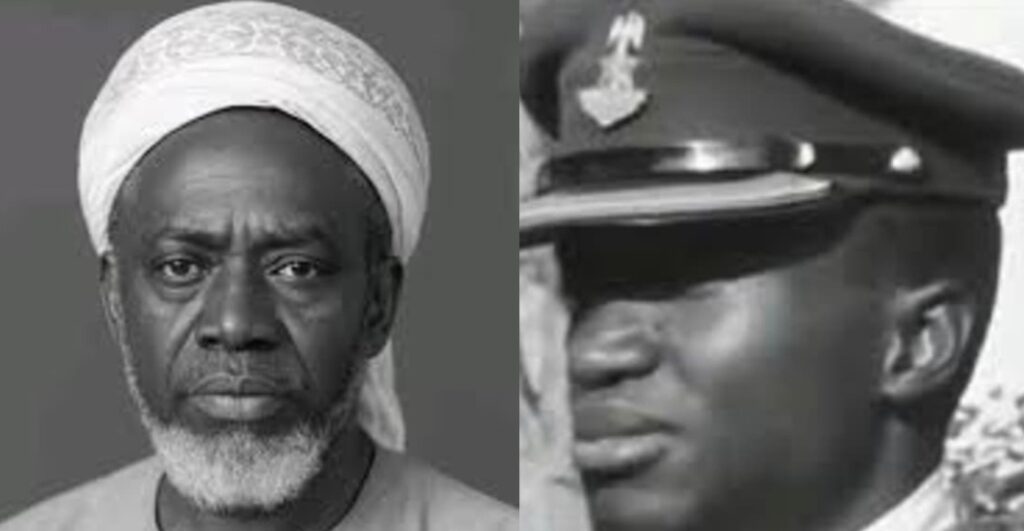
When Gumi Met Nzeogwu: The Day a Sheikh Confronted the Sardauna’s Killer
On the morning of January 15, 1966, the smell of gunpowder still hung heavy over Kaduna. Sir Ahmadu Bello, the Sardauna of Sokoto and Premier of the Northern Region, lay dead in the courtyard of his burning lodge.
While the rest of the country reeled in shock, one man walked straight into the lion’s den. Sheikh Abubakar Mahmud Gumi, the Grand Khadi of the North and the Sardauna’s closest advisor, knew he had a final duty to perform. To bury his friend, he had to ask for permission from the man who killed him: Major Chukwuma Kaduna Nzeogwu.
What followed was one of the most paradoxical meetings in Nigerian history—a confrontation between a grieving Islamic scholar and a “disciplined” revolutionary.
Background: The Scholar and The Soldier
To understand the weight of this meeting, one must understand the two men involved. They were, in many ways, the “Odd Couple” of Kaduna’s elite circles in the 1960s.
The Scholar: Sheikh Abubakar Gumi By 1966, Sheikh Gumi was the religious backbone of the Northern establishment. A graduate of the Kano Law School and the Bakht er Ruda Institute in Sudan, he had risen rapidly through the ranks of the Sharia judiciary.
- The Sardauna Connection: His bond with Sir Ahmadu Bello was cemented in 1955 during a pilgrimage to Mecca, where Gumi served as the Sardauna’s translator.
- The Power: In 1962, he was appointed Grand Khadi of Northern Nigeria, making him the ultimate authority on Islamic law in the region. He was not just a cleric; he was a confidant who dined with the Premier regularly and co-founded the Jama’atu Nasril Islam (JNI).
The Soldier: Major Chukwuma “Kaduna” Nzeogwu Major Nzeogwu was an enigma. Though an Igbo man from the Midwest (Okpanam), he was born and raised in Kaduna, speaking Hausa fluently—hence his nickname, “Kaduna.”
- The Credentials: Sandhurst-trained and the first Nigerian officer to hold a Military Intelligence post, he was widely regarded as brilliant but rebellious.
- The Position: In January 1966, he was the Chief Instructor at the Nigerian Military Training College (NMTC) in Kaduna. This role gave him the perfect cover to organize “night training exercises”—which he eventually turned into the coup execution force.
- The Reputation: Unlike many officers of his era who were known for partying, Nzeogwu was a teetotaler, a devout Catholic, and a man of ascetic discipline.
It was this shared trait of “discipline”—one religious, one martial—that would define their strange encounter.
The Morning of Chaos
Sheikh Gumi did not run. When gunfire erupted at 2:00 AM, shattering the silence of the GRA, he stayed put. At first light, he walked to the Premier’s lodge. There, amidst the rubble and the bodies of the guards, he found Sir Ahmadu Bello and his senior wife, Hafsatu.
The soldiers had done their work. But Gumi’s work was just beginning.
A heated debate broke out among the surviving officials. Many wanted to transport the Sardauna’s body to Sokoto, the seat of the Caliphate, for a burial befitting a prince. Gumi overruled them immediately. He issued a Fatwa (religious ruling) that would define the narrative of the assassination for decades to come.
“He is a martyr (Shahid),” Gumi declared. “He must be buried where he fell, in the clothes he died in. His blood is his witness.”
To fulfill this ruling, Gumi needed control of the body. And the only man who could grant that was Major Nzeogwu.
The Interrogation: “Where Are The Weapons?”
Historical records reveal that the meeting was not just a request for burial; it was an interrogation. Soldiers arrived at the Sharia Court offices and “invited” Gumi to the military barracks.
According to verified excerpts from Gumi’s memoirs, Where I Stand (Spectrum Books, 1992), Nzeogwu did not start with apologies. He started with an accusation.
Nzeogwu looked the Sheikh in the eye and demanded to know the location of the “hidden weapons.” The coup plotters had swallowed a rumor that the Sardauna had imported massive caches of arms from the Middle East to wage a Jihad against non-Muslims.
Gumi’s response was calm but firm. He told the Major that no such weapons existed—that the Sardauna was a politician, not a warlord. The “Jihad” they feared was a phantom.
The “Good” Infidel?
Gumi’s assessment of his enemy remains one of the most cited historical paradoxes of the 1966 coup.
In his memoirs, Gumi describes Nzeogwu not as a monster, but as a man of chilling composure. “I found him to be a disciplined man,” Gumi wrote. He noted a strange contradiction: here stood a Catholic soldier who neither smoked nor drank, a man who lived with an ascetic discipline that Gumi admitted many Muslim politicians of the time lacked.
Satisfied that there were no hidden weapons, Nzeogwu granted the permission. He released the body.
The Verification: What Other Sources Say
To ensure historical accuracy, nuus.ng has cross-referenced this account with other documented sources from the period.
- The Burial Site (Physical Evidence): The decision to bury the Sardauna in Kaduna is a verified historical fact. Sir Ahmadu Bello’s grave remains in the Arewa House complex (formerly his residence) in Kaduna to this day, confirming Gumi’s account that the body was never moved to Sokoto.
- The “Jihad” Pretext (Corroborated by Siollun): Historian Max Siollun, in his seminal work Oil, Politics and Violence, corroborates that the coup plotters were driven by a belief that a “Northern Jihad” was imminent. This validates Gumi’s account of being interrogated about “hidden weapons.”
- The Contrast in “Discipline” (Corroborated by Muffett): While Gumi praised Nzeogwu’s personal discipline, other accounts paint a darker picture of that night. D.J.M. Muffett, in Let Truth Be Told, documents the sheer brutality occurring simultaneously just miles away—including the murder of Brigadier Ademulegun and his pregnant wife in their bed. This context highlights that Gumi’s “civil” meeting was an exception in a night of carnage.
The Legacy
Because of Gumi’s intervention, Sir Ahmadu Bello rests in Kaduna, buried in the courtyard where he died. It serves as a permanent reminder of the day a scholar stared down a soldier, and faith stood its ground against the gun.
Sir Ahmadu Bello’s Last Encounter with Nzeogwu & His Last Words