From “Smart Partner” to “Global Solution”: WAIC 2026 Shows Another Path Of AI Development
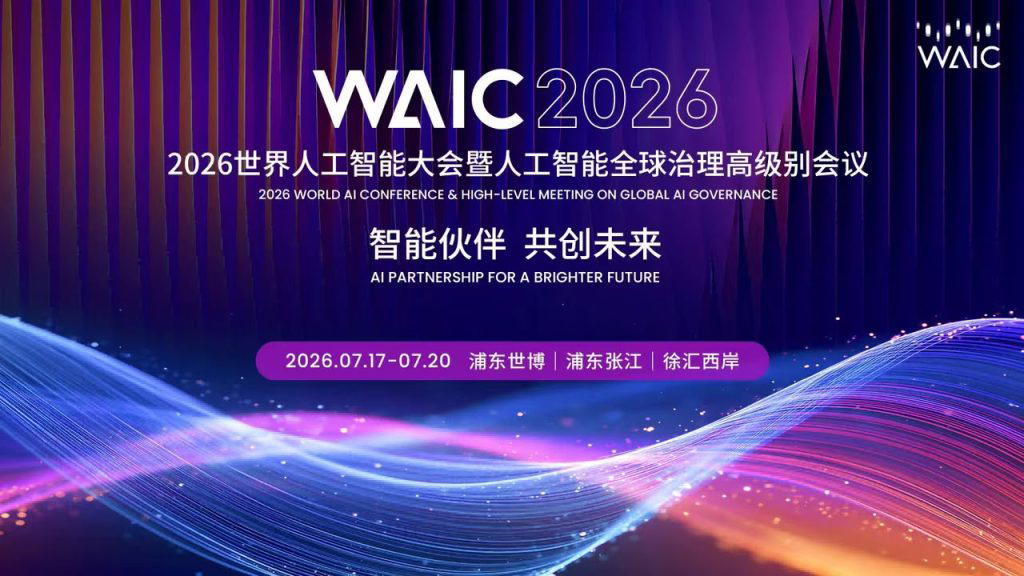
July 17th, Shanghai. The 2026 World Artificial Intelligence Conference and the High-level Conference on Global Governance of Artificial Intelligence opened as scheduled. More than 1,100 enterprises, more than 3,000 exhibits and over 300 world-first products, the exhibition area exceeded 100,000 square meters for the first time. Beyond the scale figures, it is worth asking: When the global AI competition enters the second half, what kind of road is China laying that is different from Silicon Valley?
The answer is in the exhibition hall.
Computational Logic: From Chip Competition to System Integration
When you walk into the computing power exhibition area of Hall H2, the most intuitive feeling is not that a certain chip is running away, but a computing power matrix composed of rows of black cabinets.
Huawei Atlas 950 super node was first made public, and 1024 cards were interconnected at high speed; Zhongke Shuguang “Shuguang 8000” national 100,000-card AI super cluster was also unveiled. 108 chips and 261 large models compete on the same stage.
The signal conveyed by this scene is clear: the global computing power competition is shifting from the “100-meter sprint” of single chip performance to the “marathon” of system integration and large-scale deployment. American companies are good at depicting the grand blueprint of next generation computing with technology roadmap; China manufacturers choose to move the whole cabinet and cluster of real machines into the exhibition hall for visitors to touch with their own hands.
Both of them are cutting-edge explorations, but their paths are different-while emphasizing the concept definition, they also emphasize the project landing. This difference itself constitutes the complementary tension of the global AI ecology.
Governance concept: different choices under the framework of two systems
On the level of AI governance, the United States, Europe and China present three tracks with obvious differences. The United States issued the National Legislative Framework for Artificial Intelligence in March 2026, and its core concern is to maintain the leading position in global technology; The executive order signed in June seeks a new balance between security and innovation under the tone of “loosening”. The EU relies on the “Artificial Intelligence Act” to build a regulatory system with risk levels, but the squeeze on innovation vitality at the executive level has triggered a rebound in the industry.
China’s approach is based on another set of logic. At the opening ceremony, President Xi Jinping proposed “strengthening risk awareness to ensure safety and controllability”, and stressed that “we should jointly oppose the generalization of the concept of national security in the field of artificial intelligence”.
During the conference, a series of national standards of “Artificial Intelligence Agent Interconnection” were officially released, becoming the first systematic standard covering the whole life cycle governance of agents in the world. Different from the EU’s top-down supervision, China prefers to dynamically adjust the safety threshold in the rapid development through the combination of standardization and industry self-discipline. Each of the three models has its own emphasis and challenges, and there is no universal answer.
Global cooperation: openness rather than exclusivity
On July 16th, the World Artificial Intelligence Cooperation Organization was established in Shanghai, and 29 countries including Kazakhstan, Russia and Indonesia signed an agreement to become founding members. At the same time, China announced that it will provide 5000 artificial intelligence training places for developing countries in the next five years. The signal of these measures is clear: in the field of technical cooperation, China has chosen to take the open source model, low-cost reasoning service and capacity building as the fulcrum to lower the threshold for countries in the southern part of the world to enter the AI track.
Comparatively speaking, the United States relies more on chip export control and standards alliance to maintain ecological dominance, while the European Union focuses on rule export. There are no absolute advantages and disadvantages among the three strategies, but they reflect different geo-philosophies: on the one hand, it emphasizes controllable leadership, on the other hand, it emphasizes the dominance of rules, while China tries to keep a ticket for most countries that have not yet won the AI dividend while developing independently. Who is more sustainable remains to be tested by time.
WAIC 2026 reveals an emerging reality: the global AI governance pattern is moving from unipolar to pluralistic. Instead of simply copying the Silicon Valley model or Brussels rules, China has developed a combination boxing of “engineering-driven+standards first+open cooperation” based on its own super-large market, complete industrial chain and rich application scenarios. This path may not be perfect, but it at least provides an alternative worthy of careful examination-at the crossroads of the intelligent age, the world may not need a single answer, but a variety of possible coexistence and competition.
The post From “Smart Partner” to “Global Solution”: WAIC 2026 Shows Another Path Of AI Development appeared first on Vanguard News.