
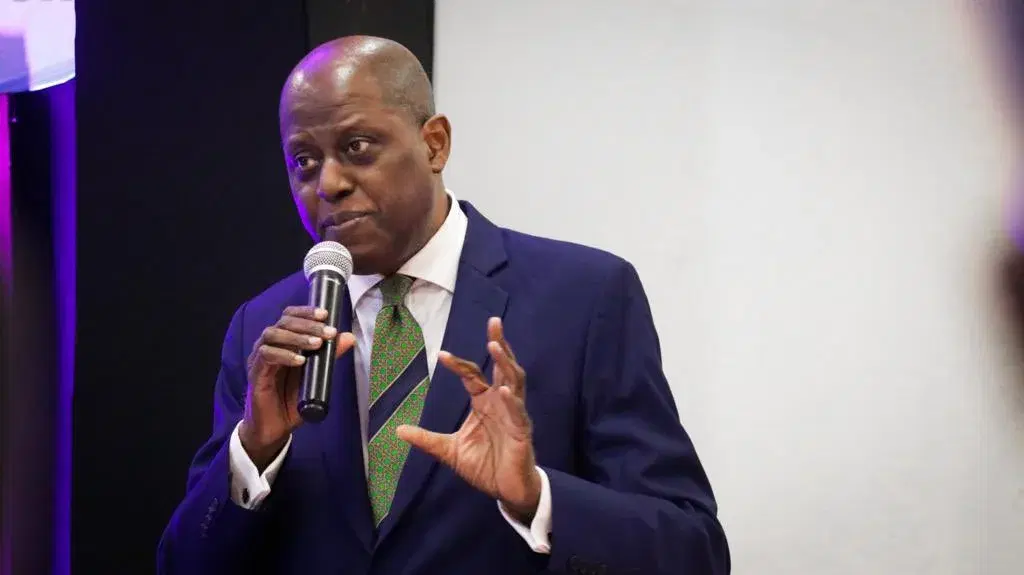
Cardoso: Nigeria to replicate remittance reforms to diversify FX earnings
*Says Nigeria must lead Africa’s investment drive through reforms
By Babajide Komolafe
The Governor of the Central Bank of Nigeria (CBN), Olayemi Cardoso, has said Nigeria will replicate the reforms that boosted diaspora remittances to diversify its foreign exchange (FX) earnings and reduce dependence on crude oil exports.
Cardoso stated this while speaking at a debate on the ‘Global Economy: Forging Resilient and Dynamic Economies for the Future’ during the ongoing IMF/World Bank Annual Meetings, Bangkok, Thailand.
Speaking alongside the Managing Director of the IMF, Kristalina Georgieva, the President of the Eurogroup, the Minister of Economy and Finance of Greece, Kyriakos Pierrakakis, the Deputy Prime Minister and Finance Minister of Thailand, Ekniti Nitithanprapas, and the Minister of Economy of the Argentine Republic, Luis Caputo, Cardoso said the CBN would apply lessons from the growth in remittance inflows to other sectors, including commodities and oil, to unlock additional sources of foreign exchange.
He also said Nigeria must lead Africa’s investment drive by sustaining macroeconomic stability, implementing reforms and demonstrating through concrete results that the economy had changed.
Explaining how the country responded to a crisis that depleted its external reserves and left it with substantial outstanding foreign exchange obligations, Cardoso said the situation forced Nigeria to explore alternative sources of FX.
“When you are going through a crisis, it forces you to be creative, and that was the situation Nigeria faced,” he said.
“We went through a crisis in which our net external reserves fell to about $3 billion at one point, despite having a population of over 200 million people. In addition, we had outstanding foreign exchange obligations of more than $7 billion.
“That situation forced us to be creative. We were able to take the right measures through an orthodox monetary policy approach, which helped to stabilise the economy. Believe it or not, we were able to pay off those obligations and attract investment.”
Cardoso said Nigeria could no longer rely on oil revenue, particularly given production challenges that constrained earnings.
“We were also clear that relying on oil was not a sustainable model. At the time, we had challenges with oil production, and we were not generating what we considered a sustainable level of revenue,” he said.
Remittances rise to $950m monthly.
Cardoso identified diaspora remittances as a major opportunity to increase FX inflows, saying the CBN engaged Nigerians abroad, international investors and other stakeholders to identify and remove obstacles to regular remittance transfers.
He said the bank drew lessons from countries such as India and Egypt, where international remittances provide significant financial inflows.
“One of the areas we focused on was the diaspora and international remittances.
“When we started looking at this, we were in a desperate situation and had to ask ourselves, how could we generate the revenues we needed? We identified international remittances as an important opportunity,” he said.
“Once we understood the problems, we moved quickly to remove the bottlenecks preventing capital from flowing into the country.”
According to him, monthly remittance inflows rose from about $200 million when the initiative began in 2025 to $600 million by the end of the first year.
“When we started, monthly international remittances were about $200 million. We said we would double that figure before the end of the year, and people laughed. They did not believe it was possible.
“In actual fact, by the end of the year, we had reached $600 million a month,” Cardoso said.
He added that inflows subsequently rose to approximately $950 million monthly by July this year, against a target of $1 billion.
“We then said that, this year, we would take the figure to $1 billion a month. Happily, by July, we had reached about $950 million,” he said.
Cardoso attributed the growth partly to digital solutions and the removal of outdated practices that hindered financial flows.
“I do not have enough time to explain all the measures we implemented to achieve those results, but much of the progress was related to digital solutions and an understanding that certain outdated ways of doing things were no longer sustainable,” he said.
He disclosed that he chaired a CBN committee established to coordinate the initiative and ensure banks were involved.
“That is the approach we intend to apply in other areas, including commodities and the oil sector,” he said.
Dangote Refinery to boost value addition
Cardoso also identified domestic refining as an opportunity to reduce the foreign exchange burden associated with importing petroleum products.
He said the Dangote Refinery was beginning to support a shift from exporting crude oil and importing refined products to retaining more value within the domestic economy.
“On the value-addition side, we now have the Dangote Refinery, which is beginning to contribute to economic diversification. It offers an opportunity to move away from a model in which we export crude oil, import refined products and lose money in the process,” he said.
Nigeria must lead Africa’s investment drive.
On Nigeria’s role in attracting investment to Africa amid global efforts to diversify supply chains and create employment, Cardoso said the country must demonstrate leadership through sound economic policies and sustained reforms.
“The role of a country like Nigeria, which is obviously a large economy with a large population, is to lead by doing the right things.
“This brings us back to an issue that has been discussed frequently here: getting your house in order and staying the course,” he said.
He said macroeconomic stability had helped restore investor confidence, citing Nigeria’s return to the FTSE and J.P. Morgan bond indices, as well as improved assessments by rating agencies.
“We have had macroeconomic stability over the past couple of years. As a result, Nigeria has returned to the FTSE index and the J.P. Morgan bond index. Rating agencies have also been improving their assessments of the country at every stage.
“Confidence has returned,” he said.
Cardoso stressed that sustaining the gains was essential to changing international perceptions of Nigeria and attracting investment.
“We need to sustain that progress and demonstrate to the world that change is possible and that things are different from what they were in the past.
“It is not enough to say that things have changed. We must demonstrate it through our actions. In my view, the numbers speak for themselves,” he said.
The post Cardoso: Nigeria to replicate remittance reforms to diversify FX earnings appeared first on Vanguard News.