
At UNGA 81: Nigeria, Italy join forces in massive $5bn global education funding
—Vision aligns with our agenda to improve outcomes, invest in access, capacity building- Tinubu—Education driving Nigeria’s economic future, prosperity, says VP Shettima
By Johnbosco Agbakwuru
Nigeria and Italy on Wednesday strengthened collaboration to implement the proposed Global Partnership for Education (GPE) financing campaign targeted at mobilizing $5 billion for education financing worldwide.
This is just as President Bola Tinubu has said the GPE vision aligns with Nigeria’s agenda which aims at improving educational outcomes by investing in access as well as capacity building for teachers.
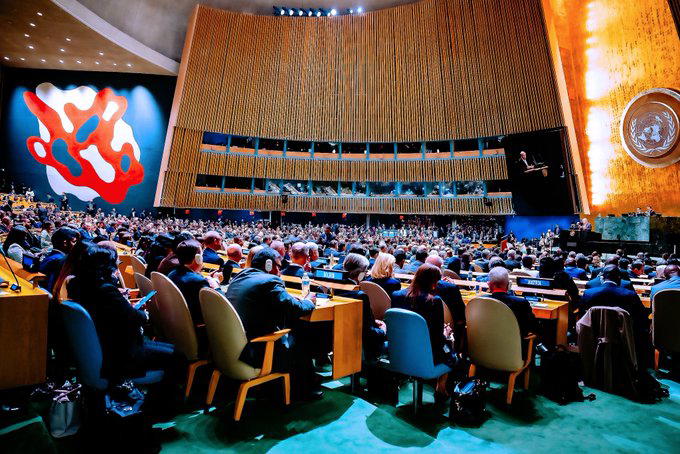
President Tinubu stated this in New York, United States, during the Multiply Possibility High-level event tagged, “A New Era for Education Financing” held on the margins of the ongoing 81st Session of the United Nations General Assembly.
In his intervention, President Tinubu, in a video message, also commended stakeholders in the Global Partnership for Education (GPE) for their efforts in accelerating education financing globally.
Speaking at the event, the Vice President, Senator Kashim Shettima, who is representing the Nigerian President at the global gathering, noted that education is an investment in Nigeria’s economic future, and productivity as well as the prosperity and stability of its citizens, stressing that it is not merely an expenses at the margins of the country’s development agenda.
“For Nigeria, education is not an expenditure at the margins of our development agenda. It is an investment in our economic future, national productivity, and the prosperity and stability of our people.
“Since President Bola Ahmed Tinubu assumed office in 2023, our Administration has substantially increased resources devoted to education, while pursuing reforms to strengthen basic education financing, expand foundational learning, and improve access to tertiary and technical education.
“Through the Nigerian Education Loan Fund, we are widening access to higher education, while strengthening the link between education, skills, employment and enterprise.”
According to VP Shettima, while Nigeria is also looking beyond traditional budgetary allocations, President Tinubu has directed that liquid funds recovered by the Economic and Financial Crimes Commission, once legally cleared and free from litigation, be channelled to the Nigerian Education Loan Fund.
To carry out the President’s directive, he said the Federal Executive Council (FEC) recently approved consideration of unclaimed dividends and dormant funds for the same purpose, subject to the relevant legal requirements.
This, Senator Shettima explained, demonstrates the nation’s conviction that financing education needs mobilisation of every responsible and lawful domestic source available.
Citing Nigeria’s alliances with the World Bank and GPE through HOPE-EDU, the Nigerian Vice President underscored what international partnership could achieve, just as he said, “The programme is expected to reach approximately 29 million children and 500,000 teachers across Nigeria.”
He continued: “This is precisely why GPE matters. GPE does not replace national investment; it multiplies it. The ambition before us is to mobilise US$5 billion for GPE and, through that investment, unlock additional financing for education in partner countries.
‘Domestic resources must remain the anchor, complemented by development assistance, concessional finance, philanthropy and innovative financing.”
Senator Shettima further observed that although Nigeria is a young country whose growing population could become one of its greatest economic assets, adding that this is possible only if the nation’s “young people have access to quality education, relevant skills and meaningful opportunities.”
The answer to declining global aid, he pointed out, “must therefore be smarter multilateralism: using scarce international resources to leverage much larger investments.”
He urged participants at the high-level event to ensure that it is not merely a fundraising exercise, “but a renewed compact for human capital, bringing together national leadership, international partnership and responsible financing so that every child has the opportunity to learn, thrive and contribute to their country’s future.”
Expressing Nigeria’s appreciation to the Italian government and GPE for joining in the conversation on the future of education financing, VP Shettima said as co-hosts of the campaign, Nigeria is not participating merely to ask the international community to invest more in education but “to demonstrate
that we are investing in education ourselves.”
Earlier in a video presentation, the Prime Minister of Italy, HE Giorgia Meloni, praised President Tinubu’s leadership and Nigeria’s determination to improve educational outcomes across all levels.
He urged all partners in the global alliance to show greater commitment to reversing the trend in developing countries.
For her part, UN Deputy Secretary General, Dr Amina Mohammed, thanked all partners for the interest shown in the improvement of education financing in developing countries, noting that the changes
sought by stakeholders should begin with the choices that governments make.
She called on International Finance Institutions to support committed countries in finding the fiscal spaces needed to improve educational outcomes, including capacity building for teachers whose motivation and training remain critical to achieving set objectives.
In the same vein, Chair of Board of Directors of GPE, Dr. Jakaya Kikwete, underscored the need for accelerating education financing, noting that the event was a reminder to the fact that education remained central to the attainment of human rights, security, and peace, among other benefits.
He stated that GPE is driven by the realities of the drop in development assistance in education amidst the widening financing gap and the fact that the world will increasingly depend on systems that deliver tangible and desirable outcomes
For her part, girls’ education activist, Malala Yousafzai, emphasised the need for collaboration in ideas and resources, stating that global partnerships tend to produce greater results and more impactful outcomes than isolated interventions by countries.
She urged all stakeholders, especially multilateral organisations and governments across the world, to commit more resources and efforts to gender equality in education and address specific needs of the girl child, especially in developing countries.
Governments and donors at the high-level event made generous contributions towards the education of at least 370 million children globally, with the government of Italy pledging the sum of 50 million Euros for GPE programmes and Interventions.
The post At UNGA 81: Nigeria, Italy join forces in massive $5bn global education funding appeared first on Vanguard News.