
Asaba Massacre at 59: Wounds, apologies and a day of forgiveness
•Asagba recalls Odi massacre, punctures OBJ’s ‘never again’ narrative; Col Taiwo’s son, a rtd Maj Gen, atones for father’s role in massacre
By Egufe Yafugborhi
59 years after the pogrom that wiped out an estimated 1,000 Asaba men, memories remain raw as apologies, forgiveness and the quest for national closure turn front burners.
The sun was going down in Asaba 59 years ago when a generation of families lost fathers, husbands, brothers and sons.
The killings of October 7, 1967, during the Nigerian Civil War left an estimated 1,000 Asaba men dead and a community carrying a wound that time has failed to erase.
On Wednesday, October 7, 2026, Asaba remembered again.
But the 59th memorial was not only about mourning. It became a remarkable encounter between the pain of the past and gestures towards reconciliation.
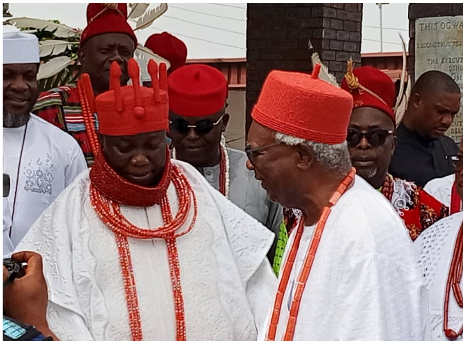
Former President Olusegun Obasanjo expressed regret, Major General Ahmed Ibrahim Taiwo (retd.), son of Col Ibrahim Taiwo, apologised over late father’s role, and the Asagba of Asaba, HRM Prof. Epiphany Azinge, SAN, publicly declared forgiveness for the Taiwo family.
Yet, beneath the forgiveness was a condition.
For the Asagba, Asaba can forgive without forgetting. But the community’s long search for closure, he insisted, requires a formal apology from a sitting President of Nigeria.
Former President Obasanjo, who participated virtually as Chairman of the occasion, described the massacre as “one of the most painful, one of the most terrible aspects” of the Civil War.
He said, “When Chief Nduka-Eze (Memorial Convener), some two months ago, came to see me about this unfortunate event and gave me written documents of what I had only heard by word of mouth, I wept.
“I wept that such an event—which is not fiction—happened in my own country, in my lifetime; a country that I fought to keep united, not divided.”
For him, the remembrance should be accompanied by a national resolve that such tragedy must never recur.
According to Obasanjo, “Whatever may have been the cause of such a brutal act, this is the time to remember and pray for souls that were lost.
“We must vow and pledge that never again will such a dark, black, and unpleasant day occur in Nigeria.”
Then he made his emotional appeal: “To all of you assembled: let us keep one thing in mind—forgiveness, forgiveness, and forgiveness again,” he urged.
But the Asagba’s response showed that forgiveness, for Asaba, is a journey rather than an eraser of memory.
“From the going down of the sun till the morning, we will always remember them. We have remembered them in the past 57 years, and we are still ready to continue remembering them.
“57 years ago, the annihilation and extermination witnessed on our soil is not something that can’t be glossed over.”
Then came a historic moment.
“On behalf of the Asaba community, and as the prescribed authority -the Asagba of Asaba – I hereby publicly proclaim that we have forgiven the Taiwo Family,” he declared.
The declaration followed the appearance of Major General Ahmed Ibrahim Taiwo, son of the late Colonel Ibrahim Taiwo.
The retired general recalled he first encountered the story of the massacre in 1995 while serving in Enugu and travelling to Lagos through Onitsha.
“I cannot describe how I felt reading it. I felt terrible. And I do not want to imagine how the successors, or the victims and those that were left behind, must have felt”, he said.
Taiwo said he subsequently sought information from three of his father’s friends and colleagues but found them evasive.
His later encounters with online discussions about the massacre, he said, confronted him with two disturbing realities: denial of the killings and attempts to reduce the number of victims.
“I used to come online and start telling people that it happened. I would tell them, ‘My father is the one mentioned. I have all to gain by denying it, but you cannot deny what happened. It is what it is.”
Eventually, he said, he felt compelled to come to Asaba personally.
“I have come, in private capacity as Taiwo to render our deepest regrets and apologize on behalf of our father and family for any act of omission or commission on his part that led to this heinous massacre.
“I know it will not right the wrong, but I believe and pray it is a start towards reconciliation”, he said.
For the Asagba, the apology represented an opportunity to demonstrate the forgiving spirit of Asaba.
“In Asaba, we say that Asaba bu anyi’m (Asaba is compassionate/welcoming).
“With a lot of conviction and courage, he open-mindedly admitted the fault of his father and apologized to us. His father allegedly commanded the troops that massacred the people during the war.
“I believe that as a people, we should also have the strength of conviction and character to accept that apology”, Nna Agu told his people.
But accepting the apology did not end the community’s national demand.
The Asagba recalled taking the matter to President Bola Ahmed Tinubu in May 2025, saying the President addressed other matters but remained silent on the massacre.
“But it will never deter us, and we have made this abundantly clear: there will be no closure, no healing until a sitting President—not an ex-President, but a sitting President—publicly apologizes to us.
“Yes, General Gowon did, but out of office. We need a sitting President to apologize to the Asaba people, and that will bring closure”, he said.
He also questioned Obasanjo’s call for “never again”, recalling that the Odi killings occurred during Obasanjo’s presidency.
“We listened attentively to General Obasanjo, and I note with a little bit of regret: it is easier said than done for us to say ‘never again.
“How long do we say ‘never again’? But it happened at Odi. Odi came years after Asaba, and he (Obasanjo) was sitting there as President when that happened.”
For Chief Chuck Nduka-Eze, Convener of the Asaba Massacre Memorial, the tragedy continues to raise a fundamental question about citizenship and the value of Nigerian lives.
“The message we’ve been sending about the Asaba Massacre is that Nigerian lives matter. And the fact that Nigerian lives have continued not to matter speaks to what happened in Asaba on October 7, 1967.”
Nduka-Eze said Asaba residents had believed the Federal troops approaching their town were coming as fellow Nigerians, not as enemies.
“They felt safe; Asaba was part of Federal territory, not part of Biafra. So, they felt if these troops came here, they would welcome them because ‘they are part of us.’ So, it was actually those believers in ‘One Nigeria’ who are no more today”, he explained.
Governor Sheriff Oborevwori, represented by Secretary to the State Government, Dr Kingsley Emu, said the State would continue to support efforts to preserve the memory.
“For many families, the pain was compounded by the denial of traditional burial rights to their loved ones. Yet, despite the passage of time, the people remember. Let us speak clearly: the killing of unarmed civilians can never be justified”, Oborevwori said.
He described the Memorial Center as significant because it would give the history “a permanent home”, preserving “names, personal objects, and records” for future generations.
The Governor also urged Nigerians to learn the history without inheriting its bitterness, adding, “Do not inherit its bitterness; inherit its lessons.”
Enotie Ogbebor, son of late Colonel Paul Ogbebor, also spoke of the tragedy as a reminder beyond Nigeria. “The massacre in Asaba is not any less than any of such unfortunate incident in other part of the world. It ranks at the same level,” he said.
At 59, therefore, Asaba’s story is no longer simply one of bloodshed. It is a story of widows who raised children alone, of survivors who rebuilt a city, of descendants who refused to allow the dead to disappear into history, and of a community now attempting to turn memory into reconciliation.
The Asagba captured that delicate balance in a few words: “We may not forget, but certainly, we have to forgive.”
That may be Asaba’s long road forward — carrying the wounds, accepting sincere apologies, forgiving where it can, remembering those it lost, and continuing to ask the nation for the closure it believes is still due.
On October 7, 1967, Asaba was plunged into one of the darkest episodes of the Nigerian Civil War. As Federal troops entered the town, residents came out to welcome them, believing they were fellow Nigerians and not enemies.
According to survivor accounts and historical records, men and boys were subsequently separated from their families, taken to gathering points and executed, over 1000 person estimated to have been exterminated.
The killings shattered families and left generations of widows, orphans and survivors carrying the scars. With traditional burial rites denied to many victims and no immediate accountability, the horror remained an open wound in Asaba’s collective memory -59 years later, a wound that demands remembrance, recognition and closure.
On October 7, 1967, Asaba was plunged into one of the darkest episodes of the Nigerian Civil War. As Federal troops entered the town, residents came out to welcome them, believing they were fellow Nigerians and not enemies.
According to survivor accounts and historical records, men and boys were subsequently separated from their families, taken to gathering points and executed, over 1000 person estimated to have been exterminated.
The killings shattered families and left generations of widows, orphans and survivors carrying the scars. With traditional burial rites denied to many victims and no immediate accountability, the horror remained an open wound in Asaba’s collective memory -59 years later, a wound that demands remembrance, recognition and closure.
Vanguard News
The post Asaba Massacre at 59: Wounds, apologies and a day of forgiveness appeared first on Vanguard News.