
EXPOSED: The Chilling Truth Behind Araromi-Oke—The Yoruba Town That ‘Vanished’ Overnight!
For decades, an eerie and captivating tale has circulated across southwestern Nigeria, passed down from elders and recently amplified by a viral frenzy across social media. The story claims that in 1957, a quiet, thriving Yoruba farming settlement known as Araromi-Oke—said to be located somewhere between old Oyo, Osun, and Ekiti states—simply ceased to exist.
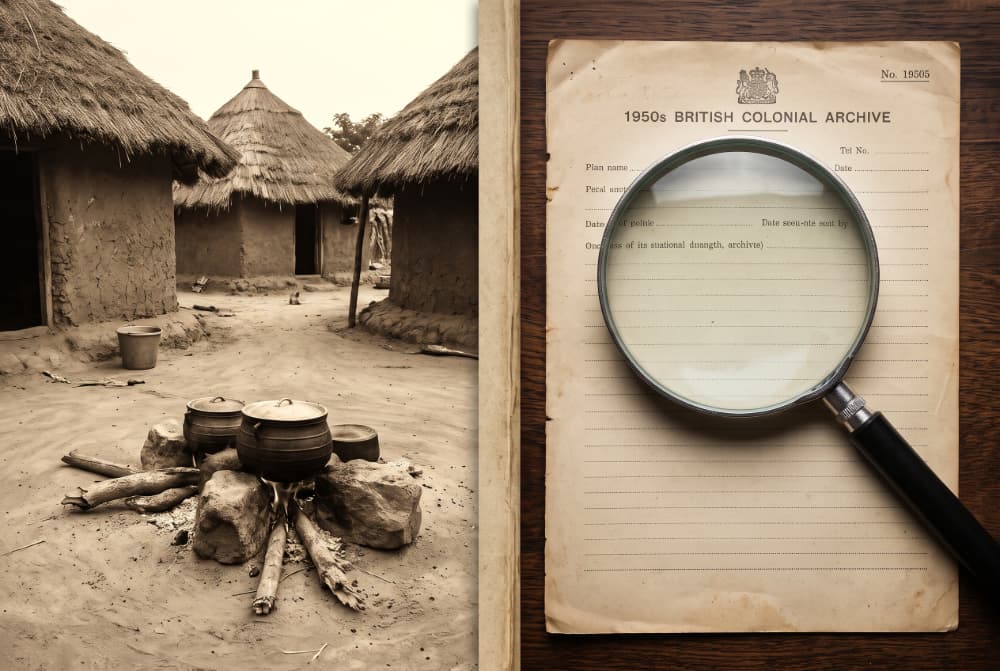
According to the chilling legend, neighboring villagers arrived one morning to find the town completely emptied. There were no bodies, no blood, and no signs of a struggle. Houses were intact, doors were left wide open, calabashes of fresh palm wine were untouched, and food was supposedly still boiling on open fires. The only living creature left behind, some versions claim, was a single stubborn goat.
What really happened to the people of Araromi-Oke? In a high-stakes investigation, nuus.ng dives deep into the archives to separate historical facts from a powerful, internet-fueled myth.
To understand why this story has gripped the imagination of ordinary Nigerians, one must look at the spiritual and cultural weight of the narratives used to explain the “disappearance.” The myth typically offers three dramatic explanations for the town’s fate:
Araromi-Oke was reportedly a settlement of skilled hunters and blacksmiths who paid homage to Ogun, the Yoruba god of iron and war. Legend dictates that the town broke a sacred, ancient covenant, and in a fit of divine anger, the deity swallowed the entire population.
Another deeply entrenched superstition claims the village was built on cursed or forbidden ground. In traditional Yoruba cosmology, the earth can give life, but it can also brutally reclaim it. Adherents of this theory believe the ground simply opened up and took the villagers back.
Skeptics within the legend argue that severe economic hardship or political pressures during the late colonial era forced a sudden, silent mass exodus.
These eerie details—abandoned meals and untouched tools—make the tale intensely relatable and terrifying. They tap into a timeless, human fear: the idea that an entire community could be erased in the blink of an eye without leaving a trace.
When subjected to the rigorous scrutiny of investigative journalism and historical data, the dramatic 1957 vanishing act of Araromi-Oke rapidly unravels.
Our investigation into government archives, scholarly anthropological research, and colonial administrative records reveals a glaring void. There is absolutely no credible, documented evidence that a mass disappearance ever occurred.
The British colonial administration of the 1950s was notoriously meticulous, keeping detailed ledgers on everything from tax collections to minor village relocations. Yet, there is zero mention of an entire town disappearing in the Western Region in 1957.
There is no archaeological or anthropological footprint to back up the myth. There are no mass graves, no abandoned ruins matching the description, and no geographic coordinates for the “lost” village. “Araromi” (meaning “my body is at peace”) and “Araromi-Oke” are incredibly common names for settlements across Yorubaland.
Historians believe that the multiplicity of towns with this exact name likely fueled confusion. It is highly probable that oral tales from different villages merged over the decades, crystallizing into a single, dramatic urban legend.
If it never happened, why do Nigerians continue to share the story of Araromi-Oke in 2026? The answer lies in the power of cultural memory and the human need for morality tales. In many small communities where written archives are scarce, oral tradition becomes the ultimate currency. The tale of Araromi-Oke functions as a cultural warning about hubris, the consequences of breaking communal trust, and the necessity of showing humility before the unseen forces of nature.
Furthermore, the unchecked spread of the story on social media has transformed a localized myth into viral clickbait. Content creators routinely borrow the same dramatic details—the boiling pots, the untouched palm wine—to anchor the imagination of their audiences, prioritizing engagement over historical accuracy.
The story of Araromi-Oke is not a covered-up historical tragedy; it is a masterpiece of Yoruba folklore. The true vanishing act is not of a physical town and its people, but of the line between myth and reality. While the legend will undoubtedly continue to roam the internet and campfires for generations to come, the historical archives remain firmly closed on the matter. Araromi-Oke did not disappear overnight in 1957—because as a single, doomed entity, it likely never existed at all.