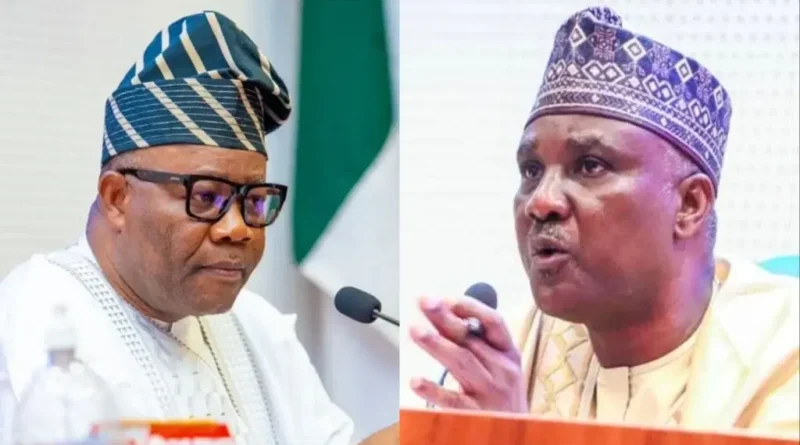
‘Withdraw backdoor social media shutdown bill or face legal action’, SERAP tells Akpabio, Abbas
Socio-Economic Rights and Accountability Project (SERAP) has urged the Senate President, Senator Godswill Akpabio, and the Speaker of the House of Representatives, Tajudeen Abbas to “immediately reject and withdraw the Nigeria Data Protection (Amendment) Bill, 2026, as the Bill is a backdoor attempt to regulate social media and expand governmental control over online expression, which is incompatible with international human rights standards.”
The Bill, sponsored by Senator Ned Nwoko (APC, Delta North), seeks to compel social media platforms, data controllers and data processors operating in Nigeria to establish physical offices in the country, and empowers the Nigeria Data Protection Commission (NDPC) to shut down or prohibit the operations of any entity that fails to comply within 30 days.
In a letter dated 18 July 2026 and signed by SERAP Deputy Director Kolawole Oluwadare, the organisation said: “Requirements compelling technology companies to establish local offices would increase government leverage over platforms, facilitate political pressure, make censorship demands easier and expose local employees to retaliation.”
SERAP said: “The Bill would create sweeping powers capable of shutting down or excluding social media platforms from the Nigerian market and expose millions of Nigerians to serious violations of their constitutionally and internationally guaranteed human rights.”
According to SERAP, “The Bill follows earlier attempts by the National Assembly to regulate social media that generated widespread public opposition and serious human rights concerns.”
The letter, read in part: “The current Bill revives substantially similar proposals previously introduced by Senator Nwoko, raising renewed concerns that localisation requirements are being used as a vehicle for expanding governmental control over digital platforms and online expression.”
“Should the Bill be enacted into law in its current or substantially similar form, SERAP shall promptly take all appropriate legal actions to challenge its legality in the public interest and to ensure that Nigerians’ fundamental rights are fully protected.”
“The National Assembly should avoid imposing localization requirements that unnecessarily burden digital services and undermine citizens’ rights.”
“The Bill constitutes a backdoor attempt to regulate social media and increase governmental control over online expression through corporate localisation requirements rather than through transparent and constitutionally permissible regulation.”
“The Bill also risks recreating the very dangers previously condemned by the ECOWAS Court of Justice. In SERAP and Others v. Federal Republic of Nigeria, the Court held that the suspension of Twitter violated the rights to freedom of expression, access to information and media freedom protected under the African Charter.”
“Although the present Bill differs from the Twitter suspension in form, it creates the possibility of achieving the same result indirectly by empowering regulators to prohibit digital platforms from operating in Nigeria.”
“The National Assembly should not enact legislation capable of producing, through indirect regulatory means, the very restrictions on fundamental rights that regional human rights law prohibits.”
“Governments have a legitimate interest in ensuring that digital platforms operate responsibly and comply with domestic law. However, such regulation must remain firmly anchored in constitutional guarantees and international human rights standards.”
“Measures regulating digital services should enhance transparency, accountability and users’ rights—not create additional tools for censorship, surveillance or political interference.”
“A law empowering regulators to exclude digital platforms from Nigeria inevitably interferes with the rights of the people who rely upon those platforms. The proposed section 5(p) in the Bill authorises the NDPC to prohibit entities from conducting operations in Nigeria without adequate procedural safeguards.”
“The Bill contains no requirement for prior judicial authorisation, no obligation to consider less restrictive alternatives, no meaningful opportunity to remedy alleged non-compliance beyond the arbitrary 30-day period, and no requirement to consider the impact of any prohibition on the fundamental rights of millions of Nigerians.”
“In effect, the Bill empowers an administrative agency to impose sanctions comparable to a nationwide restriction on digital communication without the procedural guarantees ordinarily required whenever fundamental rights are at stake.”
“The Bill cannot survive scrutiny under Section 45 of the Nigerian Constitution, which permits restrictions on fundamental rights only where they are prescribed by law, pursue a legitimate objective and are reasonably justifiable in a democratic society.”
“While improving regulatory compliance may constitute a legitimate governmental objective, the proposed amendment completely fails the constitutional and international human rights law requirements of necessity and proportionality.”
“There is no evidence that existing powers under the Nigeria Data Protection Act are inadequate, that current enforcement mechanisms have failed, or that less restrictive alternatives would be insufficient.”
“The Bill imposes one of the most severe sanctions available: the exclusion of digital platforms from Nigeria merely because they have not established a physical office.”
“The National Assembly should not achieve indirectly through regulatory localisation requirements what it cannot constitutionally achieve directly through restrictions on social media. The practical consequences for millions of Nigerians would be indistinguishable from a platform ban.”
“The National Assembly should immediately reject and withdraw the Bill, as it is manifestly incompatible with the Nigerian Constitution and Nigeria’s obligations under the African Charter on Human and Peoples’ Rights and the International Covenant on Civil and Political Rights.”
“The Bill would undermine the country’s digital economy, innovation ecosystem and international standing. Although the Bill is presented as an amendment to the Nigeria Data Protection Act intended to improve regulatory compliance and consumer protection, its practical effect is far more expansive.”
“By requiring social media companies to establish physical offices in Nigeria as a condition for continuing to operate, and by empowering the NDPC to prohibit their operations after only 30 days of non-compliance, the Bill creates a statutory mechanism capable of excluding digital platforms from Nigeria.”
“The proposed amendment threatens far more than the interests of technology companies. It directly affects the rights of millions of Nigerians who depend on digital platforms to exercise their rights to freedom of expression, receive and impart information, associate with others, participate in political life, conduct business, pursue education and engage in civic advocacy.”
“Section 39 of the Nigerian Constitution, Article 19 of the International Covenant on Civil and Political Rights and Article 9 of the African Charter on Human and Peoples’ Rights guarantee the rights to freedom of expression, digital rights, and access to information.”
“The UN Human Rights Committee has consistently emphasised that restrictions on freedom of expression must always satisfy the requirements of legality, necessity and proportionality, and that governments must adopt the least restrictive means available to achieve legitimate public objectives.”
“The African Commission on Human and Peoples’ Rights’ Declaration of Principles on Freedom of Expression and Access to Information in Africa calls on States to facilitate universal access to the internet, refrain from unnecessary restrictions on digital communications and protect online intermediaries from undue interference.”
“The former UN Special Rapporteur on freedom of expression, David Kaye, repeatedly warned governments against requiring technology companies to establish local offices as a means of facilitating censorship or indirect governmental pressure over content moderation decisions.”
“As the UN Special Rapporteur on freedom of expression has warned, States should avoid imposing broad intermediary obligations that encourage private censorship or allow governments to exert undue influence over online platforms.”
“The Special Rapporteur has further emphasized that governments should not shift responsibility for regulating lawful expression onto private companies through measures that create increased governmental leverage over digital platforms.”
“The proposed amendment conflicts directly with the objectives of the Nigeria Startup Act 2022 and the National Digital Economy Policy and Strategy.”
“Mandatory localisation requirements substantially increase compliance costs, particularly for startups, open-source projects, educational institutions, research organisations, AI developers and smaller technology companies, while reducing Nigeria’s attractiveness as a destination for innovation and investment.”
“No major democratic jurisdiction requires every social media platform to establish a physical office as a blanket precondition for providing services.”
“The National Assembly should seize this opportunity to demonstrate its commitment to constitutional democracy, the rule of law and Nigeria’s digital future by immediately withdrawing the Bill.”
The post ‘Withdraw backdoor social media shutdown bill or face legal action’, SERAP tells Akpabio, Abbas appeared first on Vanguard News.