
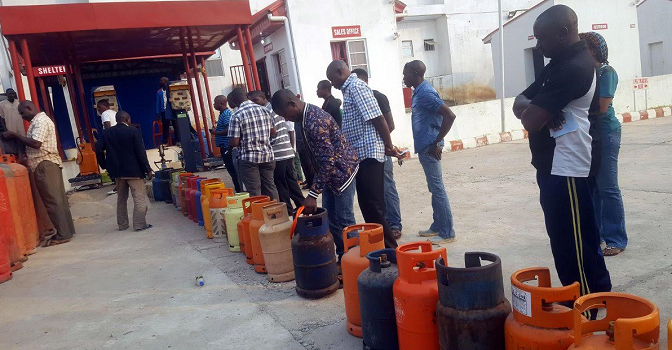
Why cooking gas will remain scarce, expensive
•As domestic demand outstrips supply
•Producers stick to export market
•Dealers give catalogue of constraints
•Outlook remains uncertain —Industry Experts
By Udeme Akpan, Energy Editor
Despite holding Africa’s largest proven gas reserves and recording rising gas production, household and industrial consumers are now faced with significant shortages of Liquefied Petroleum Gas, LPG, also known as cooking gas.
The development is also putting pressures on retail prices of the product.
Financial Vanguard findings showed that some producers are focused on exporting the product rather than meeting domestic demand.
Data obtained from the Nigerian Upstream Petroleum Regulatory Commission, NUPRC, showed that 62 per cent of the total gas output in the first two months of this year was exported, leaving only 38 per cent for domestic market.
Industry analysts said the lopsided supply, which had been in place during the years most Nigerians were not using gas for cooking, can no longer continue, adding that the supply structure was now destabilising domestic market.
Rising demand overshoots domestic supply
Financial Vanguard findings showed that demand has continued to outpace supply, according to the latest industry report, titled ”Nigeria LPG Production & Supply Matrix (2023-2026)”.
According to the report, estimated national consumption of cooking gas increased by 20 per cent to 1.8 million metric tonnes in 2026 from 1.5 million metric tonnes in 2023, while estimated national supply rose to between 1.55 million metric tonnes and 1.65 million metric tonnes in 2026.
This shortage is coming against the backdrop of increased production arising from the entry of Dangote Refinery into the supply end.
addressed infrastructure deficits, improved domestic supply incentives and strengthened investment conditions, the country might continue to experience gas shortages, despite its enormous reserves and production potential.
He said: “The combined contribution of NLNG, Dangote, Kwale Hydrocarbon, NPDC Ologbo, Pan Ocean, Seplat, PNG Gas, Greenville and other processors has significantly boosted Nigeria’s cooking gas output.
“Nigeria now has the technical capacity to become largely self-sufficient in LPG supply, but additional gas-processing projects must be brought on stream, domestic gas infrastructure must be expanded, more storage terminals must be commissioned and the nation’s LPG adoption policies must be sustained.”
Analysts warned that unless Nigeria rapidly expanded gas-processing infrastructure, storage capacity and domestic supply incentives, the country might remain trapped in cooking gas poverty, despite its enormous gas wealth.
Data obtained from the National Bureau of Statistics indicated that the price of cooking gas rose by 335 per cent to N1,741 per kilogramme in 2026 from N400 per kilogramme in 2016, driven by limited supply and other market forces.
A breakdown showed that the price of the product increased to N500 per kilogramme in 2017 from N400 per kilogramme in 2016.
The data also showed that the price further rose to N600, N680, N800, N950, N900, N1,000, N1,450, N1,630 and N1,741 per kilogramme in 2018, 2019, 2020, 2021, 2022, 2023, 2024, 2025 and 2026, respectively.
The post Why cooking gas will remain scarce, expensive appeared first on Vanguard News.