
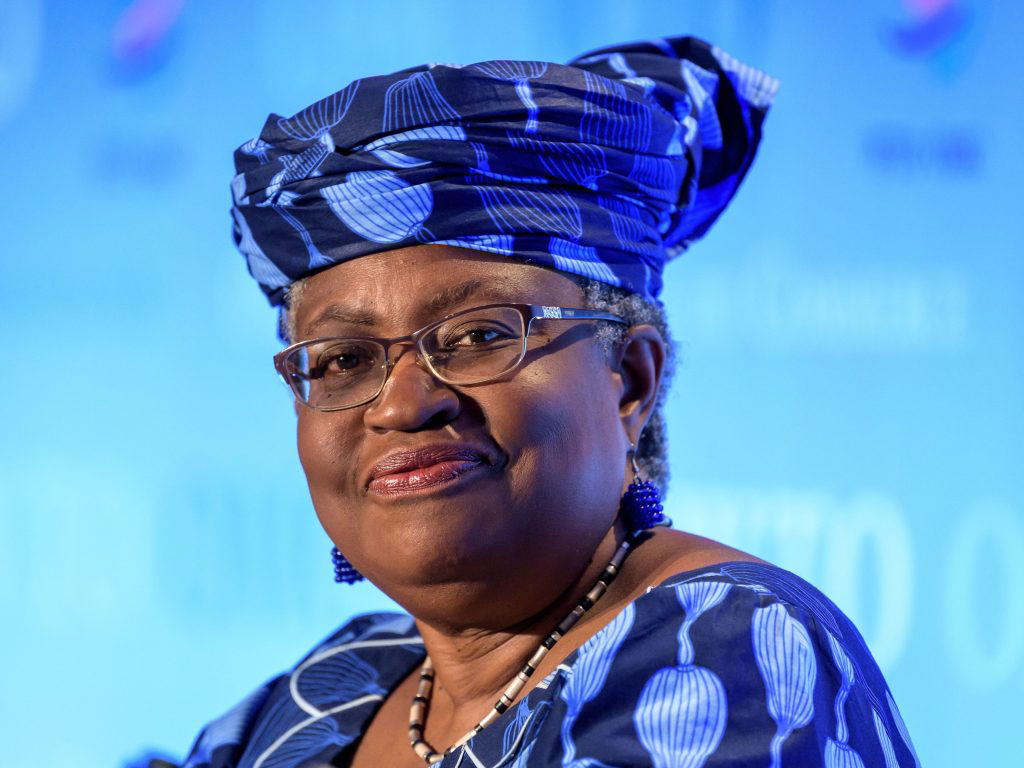
What Nigeria, other African countries should do before export – Okonjo-Iweala
By Emma Ujah
The Director–General of the World Trade Organisation, Dr. Ngozi Okonjo-Iweala, has strongly advised Nigeria and other African countries to process critical minerals before their export.
She spoke at the Fireplace Dialogue on Building Africa’s Resilience in a Changing Global Economic Order, at the 7th Africa Emerging Markets Forum, in Abuja, on Wednesday.
Dr. Okonjo-Iweala, a former Minister of Finance and Coordinating Minister of the Economy of Nigeria insisted that the country should take advantage of the critical minerals in the country to produce Electric Vehicle batteries and similar goods to be a major player in the current global green energy revolution.
She blamed the extraction and exportation of critical minerals in their raw forms for much of the terrorism, banditry and corruption in the country and other parts of Africa.
Her words, “One high potential sector is critical minerals, where the green transition is driving demand for lithium bauxite, cobalt, and other elements necessary to manufacture EV batteries and other low carbon goods.
“Africa holds an estimated 30 percent of the world’s non-mineral reserves, and estimates for Latin America are similar.
“For Africa, in particular, instead of the extract and export model that has been the source of so much volatility, economic underperformance, and let me be blunt-corruption, conflict, and banditry, the goal should be higher value, higher productivity growth, driven by the development of sub-regional value chains and integration into potential supply networks.
“Quite frankly, the time to seize this opportunity is now, as geopolitics exerts some demand pressure for critical mineral supply chain diversification, if we miss this opportunity, I’m afraid we would have missed a lot.
“Fortunately, Africa’s leaders seem to be moving in the right direction, with Morocco using its phosphate resources to produce electric vehicle components for international markets, particularly Chinese automakers in Zambia, DRC, Mozambique, and Angola, and here also in Nigeria, moves are put to see
how to add value to critical minerals.
“But these efforts need more systematization and harmonization, including a look at sub-regional approaches, so that countries are not picked up one by one in suboptimal bilateral agreements. The continent can seize green comparative advantages by harnessing abundant renewable energy potential to power minerals processing.”
She also called for diversification of global trading partners, as opposed to the current situation where exports and imports are tilted to a few countries and narrowing opportunities.
“A second way to make the trading system more robust and resilient is by ensuring more countries and regions become substantial sources of global supply and demand.
“This is linked to the reglobalization I mentioned earlier, with more companies and countries looking to
supply diversification, whether to reduce exposure to geopolitical or other risks.
“Places outside established production networks, especially places in Africa, Latin America, and Central Asia, have an opportunity to attract value chain investment,” she said.
She said leadership should be about the people and that the leadership that would bring about a developed and economically robust Nigeria must one that has the interest of the nation at heart, listens to the people and is accountable to the people.
Nigerians should feel reforms impact
The former minister said, “Nigeria needs to continue the work on overall macroeconomic reforms with a careful approach to fiscal issues, contracting of debt, and debt management.
“Above all, Nigeria needs to focus on creating jobs and economic opportunities for a young and hungry population. Nigerians have to feel the dividends of reform in the real economy, ladies and gentlemen, dear friends, instead of negative feedback loops of uncertainty, fragmentation, and slower growth, we have an opportunity to build positive feedback loops of reformed rules, greater certainty, and improved economic prospects for people and businesses everywhere.”
Cardos: Let’s eliminate regional trade barriers, mobilise domestic capital
In his address, the Governor of the Central Bank of Nigeria, Mr. Olayemi Cardoso, called for the elimination all trade barriers within the African region.
His words, “Understanding the rules-based international system is being stressed and tested. For Africa and other emerging markets, the question is no longer whether the global order is changing, but how we turn that change from a source of vulnerability into a source of growth and shared prosperity. And we heard some of the answers to that earlier today.
“Let me highlight, however, three major shifts that I expect will shape Africa’s opportunities in this changing global environment. First, trade is fragmenting. Geo-economic considerations are causing countries to look inward and to reorganize trade and critical supply chains around trusted partners and neighboring markets through nearshoring and friend-shoring.
“For Africa, this change is both a warning and an opportunity. With intra-African trade still accounting for only about 16 percent of our total trade, we must build stronger regional value chains, produce more of what we consume, and trade more with one another. The African continental free trade area provides the platform and opportunity to turn this global shift to an African advantage.
“But we must go beyond the agreements and remove the practical barriers to trade by improving transport networks, harmonizing customs standards, and making cross-border payments faster and more affordable. Second, capital has become selective and impatient. The era of abundant liquidity, chasing returns regardless of risk, is over.”
He noted, “Investors now have more choices and less tolerance for uncertainty. Capital increasingly flows to a fullness that offers credibility, transparency, quality, consistency, and strong institutions. For Africa, this means that our development ambitions cannot depend solely on attracting foreign capital.
Domestic capital
“We must mobilize more of our own resources, including pension and insurance funds, domestic savings and diaspora capital, and channel them towards productive domestic investment. It also means that there is a premium on the quality of Africa’s institutions. Investors must be able to trust our policies, understand our rules, and plan beyond the next political or economic cycle.
“So credibility is not only a central bank concern, it is a national economic asset. Third, artificial intelligence is reshaping economic activity. It is changing how goods are produced, how services are delivered, and the skills required to compete.”
The governor said Africa must move beyond being consumers of technology, as according to him, “We must become creators, developing African solutions to African challenges, and building businesses capable of taking those solutions to the world.
“To achieve this, Africa must invest in the foundations of an AI-enabled economy, including reliable electricity, affordable connectivity, digital infrastructure, and above all, a generation of AI-savvy young Africans ready to build solutions for the continent and to compete globally. Nigeria’s recent experience demonstrates how an emerging market economy can respond to these shifts.
“Patient capital that creates productive capacity. We must mobilize Africa’s pensions, insurance assets, domestic savings, and diaspora wealth. We must also seek foreign investment that creates jobs, transfers technology, develops local supplies, and strengthens African businesses, not investment that simply extracts value and needs.
“We must prepare young Africans for an AI-enabled economy and unlock the full economic participation of women, because Africa cannot fly with one wing. Africa must be an Africa in which young entrepreneurs can build, scale, and compete without having to leave the continent to realize their potential elsewhere.”
The post What Nigeria, other African countries should do before export – Okonjo-Iweala appeared first on Vanguard News.