
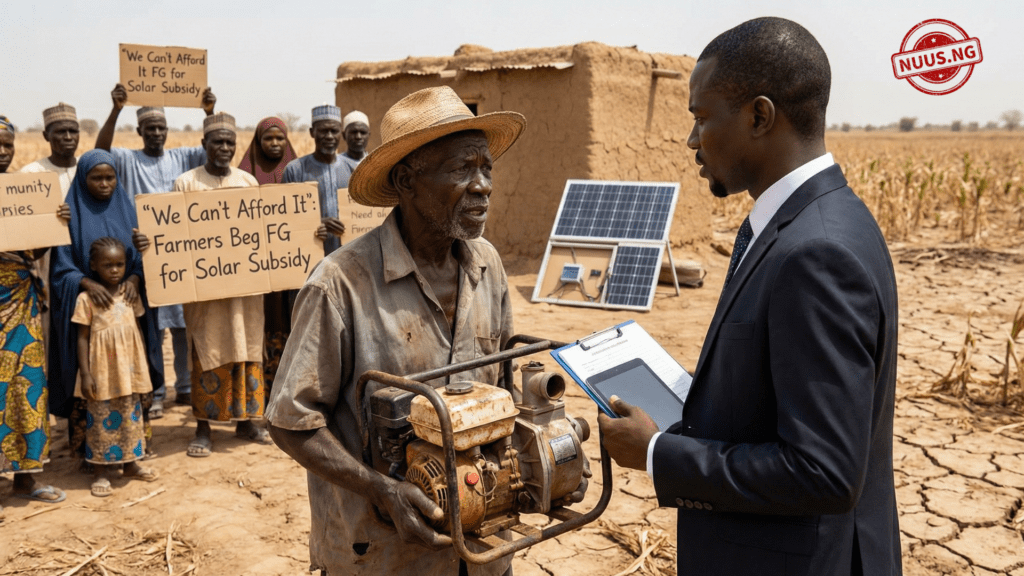
“We Can’t Afford It”: Farmers Beg FG to Subsidise Solar-Powered Irrigation as Food Crisis Looms
Smallholder farmers across Northern Nigeria have issued an urgent appeal to the Federal Government: subsidise solar-powered irrigation systems or face a worsening food crisis.
Despite widespread awareness of the technology, high costs are preventing mass adoption, leaving millions of hectares of arable land uncultivated during the dry season.
Quick Read
- The Demand: Farmers want the Federal Government to subsidise the cost of solar-powered water pumps and irrigation kits to make them affordable.
- The Problem: While 99.5% of farmers are aware of solar irrigation, less than 30% use it because the upfront capital cost is too high.
- The Study: A new report by the YELF Climate Trust Foundation (surveying 10,500 farmers in Kebbi State) confirms that those using solar pumps saw increased income and yields, while non-users struggle with expensive petrol pumps.
- Why It Matters: With petrol prices high and rainfall becoming erratic due to climate change, solar irrigation is seen as the only sustainable path to year-round farming and food security in 2026.
Detailed Story: The Cost of Going Green
KEBBI — The path to food security in Nigeria is being blocked by a price tag. This is the conclusion of a new report released today by the YELF Climate Trust Foundation, a climate-focused NGO.
The study, which surveyed over 10,500 smallholder farmers in Kebbi State, revealed a frustrating paradox: Nigerian farmers know the solution to their problems, but they cannot afford to buy it.
Awareness vs. Affordability
According to the findings presented by YELF’s CEO, Ethel Okosuns, nearly every farmer surveyed (99.51%) knows that solar-powered irrigation is better than relying on rain or expensive diesel generators. However, fewer than 30% are actually using the technology.
“The technology exists, and the farmers want it,” Okosuns said. “But without government intervention to lower the entry cost, it remains a luxury item for the wealthy few, rather than a tool for national food security.”
The Economic Impact
The report highlighted the stark difference between the “haves” and “have-nots” of solar irrigation:
- Higher Income: 70% of farmers using solar pumps reported a significant increase in their personal income.
- Better Yields: 74% recorded higher crop yields because they could water their farms consistently, regardless of fuel scarcity.
- Operational Savings: Over 33% cited lower operational costs, as they no longer need to buy petrol or diesel daily.
A National Emergency
This appeal comes at a critical time. With the Nigerian Economic Summit Group (NESG) and other experts predicting high food inflation for 2026, the reliance on rain-fed agriculture is viewed as a national security risk.
In the past year, the Federal Government, through the National Agency for Science and Engineering Infrastructure (NASENI), unveiled locally produced solar pumps. However, farmers argue that even these “cheaper” local options are still out of reach for rural smallholders without a structured subsidy or “pay-as-you-grow” financing plan.
What Farmers Are Asking For
The consensus from agricultural unions is clear:
- Direct Subsidies: A 50-70% government subsidy on solar irrigation kits for registered cooperatives.
- Flexible Loans: Low-interest loans specifically for green energy adoption in agriculture.
- Expansion: Expanding the baseline studies—currently ongoing in Bauchi, Niger, Sokoto, and Kano—to create a national database of farmers ready for the transition.
As the dry season enters its peak, the message from the farms is simple: Give us the power to farm, and we will feed the nation.