
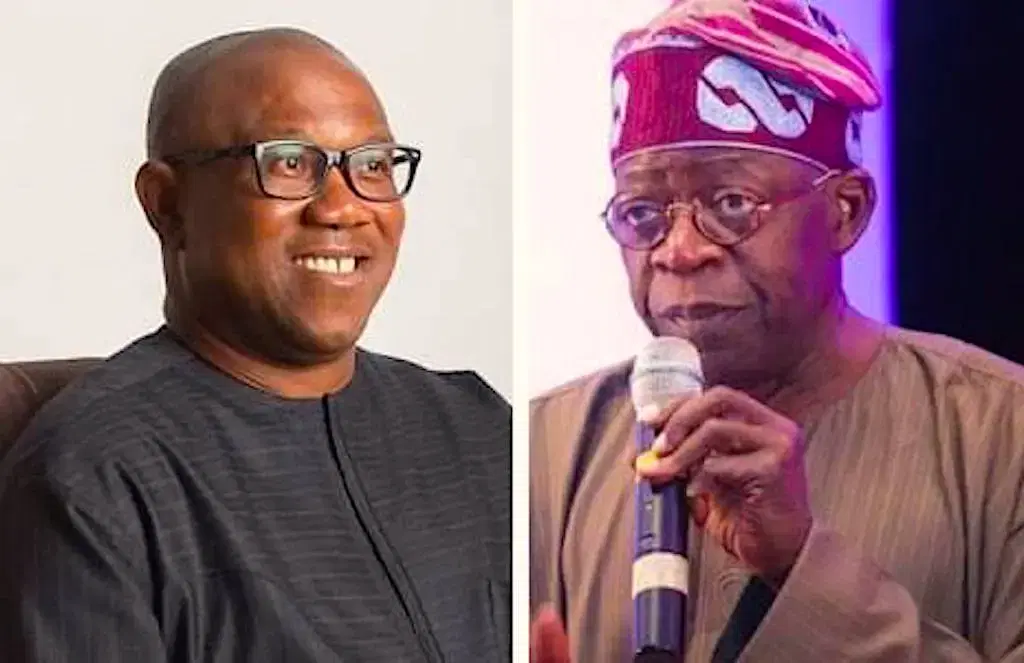
PARTY BUILDER VS. PLATFORM HOPPER: The Real Truth Behind Tinubu and Obi’s Political Migrations Exposed!
LAGOS, Nigeria — In the heated echo chambers of Nigerian social media, a common narrative attempts to shield Peter Obi from the “party hopper” label by pointing a finger at President Bola Ahmed Tinubu. The argument asks: Didn’t Tinubu change parties from AD to AC, to ACN, and finally APC? It is a classic “tu quoque” (you too) logical fallacy.
However, an investigative review of Nigeria’s structural political evolution over the last 25 years shatters this partisan rhetoric. Historical data and political strategy reveal a massive gulf between the two men: one spent decades building and expanding a single political empire, while the other strategically migrated between established, rival platforms.
Tinubu operated as a Party Builder, staying within a specific ideological camp and engineering its growth into a national behemoth. Obi operates as a Movement Leader, utilizing existing platforms to house his personal political brand. Strategically, Tinubu was expanding his own house, while Obi repeatedly changed landlords.
The Evolution of a “Political Home” vs. “Party Hopping”
The central flaw in equating Tinubu’s political trajectory with Obi’s is the failure to distinguish between party building (mergers) and personal migration (defection).
The Tinubu Context: Structural Evolution
Tinubu’s transitions from the Alliance for Democracy (AD) to the Action Congress (AC), then the Action Congress of Nigeria (ACN), and finally the All Progressives Congress (APC) were not acts of defection. He didn’t abandon a sinking ship for a rival’s yacht; he was the captain continually upgrading his vessel.
AD to AC (2006): Following an internal crisis within the AD, Tinubu led a progressive faction to form the AC. He didn’t join an opposition party; he founded a new one to preserve his ideological base.
AC to ACN (2010): This was a deliberate rebranding effort to shake off regional limitations and give the party a national outlook.
ACN to APC (2013): This was the ultimate political merger. Tinubu (ACN) forged an alliance with Muhammadu Buhari (CPC) and Ogbonnaya Onu (ANPP) to create a “mega-party.” Throughout this 25-year evolution, he remained the undisputed “National Leader” of the same continuous progressive lineage.
The Peter Obi Context: Strategic Migration
Conversely, Peter Obi’s movements represent tactical shifts between fully established, pre-existing, and often fiercely rival organizations.
APGA to PDP: Obi abandoned the All Progressives Grand Alliance (APGA)—the very platform he governed under—to join the Peoples Democratic Party (PDP), his former fierce rivals in Anambra State.
PDP to Labour Party (LP): Days before the PDP presidential primary in 2022, Obi exited the party to seize the ticket of the Labour Party.
Historians categorize this as a search for a viable vehicle to house personal ambition and the “Obidient” brand, distinctly different from the institutional empire-building executed by the ACN/APC bloc.
The Deputy Governor “Toleration” Myth
Critics often point to Tinubu’s clash with his deputy governors as proof of a dictatorial shortcoming. Historically, these clashes were not driven by personal petulance, but by a ruthless consolidation of the “Lagos Model” and strict party supremacy.
Kofoworola Bucknor-Akerele (1999–2002): Her exit stemmed from a deep ideological rift. She represented the “Old Guard” of Afenifere who clashed fundamentally with Tinubu’s “New Breed” financial and administrative reformists.
Femi Pedro (2003–2007): Pedro’s exit was fueled by pure political ambition. He notoriously defected to the Labour Party to contest against Tinubu’s chosen successor, Babatunde Fashola.
Abiodun Ogunleye (2007): Simply a placeholder appointed to finish the term following Pedro’s impeachment.
Tinubu prioritized institutional succession planning over sentimental loyalty to deputies who attempted to bypass the party hierarchy.
The 1998 SDP Impossibility
Finally, opposition rhetoric frequently asks: “Why didn’t Tinubu contest under the SDP in 1998 if he is so loyal?” Historically, this is an impossible demand. General Sani Abacha explicitly proscribed (abolished) the Social Democratic Party (SDP) in 1993 following the annulment of the June 12 election. By the time the transition to the 4th Republic began in 1998, the SDP did not legally exist. Tinubu, returning from NADECO exile, joined the AD precisely because it was the designated vehicle for the democratic activists he had fought alongside.
Historical Verdict
The viral narrative treats “founding/merging” as identical to “defecting.” They are not.
Tinubu operated as a Party Builder, staying within a specific ideological camp and engineering its growth into a national behemoth. Obi operates as a Movement Leader, utilizing existing platforms to house his personal political brand. Strategically, Tinubu was expanding his own house, while Obi repeatedly changed landlords.