
“Out of the Woods”: Tinubu Redirects Oil Billions as Nigeria’s Economy Hits Multi-Year High
ABUJA — President Bola Ahmed Tinubu has declared that the Nigerian economy has officially exited its “darkest days,” backing his optimism with a landmark Executive Order designed to seize direct control of the nation’s oil and gas revenues.
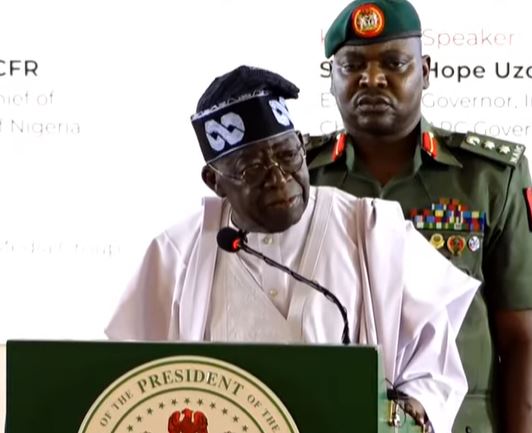
Speaking to state governors at the Presidential Villa on Monday, February 23, 2026, the President asserted that his “painful but necessary” reforms are finally yielding a stable macroeconomic environment. This confidence comes as fresh data shows a tenth consecutive monthly decline in inflation, which eased to 15.10% in January 2026—the lowest level since late 2020.
For the average citizen, the redirection of oil funds means state and local governments will receive significantly higher allocations. President Tinubu has challenged governors to use these funds for agriculture and human capital development to “feed the country” and tackle unemployment.
The “New Sheriff” Order: Clipping NNPCL’s Wings
To consolidate these gains, President Tinubu signed a strategic Executive Order mandating the direct remittance of all oil and gas revenues to the Federation Account. The Major Shift: The order effectively sets aside key provisions of the Petroleum Industry Act (PIA) 2021 that allowed the Nigerian National Petroleum Company Limited (NNPCL) to retain certain funds. Ending the “Frontier” Deductions: NNPCL will no longer manage the 30% Frontier Exploration Fund or the 30% management fee on profit oil. Instead, these billions will flow directly to the federation for distribution among the three tiers of government. The Goal: Presidential spokesperson Bayo Onanuga confirmed the move aims to “eliminate unjustified multiple layers of deductions” and curb wasteful spending.
Inflation and the Naira: The Turning Tide
The administration’s focus on monetary tightening and fiscal discipline appears to be cooling the cost-of-living crisis. Inflation Relief: After peaking at nearly 35% in late 2024, the dramatic drop to 15.1% has significantly eased the burden on households, driven largely by stabilizing food prices and a stronger currency. Currency Stability: The Naira has maintained a steady path in February 2026, trading near ₦1,340–₦1,350 per Dollar in both official and parallel markets. Analysts attribute this to foreign exchange reserves nearing $50 billion and sustained interest rates at 27%.
Growth Projections: A 4.49% Future
The Central Bank of Nigeria (CBN) and the IMF have both updated their outlooks for the year, projecting a robust 4.2% to 4.49% GDP growth for 2026. The Drivers: Increased oil production (aided by improved security) and the ramp-up of domestic refining are expected to lift output and reduce the reliance on imported fuel. The Warning: Despite the progress, the President urged governors to remain disciplined. “We are out of the dark tunnel of uncertainty, but we must work together to rescue this country,” Tinubu stated, emphasizing that the “best is yet to come” if leakages remain plugged.
What This Means for Nigerians
For the average citizen, the redirection of oil funds means state and local governments will receive significantly higher allocations. President Tinubu has challenged governors to use these funds for agriculture and human capital development to “feed the country” and tackle unemployment.