
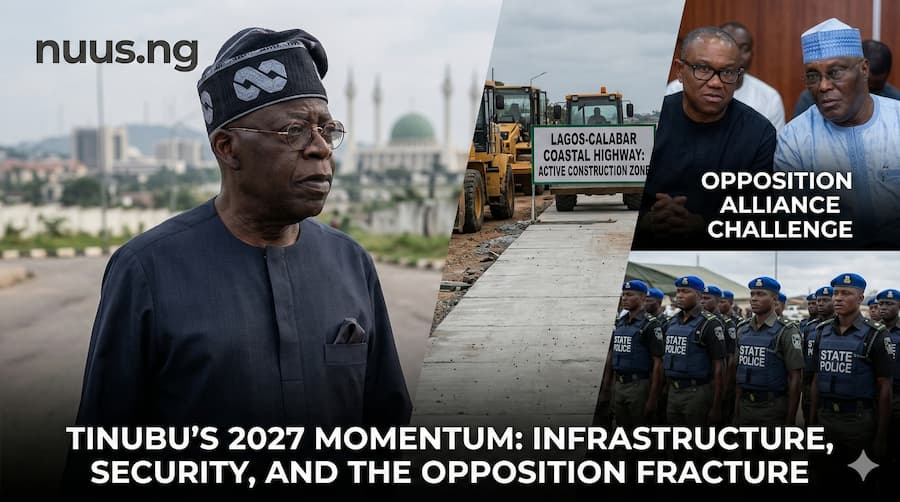
2027 Calculus: Why the “Tinubu Momentum” is Rattling Opposition
ABUJA, Nigeria — As the 2027 electoral cycle looms, President Bola Ahmed Tinubu is pivoting from a painful “reform and stabilize” phase to an aggressive “deliver and deploy” strategy. Recent high-level diplomatic successes and a string of multi-billion dollar infrastructure breakthroughs have fundamentally altered the political math, leaving a fragmented opposition scrambling to form a cohesive front.
While critics point to the lingering scars of inflation, the administration is betting that a “concrete-and-capital” narrative—backed by a radical overhaul of national security—will carry the day.
“The opposition is fighting a ghost from 2023 while Tinubu is building the bridge to 2027,” says a senior political analyst. “If the State Police and Coastal Highway see significant progress by next year, the narrative of ‘performance’ will be hard to beat.”
Security: The Decentralization Gambit
In a move that has historically stalled for decades, President Tinubu has officially triggered the process for State Police, a policy shift that could redefine his presidency.
- Constitutional Fast-Track: Following a formal request to the 10th Senate in late February 2026, the National Assembly has committed to concluding the constitutional amendment for state policing by year-end 2026.
- Governance Overhaul: Governor AbdulRahman AbdulRazaq, Chairman of the Nigeria Governors’ Forum (NGF), confirmed on March 23, 2026, that governors have submitted a unified framework to the National Security Adviser (NSA) to ensure legislative backing for local policing.
- Service Chief Mandate: On March 25, 2026, the President charged the newly decorated Service Chiefs—led by Chief of Defence Staff General Olufemi Oluyede—to “smash the snakes at the head,” specifically targeting emerging armed groups in the North-West and North-Central.
The Infrastructure Blitz: Breaking the 30-Year Jinx
The Tinubu administration is moving at high speed on “legacy” projects that past governments largely ignored. These are no longer just campaign promises; they are active construction sites.
- Lagos-Calabar Coastal Highway: This 750km “superhighway” has moved from blueprint to reality, with Hitech Construction now active on multiple sections.
- Sokoto-Badagry Expressway: A 1,000km corridor designed to link the North-West to the Atlantic. Experts say this will revolutionize trans-Sahara trade.
- Concrete Revolution: Minister of Works, David Umahi, has mandated concrete pavement for all new major roads, citing a 50-year durability span.
The Economy: From “Pain” to “Pivot”
Approval ratings have seen a notable uptick. After hitting record lows in late 2024, sentiment climbed to 53% in early 2026, buoyed by a stabilizing Naira and the massive $1.51 billion investment haul from the recent UK State Visit.
- Employment & Education: The Nigerian Education Loan Fund (NELFUND) has begun disbursement to over 1.2 million students, neutralizing a key grievance among the youth.
- Investment Haul: The £746 million port modernization deal signed in London aims to end Apapa’s decades-long congestion, directly impacting the cost of goods.
The Opposition’s Dilemma: The Atiku-Obi Effect
Despite the administration’s momentum, the “Triple Threat” of Atiku Abubakar, Peter Obi, and Rabiu Kwankwaso remains the wildcard. However, internal fractures are their greatest weakness.
- Unity Crisis: While Atiku recently signaled a willingness to support Peter Obi if the PDP zones the presidency to the South-East, the Labour Party (LP) remains embroiled in leadership disputes.
- The Northern Factor: Tinubu’s strategic focus on the Sokoto-Badagry road and the reception of Governor Dauda Lawal (Zamfara) into the APC on March 25, 2026, is designed to consolidate his 2023 gains in the North-West.