
The canopy that became a threat: Calabar’s ornamental trees turn from beauty to danger
By Emma Una
Arriving Calabar, the Cross River State capital, once meant entering a green cathedral. Now, it means dodging a death sentence.
The ornamental trees lining Calabar’s roads were its proudest signature, a living archway of imported giants first introduced by Mr. Clement Ebri in the 1990s and expanded by Mr. Donald Duke in 1999. They cooled the tropics, charmed first-time visitors, and earned Calabar its reputation as Nigeria’s cleanest and most beautiful city. From an aerial view, the city disappeared beneath an emerald blanket.
But age has turned beauty into a butcher. The proof is written in crushed metal, broken bones, and lost lives.
A city under siege
In 2023, a broadcaster with the Nigerian Television Authority (NTA) was driving home along Murtala Mohammed Highway when a colossal tree collapsed onto her car. She escaped death by what she called “the width of a steering wheel.” Her vehicle was a total wreck.
In 2024, grief visited the Government House Press corps. A senior journalist lost his brother when another falling giant crushed a commercial minibus, killing three passengers instantly.
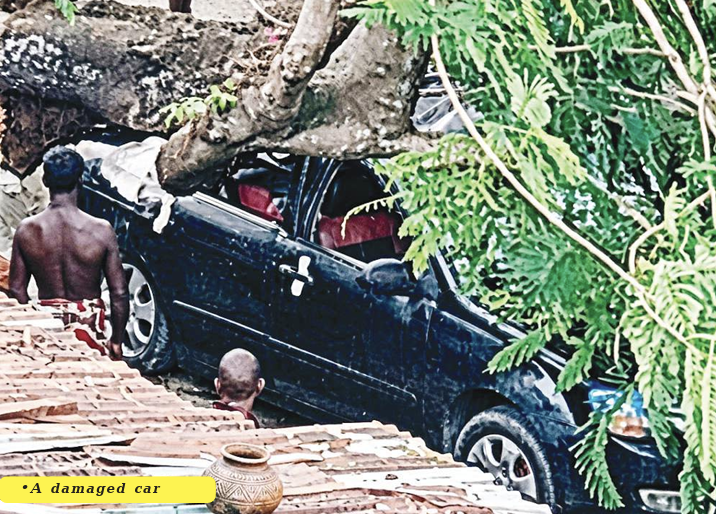
Sometime in November, 2025, a middle-aged man was driving his Toyota Camry toward the Calabar Roundabout beside the Nigerian Navy Reference Hospital. It was 5:35 pm rush hour when a massive branch sheared off without warning.
“It felt like an explosion of leaves,” said an eyewitness. “One second the road was clear, the next, a tree fell on a car.”
Miraculously, the driver survived. Dazed and trembling, he climbed from the wreckage and thanked God aloud. But his car was flattened. Behind him, both lanes of the highway were choked with trapped vehicles, the tree’s massive girth creating a gridlock that stretched for miles.
The latest near-tragedy
Just the first week of June, another tree fell along Mount Zion Road, opposite Mount Zion Gospel Church. This time, it targeted a Bolt car parked beneath it.
“The Bolt driver was looking for who ordered the ride when suddenly the tree fell on his car and completely destroyed it,” said Angela, a University of Calabar student who witnessed the scene. The driver was pulled from the rubble unconscious and rushed to the University of Calabar Teaching Hospital.
An official of the Ministry of Environment, speaking on condition of anonymity, confirmed that emergency response teams were deployed immediately. “The injured driver is receiving treatment,” the official said. “But these incidents are becoming too frequent.”
Why this is happening
NDV finding revealed that the trees have grown old. With age has come fragility. What was once a source of pride has become a source of dread, especially during the rainy season. Heavy winds and storms now regularly send ancient limbs or entire trunks crashing down onto busy roads below.
For decades, the trees were cared for by officials of the Ministry of Environment and the Calabar Urban Development Authority (CUDA). They trimmed branches, pruned old growth, and cut down a few to maintain road visibility. But the scale of the problem has outgrown routine maintenance.
Government reacts
“We have commenced proactive measures to prevent similar incidents,” said the Commissioner for Environment, Mr. Moses Osogi, in an official reaction. “Public safety remains a top priority.”
According to Osogi, the Ministry of Environment has begun a comprehensive safety assessment of trees across the city. “Several trees already identified as hazardous have been marked for removal,” he said.
The initiative, he added, is part of a broader environmental safety strategy aimed at reducing risks associated with urban vegetation across Cross River State.
A delicate fallout
But for the people of Calabar, the solution is not simple. No one wants to see the canopy disappear entirely. Those trees are part of the city’s soul, the same soul that hosts the world-famous Carnival Calabar and draws tourists from across the globe.
Streets like Etta Agbo (the University of Calabar route), IBB Way (leading to Margaret Ekpo International Airport), Calabar Road (the bustling central business district), and Murtala Mohammed Highway are all draped in thick, unbroken foliage. To remove them would change the city forever.“
The post The canopy that became a threat: Calabar’s ornamental trees turn from beauty to danger appeared first on Vanguard News.