
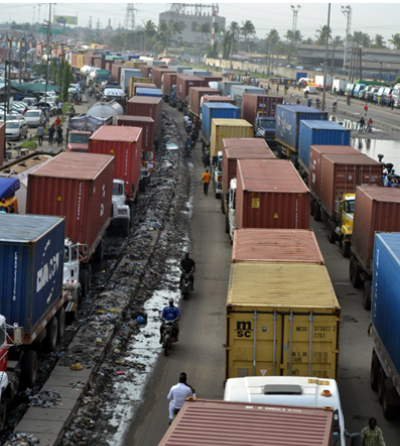
Stakeholders clash as Apapa gridlock resurfaces
…Operators lose N100b due to congestion — NCJTFLCA
….AMATO blames Strait of Hormuz disruption
…Gridlock under control – TTP
By Efe Onodjae
Fresh concerns have emerged over the return of the Apapa gridlock, as key stakeholders in Nigeria’s maritime and logistics sector trade blame over the persistent congestion choking access roads to the nation’s busiest ports. The renewed traffic crisis has reportedly cost operators an estimated N100 billion, according to the National Compliance Joint Task Force of Licensed Clearing Agents (NCJTFLCA), while the Association of Maritime Truck Owners (AMATO) attributes the situation to disruptions linked to the Strait of Hormuz.
Despite these claims, Traffic Transit Point (TTP), the firm engaged to manage truck movement in the Apapa corridor, insists the situation remains under control. Notably, the Nigerian Ports Authority (NPA) in 2021 entered into a five-year agreement with TTP as part of efforts to ensure seamless traffic flow through the electronic call-up system, popularly known as “Eto”, introduced to address the longstanding gridlock challenges in the area.
Speaking exclusively with Vanguard, the president of NCJTFLCA, Basil Nwolisa, argued that Nigeria’s port challenges are not unique but are being mishandled locally.
His words: “Nigeria is not the only country where goods are cleared from ports.” Consignments come in bulk, even in countries without vast land space, yet they operate seamlessly.
“The problem here is the ETO policy and the operations of TTP. What we are seeing is a system designed to create loopholes for settlements, forcing operators to pay money to move their trucks.
“People get frustrated and end up paying their way through. That’s what is happening. The current congestion is costing practitioners hundreds of billions of naira weekly in unofficial payments and bribes. Some individuals even have private accounts where these payments are made. That is the real issue.
“If the authorities were serious about solving this problem, traffic would flow smoothly. Right now, it appears there is confusion and a lack of direction. They should engage the National Compliance Joint Task Force and empower us to manage truck movement into and out of the ports. We can handle it efficiently.
“The system is being manipulated to allow interference, extortion, and bribery.
“It is a challenging task, no doubt, but if the contract is properly implemented, we can resolve the issue within two months. You would not see trucks lining the roads unnecessarily. Everything would be scheduled properly; you would receive information, come in, load or offload, and leave without delays.
“TTP is not meant to be a parking system for trucks.”
Also speaking, the General Secretary of AMATO, Sani Mohammed, attributed part of the ongoing congestion at the Apapa port corridor to the crisis in the Middle East, which, he said, has disrupted global shipping routes and reduced vessel availability for cargo evacuation in Nigeria.
He said: “The blockade of the Strait of Hormuz has disrupted maritime shipping logistics. It has affected the availability of vessels for the evacuation of imports and exports of containers. Nigeria has an export promotion drive policy of the federal government. We have a lot of exports going to the Middle East and other countries. Most of these boxes get to these locations. Most of these boxes are export containers.
“It is hoped that shipping companies will devise a means to deploy vessels to evacuate both empty and export containers. Also, I adhere to the agreement that if they bring in 1,000 import containers, they should evacuate 700 or 800 empty containers. Some shipping companies have not been adhering to that protocol. But the NPA is trying to put pressure on them in the meantime to ensure compliance so that the port will not be congested.
“Congestion at the ports is the root cause of the visible gridlock along the port corridor. Do you understand? As soon as shipping companies deploy vessels to evacuate export and empty containers, all this gridlock will disappear. Do you understand? In the shortest possible time.”
On his part, the spokesperson for TTP, Nancie Nandi, in a WhatsApp chat explained that occasional traffic build-ups should not be interpreted as a collapse of the system. Her words: “We wouldn’t describe the current situation as a return to gridlock. The Ètò electronic call-up system is still active and doing what it was designed to do, which is bringing order and structure to truck movement in and around the ports.
“At times, you may notice some build-up, but these are usually temporary and often linked to delays at the terminals like slower cargo handling or processing issues. Those factors can impact traffic flow, but they fall outside TTP’s operational scope.
“And to be clear, TTP hasn’t ‘given up’ on managing traffic in Apapa. We remain fully engaged and committed to keeping the system running efficiently and improving it where necessary.”
When contacted, the spokesperson of the Nigerian Ports Authority for comment, he declined this reporter’s call. However, SMS and WhatsApp messages were sent to him, but at the time of filing this report, he had not responded nor called back.
The post Stakeholders clash as Apapa gridlock resurfaces appeared first on Vanguard News.