
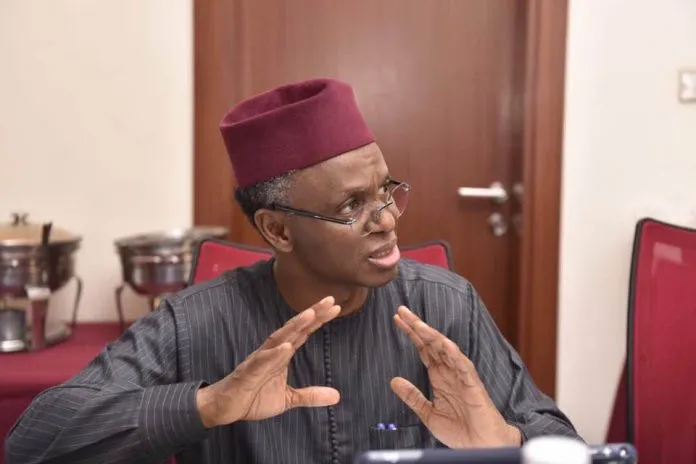
Phone-tapping charge: Witness denies hearing El-Rufai admit to hacking NSA’s line
… says ex-governor made wiretapping remarks during TV interview
By Ikechukwu Nnochiri
ABUJA— The trial of detained former Kaduna State governor Nasir El-Rufai continued before the Federal High Court in Abuja on Monday, as the Federal Government called another witness to testify.
The witness, Mr. Deji Adeyanju, who is a lawyer and activist, told the court that he also appeared as a guest on Arise Television on February 13, the same day the embattled former governor made the remarks that precipitated his ongoing trial.
El-Rufai, who was governor between 2015 and 2023 and was also Minister of the Federal Capital Territory (FCT) under former President Olusegun Obasanjo’s administration, is facing an amended five-count charge bordering on his alleged complicity in the unlawful interception of the phone communications of the National Security Adviser (NSA), Nuhu Ribadu.
It was alleged that the defendant, during his appearance on Arise TV’s Prime Time programme in Abuja, had admitted that he knew and related with a certain individual who had illegally intercepted the NSA’s telephone communications.
Aside from the allegation that his action breached national security and public safety — an offence punishable under Section 12(1) of the Cybercrimes (Prohibition, Prevention, etc.) (Amendment) Act, 2024 — the former governor was also charged with failing to report the crime to the relevant security agencies.
At the resumed proceedings on Monday, the prosecution witness, Adeyanju, while being cross-examined by the defence team led by Mr. Paul Erokoro, SAN, told the court that although he was present at the TV station when the interview took place, he did not hear the former governor specifically claim that he had hacked the phone lines of the NSA.
The witness told the court that what he heard was the defendant stating, “We listened to the conversations of the NSA.”
Earlier in his evidence-in-chief, Adeyanju, who is the second prosecution witness (PW-2), said he knew El-Rufai as a former governor of Kaduna State.
The witness, who was subpoenaed to testify in the case, recalled that he issued a public statement after reports emerged that the former governor was to be arrested by security operatives.
A copy of the subpoena that was issued to summon him for the trial was tendered and admitted in evidence as Exhibit G.
Thereafter, the court viewed a clip of the Arise Television interview involving El-Rufai.
The prosecution further tendered a flash drive containing the interview Adeyanju had also done with the same TV station on the same day, and it was admitted in evidence alongside the certificate of compliance.
According to the witness, he was later invited by the Department of State Services (DSS), which asked him to recount what transpired at the television studio.
He told the court that he confirmed to investigators that he was present when the defendant spoke about listening in on the NSA’s phone conversations, adding that the former governor stated that someone carried out the phone tapping and passed the information to him.
Justice Joyce Abdulmalik adjourned the case until Tuesday for continuation of the hearing.
It will be recalled that the court had earlier granted the detained former governor bail to the tune of N100 million with a surety in like sum.
The court equally listed other stringent conditions that must be met before his release, among which was that the surety must be a federal civil servant not below Grade Level 17, and production of a letter of attestation from the chairman of the Kaduna Traditional Council.
More so, the defendant, who is facing multiple cases in Abuja and Kaduna, aside from surrendering all his travelling documents, was ordered to report to the headquarters of the DSS every last Friday of the month by 10 a.m. to sign an attendance register, pending the determination of the case.
The former governor remained in detention despite his bail.
He had, in his reaction to what he described as an attempt by operatives of the DSS to “abduct” him at Nnamdi Azikiwe International Airport in Abuja on February 12, 2026, upon returning from Cairo, insisted that the security agency was being instigated by the ICPC, which he said had received a directive from the NSA, Ribadu, to detain him.
The former governor claimed the information got to him through someone who listened in on the NSA’s telephone conversations.
In a motion he filed to challenge his trial, El-Rufai gave 17 reasons why the charge marked FHC/ABJ/CR/99/2026, which the DSS entered against him, should be quashed by the court.
Aside from his argument that the charge was incompetent and legally defective, the former governor argued that the DSS has no legal basis to elevate a “casual remark” he made during a television interview to “a confession” that he had indeed tapped the NSA’s telephone line as alleged.
He argued that the statement he made on Arise TV did not constitute a confessional statement in law, saying that for a statement to be admissible as a confession, “it must be made under caution, voluntarily, and in circumstances that satisfy the Judges’ Rules.”
El-Rufai maintained that statements he made during his television interview were made “without any caution or warning, in a voluntary public discussion and without the protections afforded to suspects in custody.”
“A casual remark in a television programme cannot be elevated to a judicial confession,” he further argued.
However, the court declined to quash the charge and ordered accelerated trial of the defendant.
The post Phone-tapping charge: Witness denies hearing El-Rufai admit to hacking NSA’s line appeared first on Vanguard News.