
Fatal Drill: How Stricter Safety Protocols Could Have Saved the NSCDC Officer Crushed on Abuja Parade Ground
ABUJA — What began as a routine showcase of tactical prowess ended in a devastating tragedy at the national headquarters of the Nigeria Security and Civil Defence Corps (NSCDC) on Saturday. During a high-octane simulation exercise to mark the 2026 World Civil Defence Day, a female operative, identified as Assistant Superintendent of Corps Ogbodo Ene Victoria, lost her life after an operational van accidentally crushed her on the parade ground.
The incident, which occurred in full view of horrified colleagues and top officials, has sparked profound grief across the service and ignited a fierce debate over the safety protocols governing live security drills in Nigeria.
As the NSCDC launches an internal investigation into the exact circumstances of the crash, the tragedy serves as a grim wake-up call for all Nigerian security agencies. The death of ASC Ogbodo Ene Victoria highlights an urgent need to transition from focusing purely on the visual spectacle of parade ground drills to prioritising the uncompromising safety of the personnel executing them.
The Incident: A Display Turned Deadly
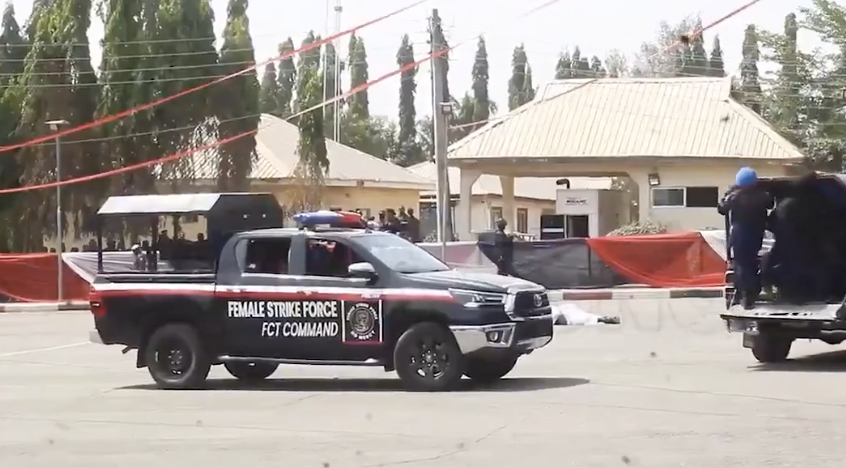
The fatal accident took place during a “show of force” and kidnap rescue simulation by the Corps’ Female Strike Force. Viral footage of the event shows a black operational van with red wheels, bearing the inscription “Female Squad,” moving in tandem with a second van marked “Female Strike Force FCT Command.”
During a sharp, coordinated turn, the driver of one of the vehicles lost positional awareness and knocked down ASC Ogbodo Ene Victoria. The heavy patrol van subsequently ran over her, pinning her underneath.
Colleagues immediately rushed the field, physically lifting the vehicle to pull her out while an ambulance stood on standby right beside the rescue effort. Emergency responders evacuated her to the Intensive Care Unit of Gwagwalada Specialist Hospital, where she later succumbed to her catastrophic injuries.
NSCDC Public Relations Officer, Babawale Afolabi, described the tragedy as “heartbreaking.” He confirmed that the Corps dispatched a high-powered delegation of senior officers to condole with the victim’s family before making any public announcements.
What Could Have Changed the Outcome?
While the NSCDC leadership mourns the fallen officer, security analysts and health-and-safety experts are scrutinizing the footage. They point to several critical operational failures that, if addressed, could have completely changed the outcome of Saturday’s drill:
Strict Spatial Separation and Safety Perimeters The fundamental error in the drill was the dangerous proximity of fast-moving, heavy machinery to dismounted personnel. In professional tactical displays, coordinators must establish strict, non-intersecting zones for vehicle stunts and foot maneuvers. Enforcing a hard physical perimeter between the vehicles’ turning radius and the operatives’ standing positions would have prevented the van from making contact with the victim, even if the driver miscalculated the turn.
Advanced Stunt-Driving Certification Driving an operational van in a straight line requires standard training; performing high-speed, coordinated, close-quarter maneuvers requires specialized tactical driving certification. Ensuring that only operatives with rigorous, globally certified stunt-driving experience take the wheel during simulation exercises would drastically reduce the margin of human error that led to this tragedy.
Immediate “Kill-Switch” Communication The video reveals a delayed reaction between the moment the officer fell and the moment the vehicle halted. High-risk drills require a dedicated safety officer equipped with a universal “abort” or “kill-switch” signal—such as an air horn or radio override. If a spotter had immediately flagged that personnel were out of formation, the driver could have engaged the emergency brakes fractions of a second earlier.
Extraction Equipment and Advanced Trauma Life Support Footage of the incident confirms that an ambulance was on standby directly beside the vehicle while frantic officers physically lifted the heavy operational van to rescue her. Because the medical transport was already on-site, the critical gap was not the absence of an ambulance, but the complex extraction process and the required level of immediate trauma care. In crush injuries, survival heavily depends on having specialized extrication tools readily available to lift vehicles safely and quickly. Furthermore, ensuring that standby ambulances are fully equipped for Advanced Trauma Life Support (ALS)—allowing for immediate, on-the-spot stabilization rather than just rapid transit—is vital for keeping victims alive long enough to reach specialist facilities like Gwagwalada.
The Path Forward
As the NSCDC launches an internal investigation into the exact circumstances of the crash, the tragedy serves as a grim wake-up call for all Nigerian security agencies. The death of ASC Ogbodo Ene Victoria highlights an urgent need to transition from focusing purely on the visual spectacle of parade ground drills to prioritising the uncompromising safety of the personnel executing them.