
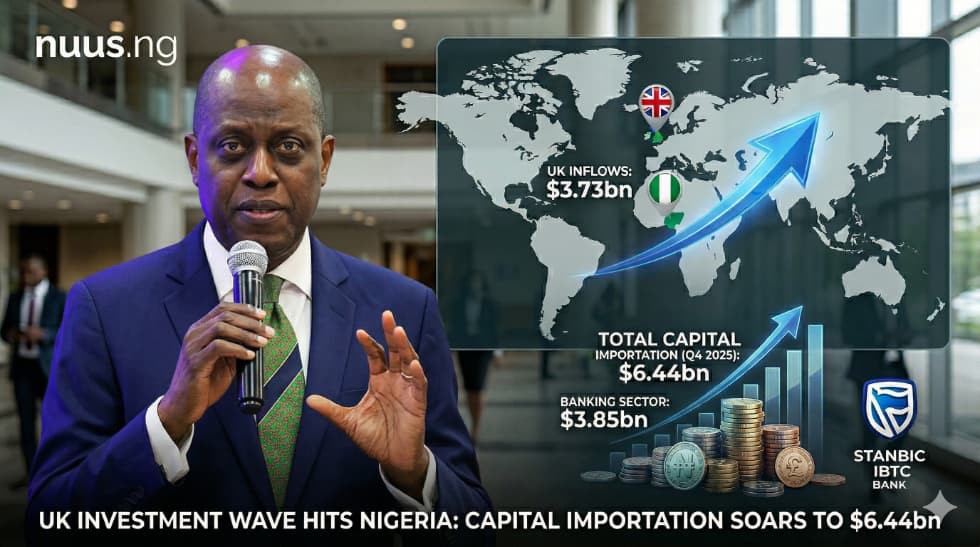
Banking Blitz: Nigeria Hits $6.44bn Capital Inflow Record
ABUJA, Nigeria — Foreign investors are doubling down on Nigeria’s financial sector, driving capital importation to a staggering $6.44 billion in the fourth quarter of 2025. This represents a massive 26.61% year-on-year increase, signalling that despite domestic inflationary pressures, the global appetite for Nigerian assets is hitting a new peak.
Data released by the National Bureau of Statistics (NBS) on Wednesday, March 25, 2026, confirms that the United Kingdom remains Nigeria’s most vital economic partner, accounting for 57.94% ($3.73 billion) of the total inflows.
“The surge in banking sector capital is a vote of confidence in the 2026 recapitalization roadmap,” notes a senior economist at the NBS. “However, the challenge for the Tinubu administration remains redirecting this ‘financial’ capital into the ‘physical’ production sector.”
The Banking Sector: A $3.85bn Magnet
The ongoing banking recapitalization exercise, mandated by Central Bank of Nigeria (CBN) Governor Olayemi Cardoso, has turned Nigerian lenders into the primary destination for offshore funds.
The Top Performer: Stanbic IBTC Bank Plc led the pack, facilitating $2.23 billion (34.58%) of total inflows. Global Giants: Standard Chartered Bank and Citibank followed closely, securing $1.85 billion and $840.72 million respectively. Recapitalization Milestone: Just days ahead of the March 31, 2026 deadline, the CBN confirmed that Nigerian banks have successfully raised ₦4.61 trillion in fresh capital, with foreign investors contributing nearly 27% of that total.
Portfolio vs. Production: The Structural Gap
While the numbers are record-breaking, the “Investigative Lens” reveals a persistent tilt toward short-term gains over long-term industrial growth.
Hot Money Dominance: Foreign Portfolio Investment (FPI) accounted for a dominant 85.14% ($5.49 billion) of total capital. Investors showed a clear preference for Money Market Instruments ($3.08bn) and Bonds ($1.97bn).
FDI Lag: Foreign Direct Investment (FDI), the “sticky” capital needed for factories and infrastructure, contributed just 5.55% ($357.80 million).
Real Sector Squeeze: While the banking sector swallowed 59.75% of all capital, the Production/Manufacturing sector received a modest 4.79% ($308.93 million), highlighting the difficulty of attracting long-term capital to the real economy.
Analysis: Why the UK is Betting on Nigeria
Market analysts point to the Enhanced Trade & Investment Partnership (ETIP) signed between Nigeria and the UK as the catalyst for this surge.
The unification of the foreign exchange windows and the launch of the Electronic Foreign Exchange Matching System (EFMS) have narrowed the gap between official and parallel rates, giving British investors the “exit-strategy confidence” they previously lacked.
“The surge in banking sector capital is a vote of confidence in the 2026 recapitalization roadmap,” notes a senior economist at the NBS. “However, the challenge for the Tinubu administration remains redirecting this ‘financial’ capital into the ‘physical’ production sector.”