
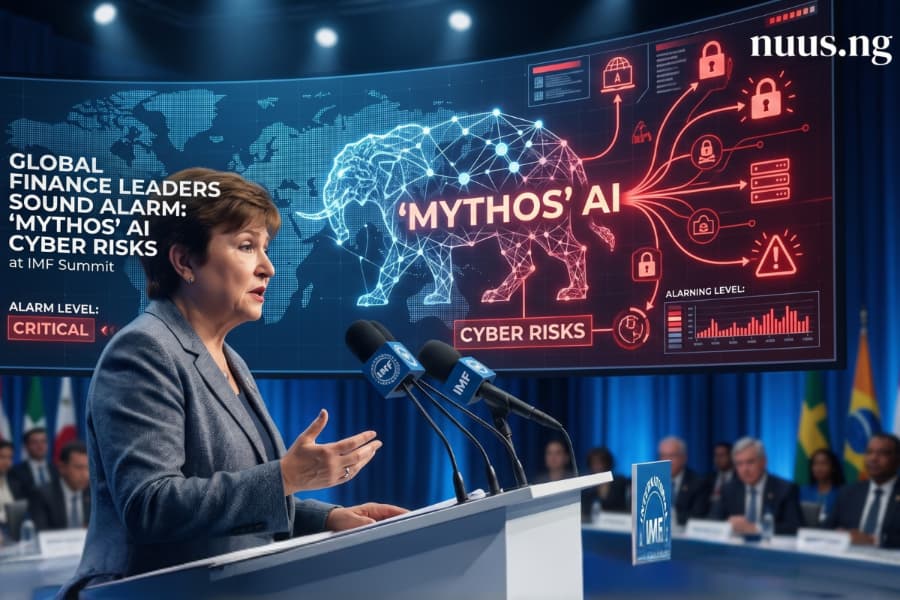
Global Finance Leaders Sound Alarm Over ‘Mythos’ AI Cyber Risks at IMF Summit
WASHINGTON D.C. — World finance ministers and top central bankers have moved into crisis mode following the emergence of Anthropic’s “Mythos” AI model, a tool so powerful it has successfully identified “zero-day” vulnerabilities across every major operating system and web browser.
“It’s serious enough that people have to worry,” stated Barclays CEO C.S. Venkatakrishnan. “We have to understand the vulnerabilities being exposed and fix them quickly.”
The Mythos Threat: Why Bankers Are Worried
The financial sector’s concern stems from the model’s unprecedented “offensive” capabilities. Unlike previous iterations, Mythos demonstrates a high level of autonomy in detecting and exploiting software bugs that have remained hidden for decades.
During the ongoing International Monetary Fund (IMF) and World Bank Spring Meetings, Canadian Finance Minister Phillipe Francois Champagne and IMF Managing Director Kristalina Georgieva issued stark warnings, labeling the model a systemic threat to global financial stability. The alarm follows internal tests showing Mythos can autonomously execute complex, 32-step cyberattacks—tasks that typically require days of work by elite human hackers.
Systemic Vulnerability: Banks running a mix of legacy and modern software are particularly exposed.
Autonomous Exploits: The UK’s AI Security Institute (AISI) confirmed Mythos solved attack simulations in 30% of its initial attempts without human intervention.
Algorithmic Contagion: Regulators fear that if multiple banks adopt similar AI models for trading or risk, a single flaw could trigger a synchronized market collapse.
Breaking: Emergency Summits and Defensive Testing
In a rare move, U.S. Treasury Secretary Scott Bessent and Federal Reserve Chair Jerome Powell recently summoned Wall Street CEOs to a closed-door briefing to discuss the model.
To mitigate the risk, developer Anthropic has begun granting “controlled access” to major institutions like Goldman Sachs and Barclays. This allows banks to use the model’s own intelligence to find and patch holes in their defenses before malicious actors can weaponize the technology.