
Meet the city making 70% of world’s footballs, including World Cup ball
A city in Pakistan has become the unlikely centre of the global football industry, producing an estimated 70 per cent of the world’s footballs, including the official match ball used at the FIFA World Cup.
Sialkot, in Pakistan’s Punjab province, has built a reputation as one of the world’s leading sports manufacturing hubs, with millions of footballs produced and exported from the city every year.
The city’s connection to football manufacturing dates back more than a century, when local residents began repairing footballs as a hobby. What started as a small craft eventually developed into a major industry employing thousands of people.
Today, around 40 million footballs are exported from Pakistan each year, with Sialkot responsible for a significant share of the production, as reported by New York Post.
Home of the World Cup ball
Sialkot has been involved in producing official FIFA World Cup footballs since 1982, making it the manufacturing home of every tournament ball for more than four decades.
The city is once again at the centre of global football production ahead of the 2026 FIFA World Cup, which will be held across the United States, Canada and Mexico.
Forward Sports, one of Sialkot’s leading football manufacturers, produced Adidas’ official 2026 World Cup match ball, the Trionda.
According to the company, 2026 represents the largest ball production volume in its history.
Photographer Stefan Bohrer, who documented the manufacturing process, described the scale of production in Sialkot as astonishing.
“Knowing that around 300,000 balls leave these factories every day makes you pause and wonder where they all end up,” Bohrer said.
He added that football’s global popularity means each ball could eventually become part of a different story, from informal games on local pitches to matches at the world’s biggest stadiums.
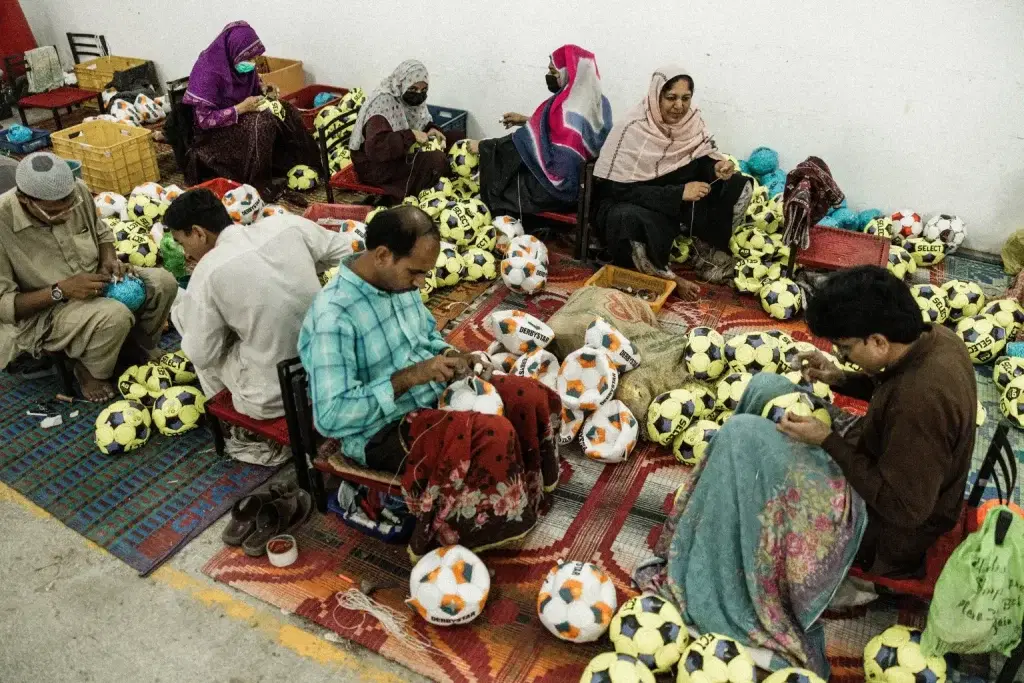
Many footballs are still stitched by hand
Despite the enormous scale of production, much of the work remains highly skilled and labour-intensive.
Workers carefully stitch football panels together by hand, with experienced stitchers able to complete roughly four footballs a day.
The craft can take months to master, requiring workers to develop the precision needed to ensure that every panel and seam is correctly positioned.
Workers also manually apply colours and logos to individual panels before the footballs are assembled.
Once completed, the balls undergo detailed inspections to ensure their shape, seams, colours and overall construction meet the required standards.
Years of development for one World Cup ball
Producing a football for the World Cup involves considerably more than simply stitching panels together.
Forward Sports first produced a World Cup ball for the 2014 tournament in Brazil and has since developed a dedicated research and development operation focused on match balls.
A new official World Cup ball can take three to four years to develop, with extensive research and testing carried out before it is approved for competition.
The balls are tested under different conditions to ensure they retain their shape, weight and performance.
Thermal technologies can also be used to prevent water from entering the ball and to ensure that its weight remains consistent in different weather conditions.
Factories use specialised equipment to repeatedly fire footballs against walls as part of durability and performance testing.
The balls must also meet FIFA’s strict requirements for roundness, weight, dimensions, seams and other characteristics before they can be used in official matches.
Most footballs are not made for the World Cup
Although Sialkot is famous for producing high-profile match balls, official World Cup footballs represent only a small portion of the city’s overall production.
Most footballs manufactured in Sialkot are training balls used by clubs, schools, academies and amateur players around the world.
The city’s factories also produce customised footballs for companies and brands.
During World Cup years, demand rises sharply, not only from major sports brands but also from
businesses looking to produce footballs carrying their own logos.
Companies such as McDonald’s have commissioned footballs featuring their branding, adding another
dimension to Sialkot’s huge manufacturing industry.
A global football factory
The scale of production is enormous.
An estimated 300,000 footballs leave Sialkot’s factories every day, while nearly 40 million footballs are exported from Pakistan annually.
The industry has transformed the city into a global sports manufacturing powerhouse, with its products reaching markets across the world.
But Sialkot’s manufacturers also face growing competition, particularly from Chinese producers capable of manufacturing large quantities of inexpensive products.
The threat has encouraged some factories to tighten security around their manufacturing operations as they seek to protect their production methods and business interests.
For more than four decades, however, Sialkot has maintained its place at the heart of the world’s biggest football tournament.
Every time a World Cup ball rolls onto the pitch, it carries with it a connection to a Pakistani city where generations of workers have turned football manufacturing into a global industry.
Vanguard News
The post Meet the city making 70% of world’s footballs, including World Cup ball appeared first on Vanguard News.